


Salmon hatchery records the rare arrival of conjoined twins
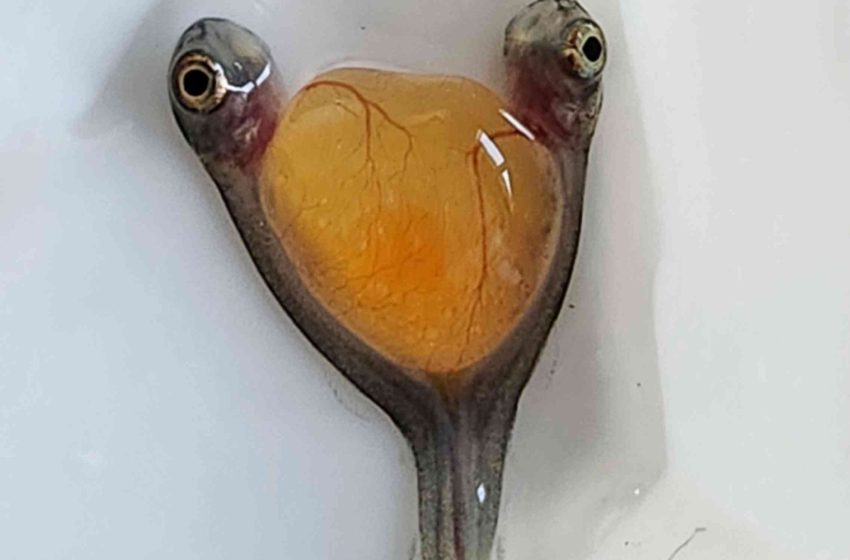
Two Chinook salmon have been documented as conjoined twins during early development at a freshwater research hatchery.
The discovery reveals how even slight disruptions in early embryonic growth can produce two bodies forced to share one fragile start to life.
The tank check revealed conjoined twins
Among thousands of newly hatched salmon fry moving through a research hatchery near Windsor, Ontario, one pair carried a striking difference.
Graduate students monitoring the fish at the University of Windsor’s Freshwater Restoration Ecology Centre (UWindsor) spotted two fry fused along their bellies while documenting early growth.
Each twin developed a separate head and tail, yet both bodies remained fused while sharing a single nutrient sac that supplies food during the first days after hatching.
That unusual anatomy gives the twins a narrow window to survive, raising questions about how long two developing fish can rely on one shared source of energy.
Salmon twins share one belly
Two heads and two tails formed, but one shared underside linked the bodies from chest to belly.
Lab notes described the fry as ventrally conjoined – joined along the belly from chest to tail – with motion staying tightly coordinated.
One attached food sac fed both bodies, so any weakness in one twin could drain the other. That shared start gave the twins extra time, yet it also set a hard limit once the food ran out.
When splitting fails
Long before eyes appear, a single egg can begin forming two embryos, then stall halfway through the split.
A 2016 paper traced many fish twins to an early partial split that later fused again. Instead of becoming two separate fish, the growing tissues stayed attached where the bodies were still soft and flexible.
No single trigger explains every case, which keeps hatcheries watching for patterns they might prevent in future seasons.
Conjoined twins share a blood system
Inside ventrally joined twins, blood vessels can bridge the gap between bodies, making one twin partly support the other.
Researchers found that some salmon-family twins formed shared vessels early, so oxygen and nutrients flowed between them before free swimming started.
In one examined pair, a smaller twin had a blocked mouth, yet the healthier twin still kept it alive.
That same connection can become a problem once feeding begins, because both bodies must compete for a limited flow.
Fuel in the salmon fry yolk
Before a young salmon can chase prey, it lives off the food packed in a bulge under its belly.
Biologists call that bulge the yolk sac, a nutrient pouch that feeds a hatchling, during its first weeks.
A federal cheat sheet on salmon life cycle notes that about 70 percent of a Chinook’s weight can come from this reserve.
For conjoined twins sharing one sac, the supply may last longer, but it cannot fix mismatched organs forever.
Salmon twins must navigate first feeding
Once the yolk sac shrinks, the young fish must move, breathe, and hunt in open water instead.
After that reserve runs low, a fry leaves its shelter and starts snapping at tiny prey for the first time.
For a conjoined pair, that first stretch of self-feeding demands two working mouths, even if the bodies still share tissue.
Any mismatch in size or organ function can show up fast, and a weaker twin can pull the stronger one down.
Care shapes survival of salmon fry
At the Freshwater Restoration Ecology Centre (FREC) staff raised thousands of fish and checked them each day.
Each check caught early injuries and odd growth, and those small decisions often determined whether a fry lived or died.
“Because so many fish pass through the research centre, once in a while, a memorable baby fish takes centre stage,” says Dr. Trevor Pitcher, director of FREC.
Even with careful care, the centre could not force two bodies to separate, so long-term survival stayed uncertain.
Stocking the Great Lakes
Across the Great Lakes, agencies raise and release hatchery fish to keep recreational fishing strong and ecosystems balanced.
A Great Lakes Fishery Commission called for Chinook salmon to remain a top predator through stocking, which involves releasing hatchery fish into open water.
In places like Windsor, that work depends on steady hatchery output, and each batch needs close watching early on.
On November 21, the Food and Agriculture Organization marked World Fisheries Day with a call for healthy aquatic resources.
A lesson in variation
In a busy hatchery, small differences in shape or color often appear long before a fish ever reaches open water.
Routine screening turns those differences into notes, photos, and survival checks, and that creates a record that other facilities can use for comparison.
Conjoined twins stand out most, but they sit on the same spectrum as smaller defects that can spread unnoticed.
Without careful records, the rarest fish becomes only a story, and a chance to understand risk disappears.
Where this goes next
The conjoined salmon at FREC showed how a single accident can expose early development, daily care, and fishery goals at once.
Future tracking could reveal whether shared feeding helps or harms, yet the case already supports careful hatchery monitoring.
Information is from an online press release by the University of Windsor.
Photo courtesy of Trevor Pitcher/University of Windsor.
—–
Like what you read? Subscribe to our newsletter for engaging articles, exclusive content, and the latest updates.
Check us out on EarthSnap, a free app brought to you by Eric Ralls and Earth.com.
—–
First Appeared on
Source link






