


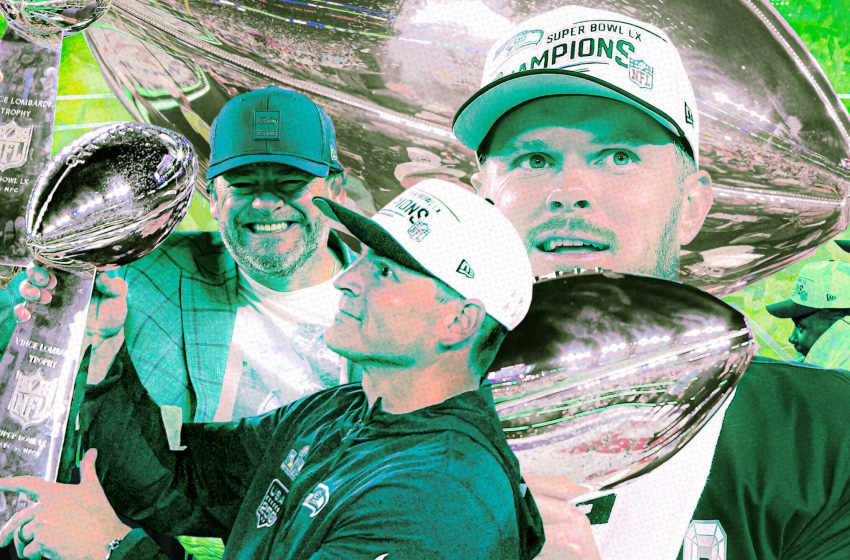
Sam Darnold’s Super Bowl Odyssey Is a Lesson in Belief
Sam Darnold laughed at the thought. He sat at a podium, crowded by a scrum of reporters, one of whom had just asked whether Darnold would have believed it a few years ago if he’d been told that he would be the first quarterback from the draft class of 2018 to start and win a Super Bowl. Not Josh Allen or Lamar Jackson or Baker Mayfield, but himself—the Jets bust who’d spent three dismal seasons in New York, become a meme, and been shipped off to Carolina for a handful of draft picks. Darnold, a freshly minted Super Bowl champion, could see the humor and the absurdity of it all, he wasn’t at all offended at the question. And yet …
“I didn’t … not believe,” Darnold said.
But for the rest of us, Sam Darnold, Super Bowl–winning quarterback, is one of the most unlikely turnarounds in recent NFL memory. To reach this point required not just Darnold having faith in himself, but having faith that he’d find the right team and the right coach, after it hasn’t worked out so many times before. In his eighth season, Darnold’s football odyssey brought him to Seattle, where the Seahawks also found themselves on a path to completing a comeback. The team’s bet on Darnold was seen as a surprise. On Sunday, he validated the team’s belief with a championship.
“Sam doesn’t care about the obstacle,” said Seahawks head coach Mike Macdonald Sunday night after the Seahawks beat the Patriots 29-13. “Everyone’s made a narrative about this guy. They have tried to put a story and a label on who he is as a person, who he is as a quarterback. He does not care. He’s the same guy every day since he showed up, he’s so steadfast.”
The story is a pretty good one. The beginning of Darnold’s career will go down as a cautionary tale about what it means to join a team bad enough to be picking near the top of the draft year after year. After just 13 wins and 39 interceptions in three seasons, Darnold left New York seemingly haunted and definitely labeled as a bust. You could argue his career rehabilitation process began in Carolina, especially in 2022, when he went 4-2 down the stretch after taking over starting duties from Mayfield.
Darnold, though, would say the process of reviving his career really began in San Francisco. Though other teams offered a better shot at starting in 2023, Darnold chose to sign with the 49ers to back up Brock Purdy. Darnold made only 46 pass attempts for a San Francisco team that won the NFC, but his year in the Kyle Shanahan passing academy was the reset he needed. And it also helped him build a positive reputation among coaches who favor the Shanahan/Sean McVay offense. In 2024, he signed with the Vikings to play for Kevin O’Connell, a former McVay assistant.
“It’s funny how it works, I didn’t play great football my first few years in my career, and then I come here to San Francisco, and I was able to learn a ton,” Darnold said. “I was able to learn and go to Minnesota and played good football there, and I was able to come to Seattle and kind of do the same.”
He was elevated to starter in Minnesota after first-round draft pick J.J. McCarthy tore his meniscus in the preseason. Together, Darnold and the Vikings went on to win 14 games, though the season ended on a bad note. Minnesota lost to the Lions in Week 18, missing out on a playoff bye in the process, then got blown out by the Rams in the wild-card round. Darnold was sacked nine times in that game.
After last season, the Vikings decided to commit to McCarthy instead of asking him to compete for the job. O’Connell said that Darnold had “earned the right” to explore free agency.
Last March, Darnold was the best quarterback on the market and the Seahawks signed him to a three-year, $100.5 million deal. The move was rather unpopular at the time—Seattle had gone 10-7 the season prior, and Geno Smith had played well. But contract talks with Smith had reached a stalemate, ultimately leading the Seahawks to trade Smith to the Raiders and to sign Darnold, giving him the type of job security he hadn’t had in years as he bounced from team to team to team. With the Seahawks, Darnold felt secure enough to buy a house in the area.
Maybe it has helped that in Seattle, Darnold’s role has been to simply be steady enough, while hitting just enough deep balls, that Seattle could rely on its excellent defense to win games. Mostly, Seattle was asking Darnold not to lose. It was a significant gamble. Though Darnold always has been among the more physically talented quarterbacks in the league, he’s had a tendency in his career toward making disastrous mistakes. In 56 games over his first five seasons, he threw 55 interceptions and fumbled 35 times.
He didn’t exactly get over all those bad habits once in Seattle. Darnold led the NFC in interceptions, and had three games with multiple picks, though he steadied as the year went on. He was at his best in the postseason, and went three playoff games, including the Super Bowl, without throwing an interception.
Seattle, meanwhile, was on its own path to reinvent itself in the post–Pete Carroll era. In many ways, winning this Super Bowl was the culmination of a long recovery process from the last time they played the Patriots in this game, after the 2014 season. You certainly remember how that one ended. That stunning loss seemed to put the organization into a tailspin they’ve only now fully pulled out of.
There are a lot of similarities between that 2014 team and this one—that year’s “Legion of Boom” defense and this year’s “The Dark Side”; the physicality of players like running back Kenneth Walker III and cornerback Devon Witherspoon; a balanced offensive attack; and, of course, the Super Bowl matchup with New England. One difference, though, is team chemistry, and the way each team’s quarterback fits into the locker room. Even as they made their way within 1 yard of a championship, the 2014 Seahawks were a tinder box of conflicts, many stemming from defensive players’ belief that quarterback Russell Wilson and the offense were coddled by coaches.
Darnold, however, is seemingly adored by his teammates. To one media session earlier this week in San Jose, wide receiver Cooper Kupp wore a shirt emblazoned with the words “I <3 Sam Darnold.” His supporters do not just come from the offense, either. Earlier in the season, linebacker Ernest Jones IV loudly defended his quarterback after Darnold threw four picks in a Week 11 loss to the Rams.
“Sam’s been balling,” Jones said at the time. “If we want to try to define Sam by this game, Sam’s had us in every fucking game. So for him to sit there and say, ‘That’s my fault,’ no it’s not. … It’s football, man. He’s our quarterback. We’ve got his back, and if you’ve got anything to say, quite frankly, fuck you.”
But Darnold’s history leaves doubts that are hard to erase.
The Patriots didn’t necessarily believe Darnold could single-handedly beat them in this game. Earlier in the week, defensive tackle Milton Williams made a comment likening New England’s approach toward Darnold to how they’d played Texans quarterback C.J. Stroud in the divisional round. It was a less-than-flattering comp, given Stroud’s four interceptions in that game against New England.
And based on the Patriots’ defensive game plan on Sunday, they certainly thought their best path to a win was by rattling him into a mistake. New England spent the game hunting turnovers, blitzing aggressively on early downs as well as late ones. The Patriots defensive backs consistently undercut the routes of their coverage assignments, searching for a pick that might send Seattle and its quarterback spiraling. As the game wore on, New England crowded the line of scrimmage, trying to force Darnold to keep throwing, almost willing a pick to finally come.
Darnold’s final stat line was modest: 19-of-38 passing for 202 yards and one touchdown. But he met the moment in what he didn’t do: throw an interception or fumble.
“I think with our defense, the way they’ve been playing, my job is to take care of the football,” Darnold said. “I knew that coming into the game and I did that. I took the open guy when they were there, and if I had to take sacks, if I had to throw the ball away, I was able to do it.”
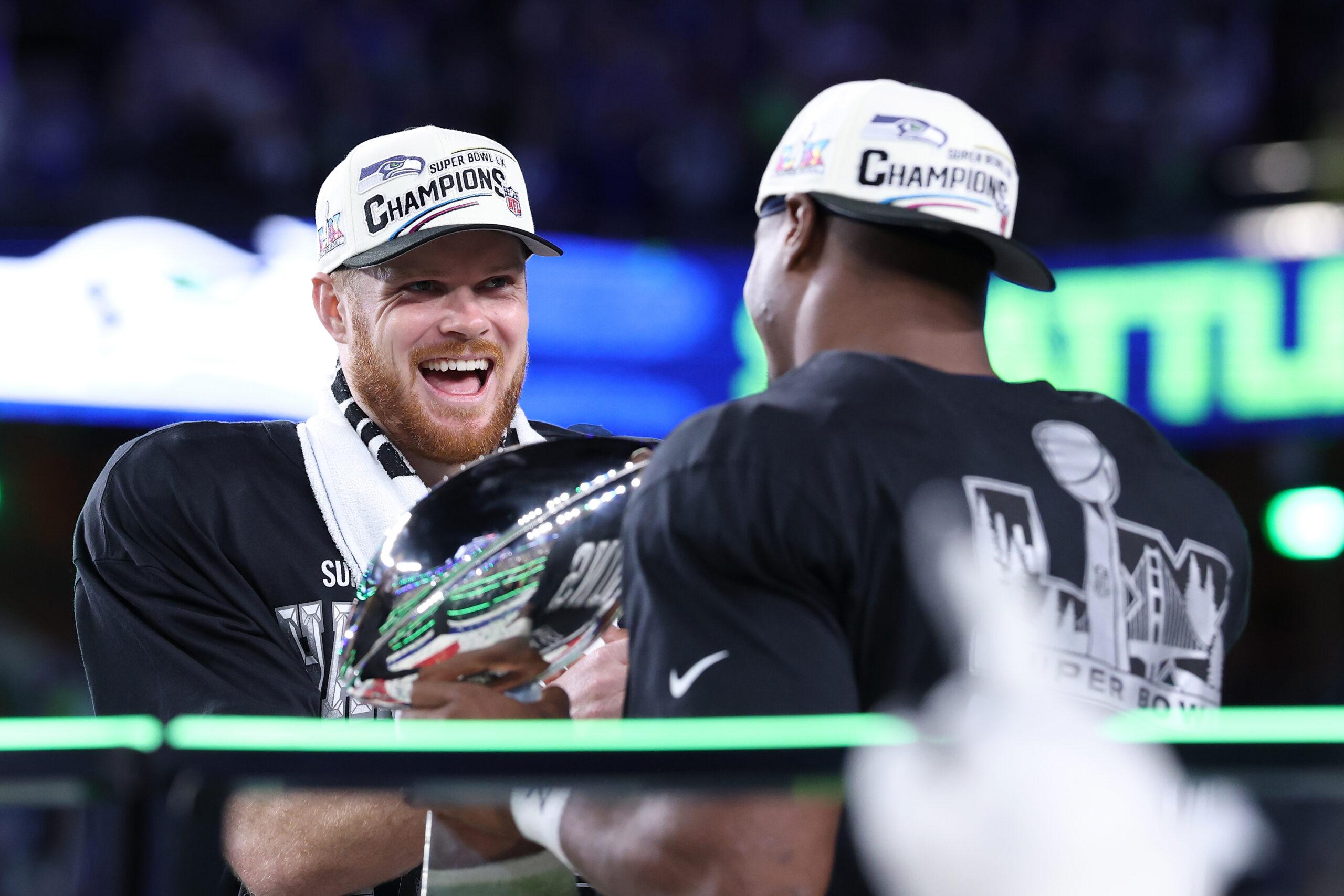
After the confetti cannons, Darnold walked through the clusters of people grouped around the 50-yard line, doling out quick daps and hugs. Without the hats and T-shirts and the blue-green strips of tissue floating down through the air, it would have been hard to tell that he’d just won a Super Bowl, though there were a few moments when a grin snuck through.
Late Sunday, Darnold said it hadn’t really sunk in yet. His mind was clearly still on the offensive slog of the game—he brought up multiple times that he should have played better. Emotion surged only after he saw his parents and his fiancée, Katie.
“Me and my dad don’t really cry very often,” Darnold said. “I told my dad and my mom, I’m here because of their belief in me. They believed in me throughout my entire career, and I think that’s why I was able to believe in myself almost ad nauseum. Some people called me crazy throughout my career for believing in myself so much and having so much confidence, but it was because of my parents.”
Again, Darnold laughed a bit at himself when he described his “ad nauseum” belief. But he clearly meant what he was saying. Darnold isn’t an exuberant personality, and he doesn’t seem to have the self-importance it often takes to survive as a high-profile athlete. But the quiet, steady confidence Macdonald described is evident in Darnold. It should take an optimist to lead his conference in picks, after all—someone with the belief that the next big play is going to work out.
Darnold isn’t a Super Bowl champion because he went out and won the game for Seattle on his own. Schematically, this game was a defensive battle through and through. But this title belongs to him, because despite everything that came before he made it through and in the end he was holding the Lombardi Trophy. It’s a lesson in quarterback development for the rest of the league, yes, but also in what real confidence looks like.
Asked what he’d go back and tell himself near the start of his career if he could, Darnold said he’d just say, “Keep going.” Which he has, all the way here.

Nora Princiotti
Nora Princiotti covers the NFL, culture, and pop music, sometimes all at once. She hosts the podcast ‘Every Single Album,’ appears on ‘The Ringer NFL Show,’ and is The Ringer’s resident Taylor Swift scholar.First Appeared on
Source link






