


Scientists Capture First-Ever Evidence of Black Hole Tearing Apart a White Dwarf Star
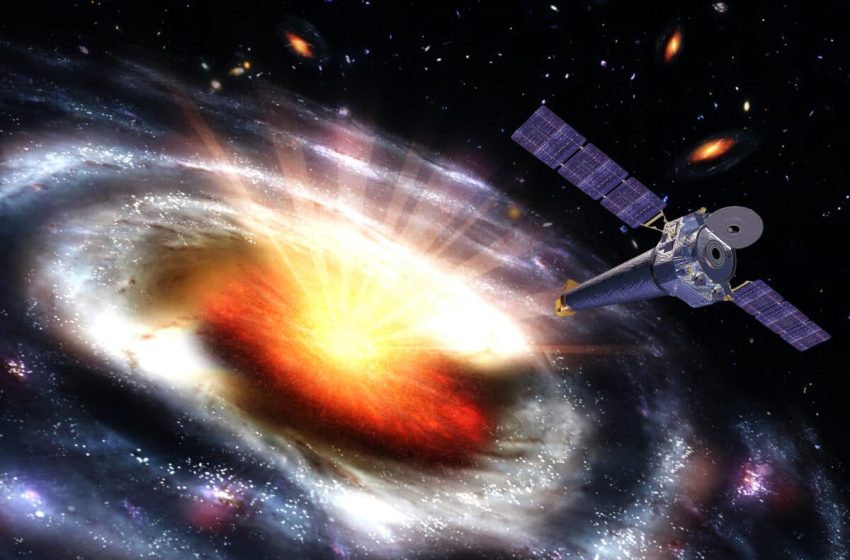
A strange cosmic outburst might just provide the first direct evidence of an intermediate-mass black hole feeding on a white dwarf star. Discovered by the China-led Einstein Probe space telescope in July 2025, this event could open a window into a long-missing class of black holes.
On July 2, 2025, astronomers using the Einstein Probe’s Wide-field X-ray Telescope (WXT) spotted something unusual in the sky. A highly variable X-ray source appeared seemingly out of nowhere, its brightness changing at an incredibly fast pace. Researchers quickly realized they had stumbled upon something important.
A Cosmic Outburst Like No Other
What made this particular explosion stand out so much? For one, the brightness was off the charts. According to the team at the National Astronomical Observatories of China (NAOC), the X-ray transient, dubbed EP250702a, places it among the most powerful outbursts ever recorded. And if that wasn’t strange enough, the timing of the event was something entirely new. Unlike typical gamma-ray bursts, which usually arrive in a predictable sequence, the X-ray signal came first. Astronomers noticed this odd timing pattern immediately, setting the stage for deeper investigation.
Soon after the initial discovery, major observatories around the world sprang into action. The WXT’s precise positioning helped researchers narrow down the source to the outskirts of a distant galaxy. The Follow-up X-ray Telescope (FXT) then tracked the evolution of the event over the next three weeks. During that time, the source’s brightness dropped by more than 100,000 times, and its X-ray emission shifted from ahigher-energy “hard” state to alower-energy “soft” one. That kind of change had never been seen in a cosmic explosion like this before.
The White Dwarf-Black Hole Model
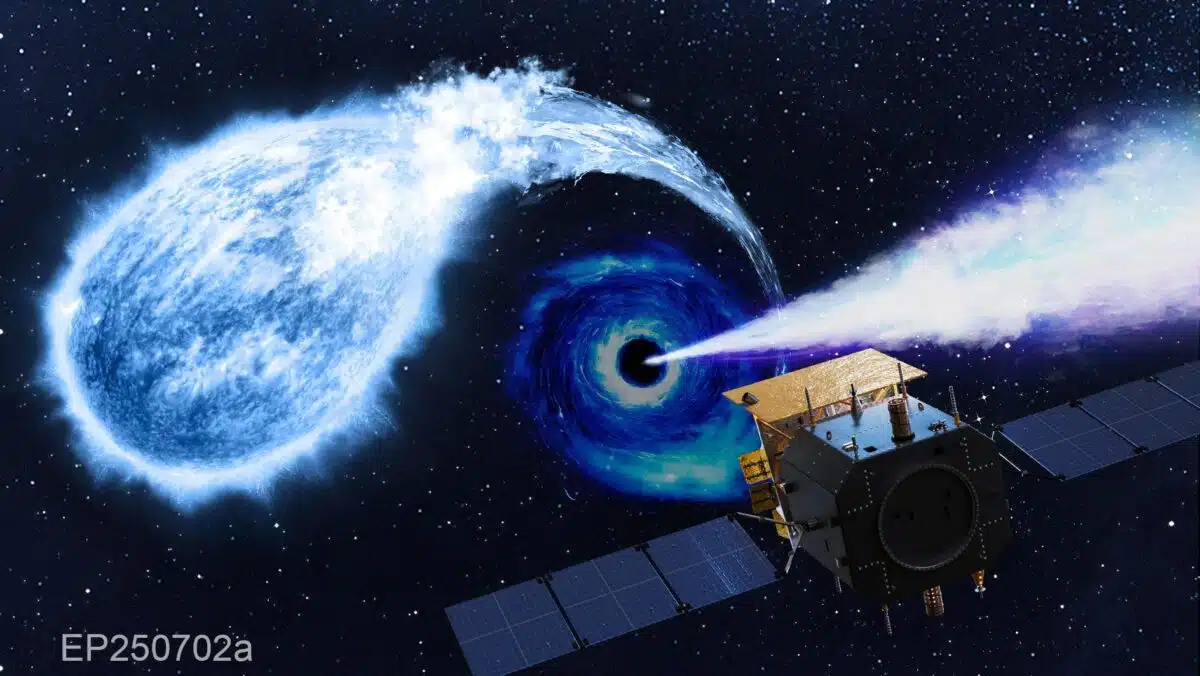
So, what exactly caused this strange event? According to scientists from the University of Hong Kong (HKU), an intermediate-mass black hole tore apart a white dwarf star. The team’s model suggests that the black hole’s gravitational forces, combined with the extreme density of the white dwarf, produced an extraordinary burst of energy that matches what was observed.
As explained in the latest research available in Science Bulletin, their theoretical work was backed up by numerical simulations led by Dr. Chen Jinhong, a postdoc at HKU, who found that the combination of forces at play could easily explain the event’s rapid evolution and high-energy output.
The involvement of the HKU team is a key part of this discovery. Professor Dai Lixin, co-author of the study, pointed out how international collaboration was critical to piecing together this complex cosmic puzzle. In a statement, she said that:
“The white dwarf–intermediate-mass black hole model can most naturally explain its rapid evolution and extreme energy output.” She added, “The robust discussion among international teams, each with their competing models to explain this event, is precisely what highlights its immense scientific value.”
Implications for Black Hole Research
Intermediate-mass black holes have been something of a mystery for astronomers, sitting between stellar-mass black holes and the much larger supermassive ones at the centers of galaxies. According to Professor Weimin Yuan from the NAOC, the discovery of this event could finally shed light on this missing class of black holes.
“The discovery of EP250702a fully demonstrates our capability to be the first to capture the Universe’s most extreme moments and further exemplifies China’s ability to make decisive contributions to international astronomical exploration.”
Moreover, the findings could open up new possibilities in the emerging field of multi-messenger astronomy. This approach combines data from a variety of different sources, like gravitational waves and electromagnetic radiation, to create a fuller picture of cosmic events.
First Appeared on
Source link






