


Scientists create a material that could forever change cement
Researchers have found that seawater and carbon dioxide can be turned into a solid building material that stores more carbon than it takes to produce.
That finding recasts a basic construction ingredient as a possible climate asset, especially where heavy industry already meets the coast.
Seawater and carbon dioxide become stone
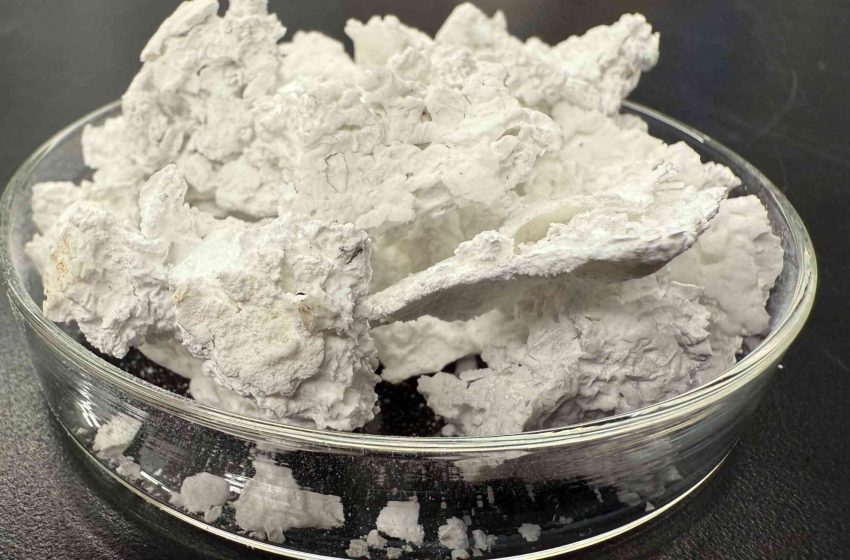
Inside a tabletop reactor, seawater yielded pale, sand-like grains that could take the place of mined aggregate in concrete.
Working with colleagues at Northwestern University, Alessandro Rotta Loria demonstrated that the material could be grown directly from that controlled chemical setting.
The solids did not emerge in just one form but could appear either as loose powders in solution or as grains built onto an electrode.
That flexibility depends on a narrow chemical balance, which sets up the deeper question of how the material changes under different conditions.
How the reaction works
Once electricity starts moving through seawater, water splits and produces hydroxide ions, charged particles that make nearby water less acidic.
At the same time, bubbling carbon dioxide through the seawater creates bicarbonate ions, dissolved carbon compounds that are ready to form minerals.
Those ingredients meet calcium and magnesium in seawater and solidify into calcium carbonate, the mineral found in limestone and shells, plus a magnesium-rich solid.
Hydrogen gas leaves the same reaction, giving the system a second product that could help pay for the process.
Shaping the mineral mix
Small changes in voltage and current, carbon dioxide flow, and water circulation produced particles that ranged from airy flakes to dense grains.
Under some conditions the solids clung to the electrode, while under others hydrogen bubbles knocked them loose into solution.
“We showed that when we generate these materials, we can fully control their properties, such as the chemical composition, size, shape, and porosity,” said Rotta Loria.
That degree of control matters because concrete, plaster, and fillers all demand different particle sizes, densities, and open spaces.
Why sand matters
A typical concrete mix relies on aggregates – sand and gravel that add bulk – for roughly 60 to 75 percent of its volume.
Replacing part of that mass with reactor-grown material could cut demand for mined sand from rivers, coasts, and seabeds.
Because the reactor-grown particles can form as powders or larger grains, the same chemistry could serve several building products.
That turns captured carbon into something that manufacturers already need in enormous quantities, which is far more useful than burial alone.
Some mixes become carbon negative
In the best mixes, the product becomes carbon-negative, storing more carbon dioxide than the process creates.
A blend split evenly between calcium carbonate and a magnesium-rich solid can hold more than half its own weight in carbon dioxide.
Later treatment with carbonation, a reaction that pulls carbon dioxide into solids, lets the magnesium-rich fraction lock away still more.
That extra step also changes the material itself, pushing the story from carbon storage alone toward performance inside a structure.
Strength after curing
During 30-day runs, deposits kept growing around the electrode until they formed inch-scale chunks instead of loose powder.
Inside the inch-scale chunks, porosity – the amount of open space in a solid – let ions keep moving and growth continue.
After further carbonation, compressive strength climbed from about 200 pounds per square inch (14 kilograms per square centimeter) to more than 870 (61).
Highly alkaline conditions still broke some aggregates apart, showing that durability will depend on where builders finally use them.
Keeping oceans separate
Instead of releasing carbon dioxide into open seawater, the team sees this chemistry happening inside modular reactors near shore.
Within those coastal units, operators could control incoming water, capture side products, and treat the leftover liquid before sending it back.
“We could create a circularity where we sequester CO2 right at the source,” Rotta Loria said.
That matters because a promising climate tool becomes much harder to defend if it disrupts the ecosystems beside it.
Future research directions
A 2018 analysis from Chatham House put cement production at around 8 percent of global carbon dioxide emissions.
For this new material to cut cement’s climate burden, the electricity driving it would need to stay clean and reasonably cheap.
Higher voltages also triggered chlorine-related chemistry at the positive electrode, a reminder that industrial designs must manage side reactions carefully.
Researchers still need tougher wear tests, because construction materials fail from grinding and impact as often as compression.
Building ingredients that store emissions
Beyond concrete, the same mineral output could feed cement, plaster, paint, or restoration projects that need calcium- and magnesium-rich solids.
Because the particles can grow on an electrode or fall free in solution, factories could target different supply chains.
That manufacturing flexibility may explain industry interest, since carbon capture survives longer when it ends as a salable ingredient.
What looks like waste gas in one process starts to look like raw material in another.
Seawater, electricity, and captured carbon can now produce building ingredients that store emissions, replace mined material, and generate useful hydrogen.
Whether the idea becomes common construction practice will depend on reactor design, clean power, cost, and hard evidence from larger tests.
The study is published in Advanced Sustainable Systems.
—–
Like what you read? Subscribe to our newsletter for engaging articles, exclusive content, and the latest updates.
Check us out on EarthSnap, a free app brought to you by Eric Ralls and Earth.com.
—–
First Appeared on
Source link






