


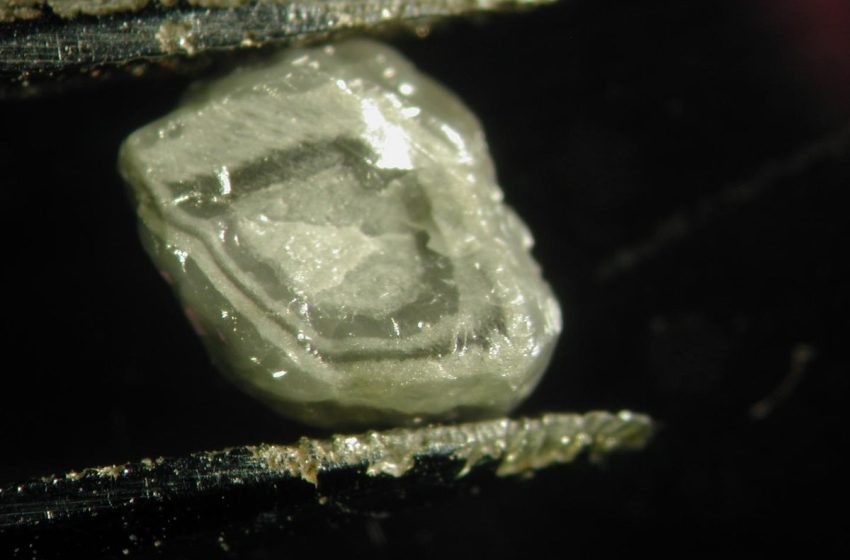
Scientists create first-of-its-kind ‘hexagonal diamond’ harder than real thing
Chinese scientists claim to have created the long theorised hexagonal diamond, stronger than the real thing, and only found until now at sites of meteorite impacts.
The commonly found cubic diamond is the hardest mineral on Earth and is used widely as jewellery, precision cutting tools, and high-performance semiconductors.
Hexagonal diamonds are rare and potentially tougher, but their actual existence has long been debated.
“As no solid experimental evidence has been provided to prove its existence, the physical properties of hexagonal diamond remain largely unexplored,” write researchers in the study published in the journal Nature.
The latest study describes the creation of this elusive form of carbon in the lab.
Researchers from China’s Henan Key Laboratory of Diamond Materials and Devices describe how they made a bulk piece of pure hexagonal diamond using extreme pressure and heat.
Atomic structure of the bulk hexagonal diamond (Nature (2026))
In the study, scientists placed a highly ordered form of graphite between anvils made of tungsten carbide and applied 20 gigapascals of pressure, which is around 200,000 times the pressure of our atmosphere.
The process was carried out at temperatures between 1,300C and 1,900C, researchers say.
When pressure was applied from the top of the stacked carbon layers, it led to the formation of a millimetre-sized piece of pure hexagonal diamond, according to the study.
“Here we report the synthesis of millimetre-sized, phase-pure hexagonal diamond from highly oriented pyrolytic graphite (HOPG),” researchers wrote.
Scientists then used X-ray diffraction, a technique that bounces X-rays off atoms to map their positions, to prove that the sample was structurally pure hexagonal diamond.
They also used advanced microscopy to clearly see the unique hexagonal stacking patterns of the carbon atoms.
Researchers tested the mechanical properties of their newly formed material by pressing a diamond tip into the sample to assess how much it resisted scratching or denting.
The hexagonal diamond sample had a hardness of around 114 gigapascals, compared to many natural diamonds, which have a hardness of around 110 gigapascals.
This suggests researchers may have created a substance slightly harder than natural diamonds.
“Bulk hexagonal diamond exhibits a slightly higher hardness than cubic diamond and high thermal stability,” scientists wrote.
“These findings resolve the long-standing controversy on the existence of hexagonal diamond as a discrete carbon phase and provide new insight into the graphite-to-diamond phase transition, paving the way for future research and practical use of HD in advanced technological applications,” they wrote in the study.
First Appeared on
Source link






