


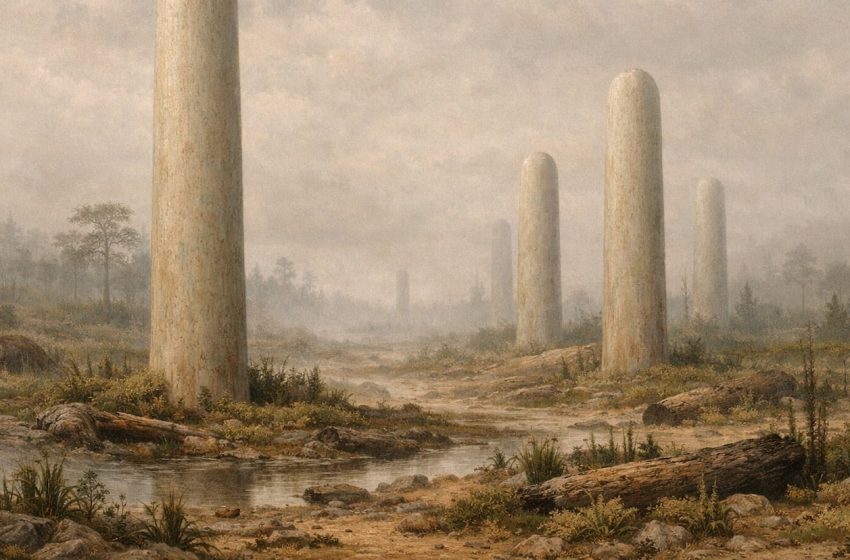
Scientists discover an extinct species that measured 26 feet in length: it inhabited the Earth 400 million years ago
A new study published in Science Advances has revealed that prototaxites—the giant structures that towered over Earth’s landscapes some 400 million years ago—were neither plants, nor fungi, nor animals. Instead, they belonged to a completely unknown and now‑extinct lineage.
The research, led by Corentin Loron and colleagues, shows that Prototaxites taiti was not a fungus at all but part of a lost branch of the eukaryotic family tree, finally solving one of paleontology’s longest‑standing mysteries, debated since the mid‑19th century.
400 million years ago
Before trees existed, Earth’s land was dominated by Prototaxites — towering structures up to 8 meters tall, likely giant fungi as visualised here using AI
Life always finds a way.
— Science girl (@sciencegirl) January 9, 2026
These organisms were enormous for their time: up to 26 feet long and more than 3 feet wide, rising like colossal pillars on a planet where the tallest plants barely reached a few inches. Their cylindrical forms dominated vast stretches of the supercontinent Gondwana, jutting out of the ground as massive, leafless, branchless columns.
For more than 160 years, scientists proposed that prototaxites might be primitive trees, giant algae, or enormous fungi—but every theory ran into contradictions. The new fossil analysis shows that these organisms had a unique internal architecture unlike anything found in any living group.
A study that rewrites evolutionary history
The research team—scientists from the U.K. and the University of Edinburgh—examined exceptionally well‑preserved fossils from Rhynie, Scotland. Microscopic and chemical analyses revealed networks of tubes, intricate internal structures, and patterns that match no known fungus, plant, or animal.
According to the authors, prototaxites represent a lost, fully extinct branch of the tree of life, opening the door to a complete rethinking of early Devonian ecosystems.
Why this discovery matters
- It rewrites what we know about the first organisms to colonize land.
- It challenges the long‑held belief that fungi were the earliest dominant giants.
- It adds an entirely new lineage to the history of life on Earth.
- It transforms our picture of early terrestrial landscapes, which may have been populated by biological giants long before the first trees appeared.
Related stories

Get your game on! Whether you’re into NFL touchdowns, NBA buzzer-beaters, world-class soccer goals, or MLB home runs, our app has it all.
Dive into live coverage, expert insights, breaking news, exclusive videos, and more – plus, stay updated on the latest in current affairs and entertainment. Download now for all-access coverage, right at your fingertips – anytime, anywhere.
First Appeared on
Source link






