


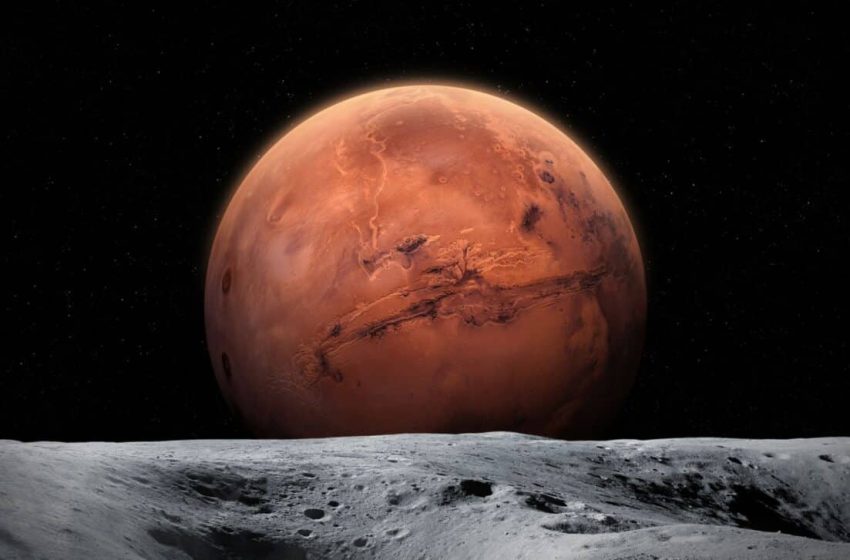
Scientists Discover Evidence That Mars Had a Lost, Massive Moon 18 Times Bigger Than Phobos!
A recent discovery suggests Mars may have once had a much larger moon, which could have caused tides in a lake that once filled Gale Crater. This intriguing possibility comes from a study of sediment layers in the crater, which the Curiosity rover has been investigating for years. If confirmed, this would explain the planet’s mysterious moon system.
Since landing in Gale Crater in 2012, NASA’s Curiosity rover has been exploring the region to better understand Mars’ ancient environments. A team of researchers, studying thin layers of sedimentary rock in the Jura outcrop of the crater, has found compelling evidence of tides, potentially indicating the presence of a much larger moon in Mars’ past.
Tidal Rhythmites Point to a Larger, Lost Moon
The team, led by Ranjan Sarkar of the Max Planck Institute for Solar System Research, identified repeating layers in the rock that resemble tidal rhythmites, sedimentary deposits formed by the regular movement of tides. These rhythmites, found in a rock formation called Jura, suggest that Mars had a much larger moon in the past, capable of generating tidal forces strong enough to affect a lake that filled Gale Crater.
“Our study provides sedimentary evidence for the case of tidally deposited rhythmites, hinting at a past larger moon for Mars.” he added, “This, in turn, aligns with the hypothesis that Mars has repeatedly had larger moons that were tidally destroyed into rings, which then reformed into successively smaller moons.”
According to the report, published in Eos, the layers indicate that the tidal cycles in the lake were about 30 days long, which is consistent with what would be expected from a large moon orbiting the planet. Phobos and Deimos, Mars’ current moons, are too small to create such large tides.
To generate these effects, the researchers propose that the fourth planet had a moon at least 18 times the mass of Phobos, which would have been positioned farther from the planet, about three times the radius of the rusty world. This larger moon would have caused significant tidal movements in the lake, creating the sedimentary patterns observed in the rock layers.
The Eternal Cycle of Mars’ Moon
The idea of a larger, lost moon also fits into a broader theory about Mars’ moon system. According to Sarkar, this larger moon might have eventually been destroyed by Mars’ gravity, possibly breaking into rings around the planet. The debris from this destruction could have formed smaller moons over time, leading to the creation of Phobos and Deimos. This cycle of moon formation and destruction is not unique to Mars, other planets with moons, including Earth, have experienced similar events throughout their histories.
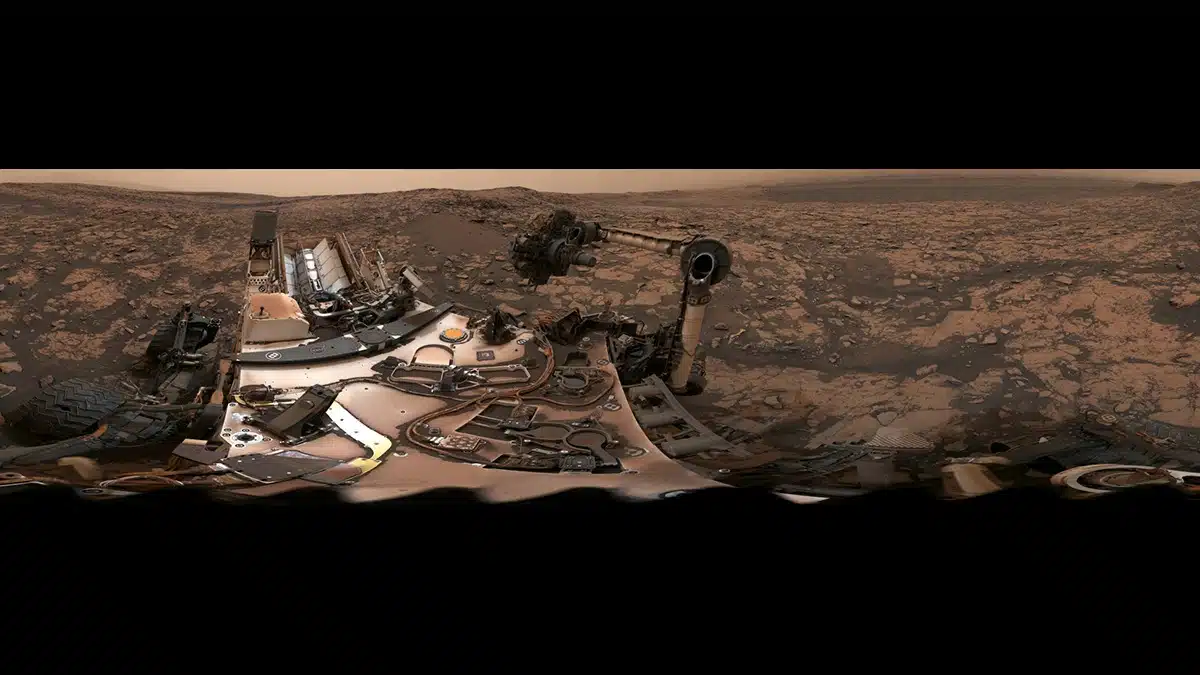
The theory of the Red Planet’ lost moon is part of a larger understanding of planetary dynamics, in which moons can be gradually torn apart by the gravitational forces of the planet they orbit. In Mars’ case, this could explain how Phobos and Deimos, which are both much smaller than the proposed larger moon, came into being.
Site Consistency Could Confirm Mars’ Lost Moon
Although the case for an ancient moon is not yet definitive, the sediment layers in Gale Crater offer strong support for the theory. Researchers will explore further sites within the crater, where similar evidence could further substantiate the hypothesis of a lost moon. As stated by Sarkar: “It’s very tricky. We can’t be decisive, so our argument is one of consistency.”
Suniti Karunatillake of the Louisiana State University pointed out that, if inconsistencies are found between the three sites;
it would “dispute our model, and possibly falsify it. But any agreement would take us toward a stronger argument for an ancient large moon.”
First Appeared on
Source link






