


Scientists Discover Rare Fossil in China With an Almost Complete Body and Powerful Jaws
A newly described fossil species from China is offering a rare glimpse into life just after the largest extinction in Earth’s history. Preserved with unusual detail, the fossils reveal powerful jaws in a group long known mostly from shells.
The species, Yunnanocyclus fortis, was identified from three specimens recovered in the Guiyang biota, a fossil-rich site in Guizhou province. According to Papers in Palaeontology, the animals lived during the Early Triassic, roughly 251 million years ago, at a time when marine ecosystems were still recovering from the Permian-Triassic mass extinction.
Cyclidans, the group to which this species belongs, remain poorly understood. Their fossil record is sparse and often limited to isolated carapaces. Xiaoyuan Sun and colleagues stated that this lack of preserved appendages has long obscured their full anatomy, making each new discovery particularly significant.
A Fossil With A Near-Complete Body Preserved
The newly described crustacean specimensstand out for their level of preservation. Beyond the oval carapace, they retain fragile anatomical features including antennules, antennae, and seven pairs of thoracic segments.
The researchers observed that, such preservation is extremely uncommon in cyclidans, where soft or delicate structures are almost never fossilized. These details help confirm their classification within Crustacea, based on the presence of appendages like mandibles and maxillipeds.
The holotype specimen measures about 19.8 mm in length and 14.7 mm in width, providing a compact yet detailed representation of the species’ morphology.
Unusually Strong Mandibles Identified
The most notable feature of Yunnanocyclus fortis is its pair of robust mandibles, a structure rarely documented in this group. The jaws measure approximately 1.7 mm long and 0.8 mm wide. Using micro-X-ray fluorescence, scientists detected high concentrations of calcium and phosphorus in the mandibles and surrounding structures. As mentioned in the study, this indicates that the jaws were thick and strongly mineralized.
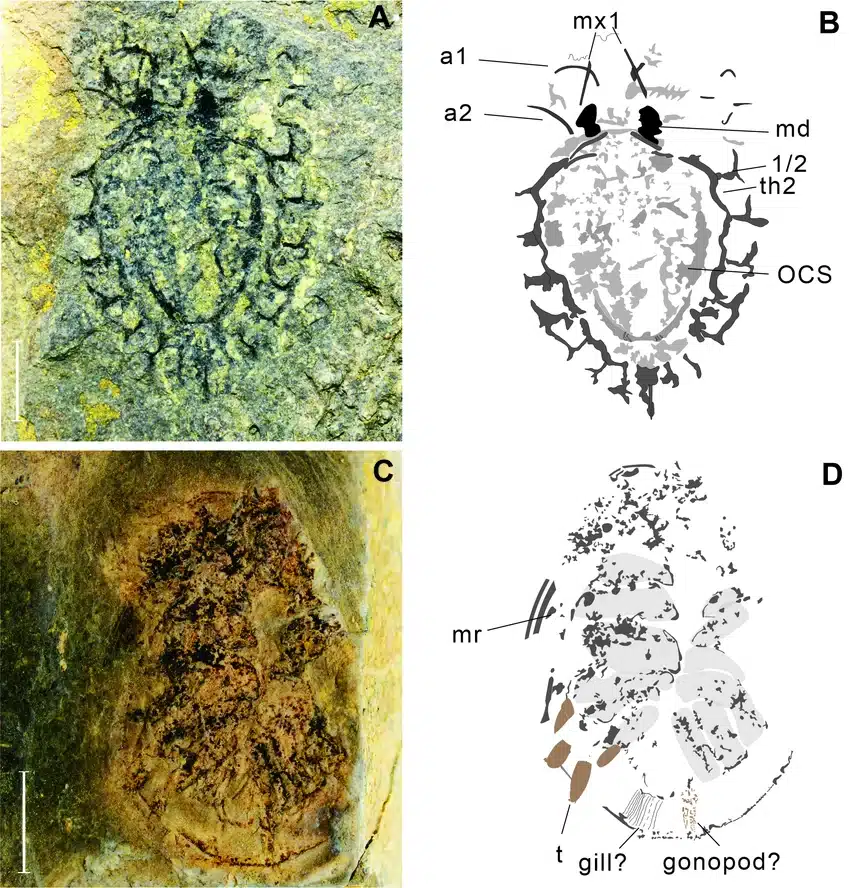
The researchers describe the mandibles as “strongly ovoid,” pointing to a functional role that may have involved processing relatively tough material, although no specific diet is identified in the findings.
“As an enigmatic and specialized group of crustaceans, they originated in the Mississippian (359 to 323 million years ago) and became extinct in the Late Cretaceous Maastrichtian (73 to 66 million years ago).” a team led by Dr. Xiaoyuan Sun of the China University of Geosciences, including researchers from China and the United States, reported.
Species Range Expanded by New Find
The presence of Yunnanocyclus fortis in China expands the known distribution of Early Triassic cyclidans. Earlier finds from this period were concentrated in Madagascar and parts of Europe. The authors noted that the new species represents the oldest record from the eastern Tethys region.
“Our discovery of new species from China expands the known paleogeographic distribution of Early Triassic cyclidans,” the researchers, however, added that: “Early Triassic cyclidans are most widely distributed in Madagascar, Europe and China. By the Late Triassic, they were recorded only in Europe.”
The team also analyzed morphological data to reconstruct cyclidan diversity through time. Their results suggest that the group experienced its highest diversity during the Carboniferous, followed by a gradual decline. The study found that this pattern supports the “early burst” model of evolution.
Evidence from the Guiyang biota indicates that complex marine communities may have reappeared earlier than previously thought, with cyclidans already widely distributed across multiple regions.
First Appeared on
Source link






