



Scientists Discover the World’s Oldest Cave Art in Indonesia, It Features a Pig
Scientists have just unearthed the world’s oldest known cave art on the Indonesian island of Sulawesi. At 51,200 years old, the painting, depicting a pig alongside human figures, pushes back the timeline for when our ancestors first began to tell stories through art.
Discovered by an international team of Australian and Indonesian researchers, the artwork is both a breakthrough and a puzzle. It’s the earliest known instance of figurative cave art, predating earlier discoveries by over 5,000 years. What makes this find particularly significant is that it gives us a glimpse into the cognitive leap that allowed humans to communicate in increasingly complex ways.
A Peek into an Ancient Tale
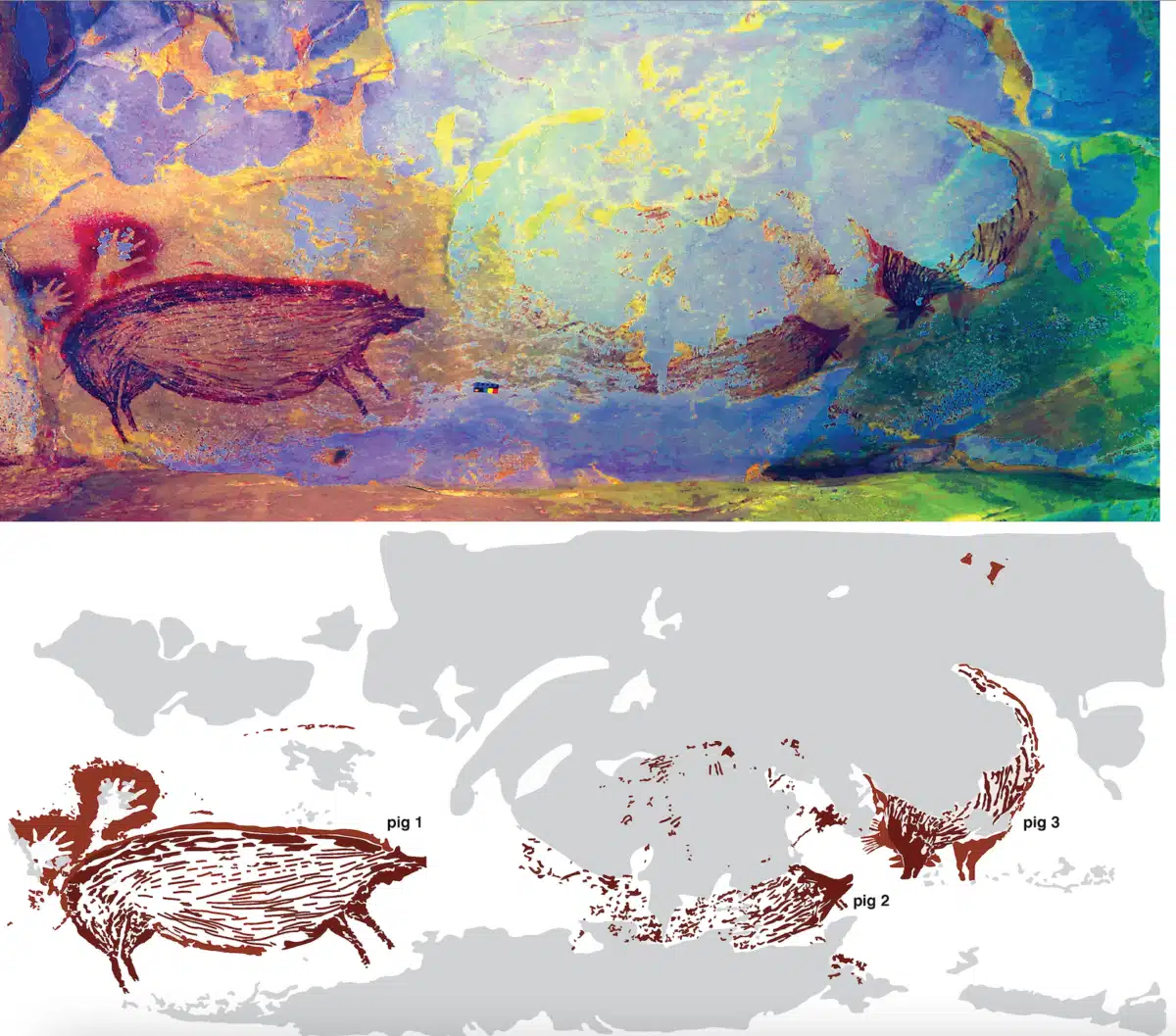
Inside the Leang Karampuang cave, there’s a wild pig—standing, its mouth slightly open—and three human-like figures interacting with it. One of the human figures is holding a stick, seemingly close to the pig’s throat, while another stands with its head near the pig’s snout. The third figure, oddly enough, is upside down with its legs spread out, reaching for the pig’s head. According to Professor Adam Brumm from Griffith University, the painting is:
“the oldest known dated, evidenced—currently—of a rock art depiction of wildlife. But it can be superseded by an earlier claim, either in this part of the world or somewhere else in the not so distant future.”
When Did We Start Seeing Things Differently?
If this artwork is truly over 51,000 years old, it suggests that early humans were capable of far more sophisticated thinking than we previously assumed. The researchers behind a Science Advances study that dates and describes it point out that the painting shows humans and animals interacting, indicating that people were already conceptualizing relationships, actions, and possibly even narratives in their minds.
Dr. Henry Gee, a senior editor at Nature, the publication that featured the detailsn speculates that:
“Something seems to have happened around 50,000 years ago, shortly after which all other species of human, such as Neanderthals and the so-called Hobbit died out.” He added, “It is very romantic to think that at some point in that time something happened in the human brain, but I think it is more likely that there are even earlier examples of representational art”.
Sulawesi: Where Early Art Found Its Roots
As more discoveries emerge from Sulawesi, it’s becoming clear that Southeast Asia was playing a pivotal role in the development of human creativity. In fact, the island has yielded some of the oldest known hand stencils and even other animal paintings. But this most recent discovery takes it a step further, revealing a more intricate level of artistic sophistication.
As stated by Brumm, one of the researchers involved in the study, what sets this new discovery apart is its narrative structure.
“These are small native pigs that are endemic to Sulawesi and are still found on the island, although in ever-dwindling numbers,” he said. “The common portrayal of these warty pigs in the ice age rock art also offers hints at the deep symbolic significance and perhaps spiritual value of Sulawesi warty pigs in the ancient hunting culture,”
Laser Technology: A New Tool for Ancient Art
Rather than relying on traditional methods like carbon dating, which can’t be used directly on paintings, scientists used a laser to extract tiny amounts of material from the artwork itself. This allows them to study various parts of the art in fine detail, yielding more accurate and reliable dates. This cutting-edge method could soon be applied to other ancient cave art sites.
“The site is a very beautiful, essential, untouched, pristine environment,” Brumm said. “The local heritage agency is doing what it can to manage a control system that will safeguard the site over time.”
While this dating method is still relatively new, it is already reshaping the field of archaeological research.
“In fact, some of the known rock art sites in this area could be that old; they just haven’t yet been scientifically dated,” he concluded. “So humanity’s earliest art could be hiding in plain sight.”
First Appeared on
Source link






