


Scientists Discovered a 300-Million-Year-Old Tropical Forest Preserved Under Volcanic Ash in China
An exceptional discovery in northern China has revealed a 300-million-year-old tropical forest preserved under volcanic ash. This forest, located near Wuda in Inner Mongolia, offers a unique opportunity to study ancient ecosystems from the early Permian period.
Published in Proceedings of the National Academy of Sciences, the study explains how volcanic ash rapidly covered the plants, preserving them in place and providing a snapshot of life from that time. According to the researchers, this remarkable preservation allows for an unprecedented examination of the forest.
Impressive Preservation of Ancient Flora
The preservation of the forest is extraordinary, with many plants and trees preserved in the exact locations where they grew. The volcanic ash settled over the area quickly, maintaining the plants in remarkable detail.
Professor Hermann Pfefferkorn, from the University of Pennsylvania and co-author of the study, described the preservation as “marvelously preserved,” noting that this level of preservation provides paleontologists with an unparalleled opportunity to study ancient plant life that was buried almost instantly by the eruption.
“We can stand there and find a branch with the leaves attached, and then we find the next branch and the next branch and the next branch. And then we find the stump from the same tree.”Pfefferkorn said.
Remarkable Diversity of Fossilized Trees
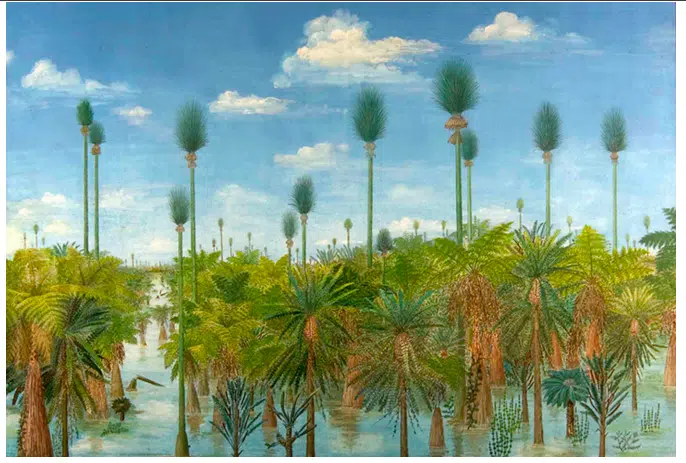
The fossilized forest features a wide variety of plant species, including six distinct groups of trees. According to the study, tree ferns formed a lower canopy, while much taller trees, such as Sigillaria and Cordaites, grew up to 80 feet. These trees were part of a rich and varied ecosystem that thrived in a tropical environment.
Researchers also found nearly complete specimens of Noeggerathiales, an extinct group of spore-bearing trees that were related to ferns. Although these ones had been identified previously in North America and Europe, their abundance in this Chinese forest is a new and important discovery.
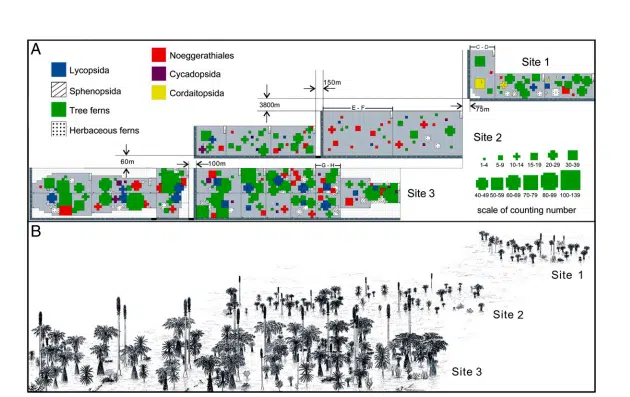
The varying composition of plants across the three study sites suggests that the forest was composed of different plant communities, potentially influenced by local environmental factors.
Earth’s Ancient Weather Report
While the discovery does not provide a complete picture of Earth’s climate shifts, it adds valuable data to help scientists better understand the environmental conditions of the era.
Professor Pfefferkorn compared the find to the archaeological site of Pompeii. Similarly, this ancient forest provides a valuable time capsule, allowing researchers to interpret the climate and ecosystems before and after the volcanic eruption.
“It’s a time capsule,” Pfefferkorn explained, “and therefore it allows us now to interpret what happened before or after much better.”
First Appeared on
Source link






