


Scientists Discovered Glass Orbs from an Ancient Asteroid Impact. The Crater Is Nowhere to Be Found.
Here’s what you’ll learn when you read this story:
-
A new study reveals a previously unknown meteorite impact that took place in northeastern Brazil some 6.3 million years ago.
-
An international team of scientists found a 900-kilometer-long “strewn field” of tektites, rocks that form when terrestrial material is rapidly heated by energetic impacts.
-
While this research proves that an impact did occur in South America’s distant past, geologists are still looking for the impact crater itself.
In its 4.6-billion-year history, Earth has had some truly catastrophic run-ins with ancient celestial bodies. None rival the cataclysmic collision between Earth and its protoplanetary sibling Theia (a cosmic crash so significant it likely formed the Moon), and few reach the intensity of the 6.2-mile-wide asteroid that ended the land-loving dinosaurs. Those events left observable traces for future scientists to study, but when it comes to most of the smaller collisions that have punctuated Earth’s history, Earth’s surface preserves scant evidence of traumatic impact. Compared to planets like Mercury and Mars—which have lower levels of tectonic or weathering activity to erode away these impacts—Earth keeps its deep-rooted scars hidden.
But over the course decades and centuries, scientists have slowly unearthed them. And now, an international team of scientists has found evidence of another ancient impact, thanks to a strewn field of tektite. This rock—whose name is derived from the Greek tektos, meaning “melted”—forms when terrestrial debris is ejected from an immense impact that supplies enough energy to quickly heat and rapidly cool quartz-rich soils and rocks.
The largest tektite strewn field, called the Australasian, covers roughly 10 percent of the Earth’s surface, and others have been spotted in central Europe, the Ivory Coast, North America, and Belize. But none have ever been found in South America—until now. The details of the discovery and analysis of the tektite samples were published in the journal Geology.
“This growth in the area of occurrence is entirely consistent with what is observed in other tektite fields around the world,” Álvaro Penteado Crósta, the lead author of the study from the Institute of Geosciences at the State University of Campinas, said in a press statement. “The size of the field depends directly on the energy of the impact, among other factors.”
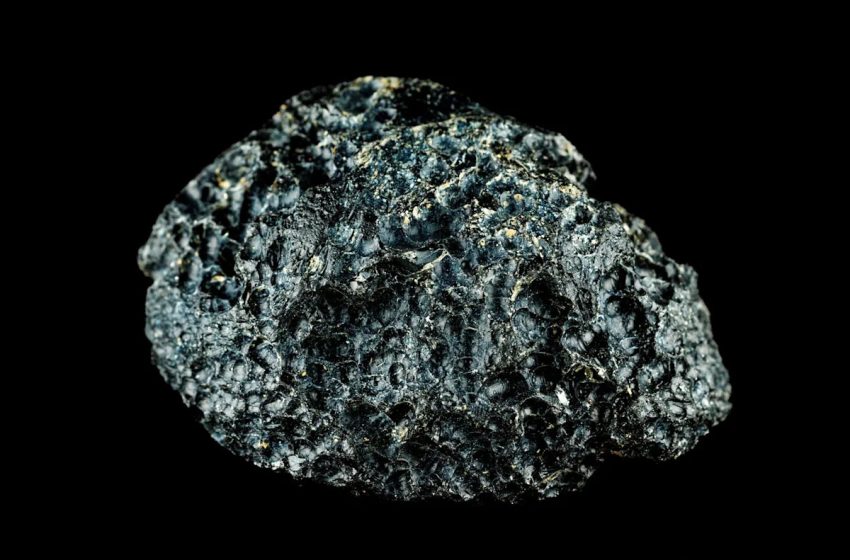
Each strewn field’s tektites are collectively given a name, and scientists named the pieces of this most recent discovery ‘geraisites’ after the Brazilian state Minas Gerais, where the 900-kilometer-long trail of specimens was first found. The researchers estimate that upwards of 600 geraisites of different sizes and weights (anywhere from 1 gram to 85.4 grams each) were discovered at the site. Most of them look black at first glance, but glow a translucent greenish-blue hue when examined under light. All of them possess the telltale aerodynamic shapes of tektites—spheres, ellipsoids, disks, or droplets—and like most tektites, they’re pockmarked with small cavities.
“These small cavities are traces of gas bubbles that escaped during the rapid cooling of the molten material as it traveled through the atmosphere, a process also observed in volcanic lava but especially characteristic of tektites,” Crósta said in a press statement.
So, where (and when) exactly did these tektites come from? The research team’s best guess—made with the help of data gathered from argon isotope dating—is that the geraisite-producing meteorite likely smacked into Earth a maximum of 6.3 million years ago, and the rocks themselves formed from 3-billion-year-old Archean crust. This means that the most likely candidate for their creation is the São Francisco craton, essentially the geologic heart of the South American continental crust.
One of the biggest remaining mysteries is that Crósta and his team have found no evidence of the crater created by this impact—which, judging by the size of the strewn field, should be fairly significant in size. The authors mention that half of the known tektite fields on Earth have no accompanying crater, but even s0, the scientists still have hope that future magnetic and gravimetric studies will detect the tell-tale ring-shaped structure of an eroded crater near the strewn field in Minas Gerais.
As it turns out, this particular chapter of South America’s geologic history is still being written.
You Might Also Like
First Appeared on
Source link






