


Scientists Find Hemoglobin Traces in Dinosaur Bones Once Thought Impossible to Preserve for Millions of Years
Scientists report chemical evidence that fragments of hemoglobin, the molecule responsible for carrying oxygen in blood, may still exist inside certain dinosaur fossils. Using a specialized spectroscopy technique, researchers identified molecular signatures in fossilized structures resembling blood vessels from Tyrannosaurus rex and Brachylophosaurus canadensis.
The finding adds new data to a scientific debate that has persisted for two decades: whether soft biological materials can survive in fossils for tens of millions of years.
A Targeted Laser Search For Hemoglobin Traces
To examine the fossil structures in greater detail, Mary Schweitzer, a paleontologist at North Carolina State University, collaborated with physicist Hans Hallen, who specializes in Raman spectroscopy, a method that identifies chemical compounds by analyzing scattered laser light. According to a study, published in Proceedings of the Royal Society A: Mathematical, Physical and Engineering Sciences, the team turned to resonance Raman spectroscopy, a version of the technique designed to amplify the signal of specific molecules.
Fossils often contain mixtures of degraded organic material and minerals, which complicates molecular analysis.
“Raman spectroscopy essentially uses light waves to identify a molecule’s energetic ‘fingerprint,’” explained Hallen. He added that “Resonance Raman, which we use here, takes that process one step further by using light that is already tuned to the molecule of interest—so only that type of molecule will resonate.”
The researchers focused on hemoglobin, which contains iron-centered heme rings linked to larger protein units called globins. Detecting these structures would indicate that fragments of blood-related molecules might still remain inside the fossil vessels.
Laser Signals Reveal Hemoglobin-like Signatures
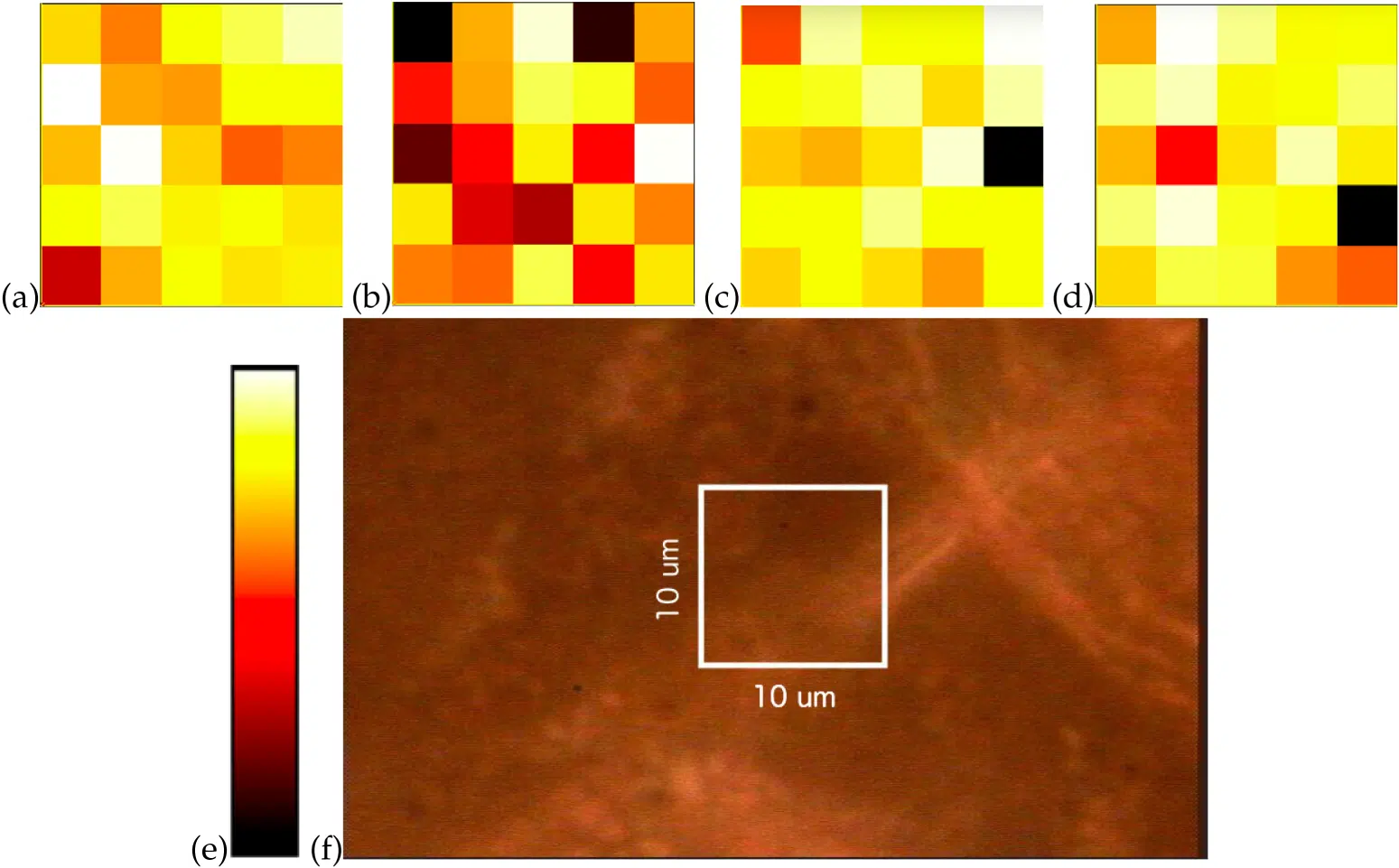
When the team analyzed the fossils using a 532-nanometer green laser, they detected spectral signals consistent with heme groups still attached to globin proteins. The signal appeared in vessel-like structures found in fossils of both Tyrannosaurus rex and Brachylophosaurus canadensis.
“The signal increase shows that hemoglobin is present, but changes in the signal also allow us to see that as the hemoglobin degrades, goethite may form on the iron within hemoglobin,” Hallen said in an university report. “We can also pinpoint where the ring-like structure of heme is being damaged.”
To verify the result, researchers conducted a second test using a 473-nanometer blue laser, which resonates more strongly with heme molecules not attached to proteins. The signal was largely absent, supporting the interpretation that the detected signatures correspond to hemoglobin fragments rather than free heme or bacterial by-products.
The spectral data also show that the molecule is partially degraded, with breaks in the heme structure consistent with the chemical alteration expected in material preserved for millions of years.
Iron Chemistry May Preserve Fossil Tissues
The analysis also gave some clues about how these molecular bits could hang around for millions of years. One detected wavelength peak suggests that lighter regions inside the fossilized vessels correspond to goethite, that as explained by Hallen, “a mineral crystal that is known to be bio-related; that is, it forms from biological action.”
Scientists propose that oxygen reacted with the iron atom at the center of the heme molecule, and that reaction might have formed these mineral crystals. This process could create alternating oxygen-rich and oxygen-poor zones inside the vessels.
In spots with less oxygen, the iron atom probably triggered repeated oxidation and reduction reactions, which created cross-links between proteins. That would have stiffened up the surrounding material. Schweitzer thinks hemoglobin itself might have helped with all this.
“Heme has been identified in sediments that are much, much older than dinosaurs, so we know that it persists,” she explained. “Understanding why hemoglobin preserves, and the role that heme plays in the process, is really important if we want to know how these ancient molecules survive through time.”
First Appeared on
Source link






