


Scientists Find World’s Oldest Fossilized Reptile Skin in Oklahoma Cave
A team of paleontologists has unearthed the oldest known fossilized reptile skin, dating back 289 million years. The small patch of skin, found in the Richards Spur cave in Oklahoma, provides unprecedented insight into the early adaptations that allowed reptiles to thrive on land, long before the age of the dinosaurs. Published in Current Biology, this groundbreaking study not only sheds light on how early reptiles evolved but also highlights the rarity and significance of soft tissue fossilization.
A Rare and Precious Find: Fossilized Skin From 289 Million Years Ago
Fossilized skin is an extraordinarily rare find, especially from ancient reptiles that lived during the Carboniferous period. Unlike bones or teeth, skin decays quickly after death, leaving very few traces behind. However, the particular conditions of the Richards Spur cave, oil-based substances that seeped into the cave’s mud, and low oxygen levels, created an environment that slowed the decay of soft tissues. These unique conditions preserved the skin for millions of years, offering a rare glimpse into the evolutionary past of reptiles.
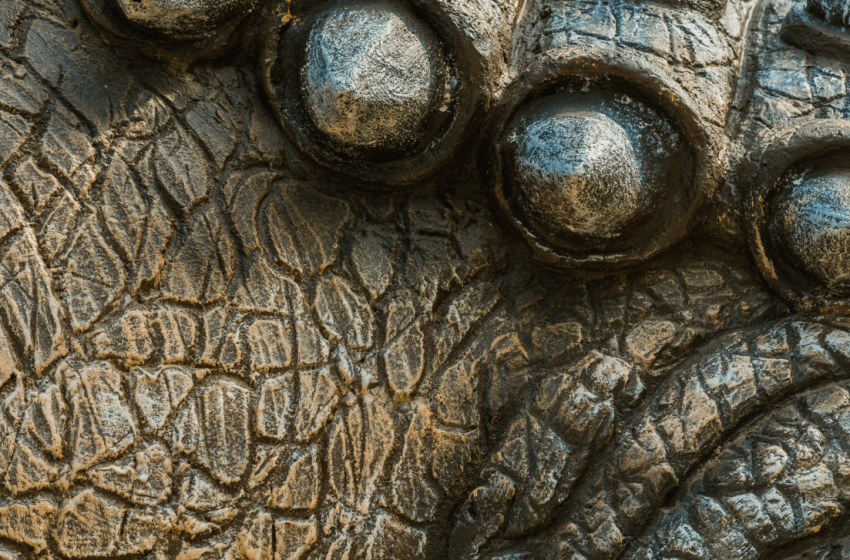
The skin fragment, no larger than a fingernail and as thin as a human hair, was meticulously extracted from cave sediment and analyzed under a microscope. The scientists were able to identify scales and wrinkles in the fossil, which resemble those of modern-day crocodiles, indicating that some reptile skin features have been stable for hundreds of millions of years.
Credit: Current Biology.
Revealing Evolutionary Adaptations for Life on Land
The fossilized skin offers compelling evidence that early reptiles had already developed water-resistant scales long before the rise of dinosaurs. This feature was crucial for survival on dry land, as it helped prevent dehydration, a major challenge for early vertebrates transitioning from aquatic environments to terrestrial habitats.
The study’s lead author, Ethan D. Mooney, a paleontology master’s student at the University of Toronto Mississauga, explained that the discovery provides valuable information about how reptiles adapted their skin to life away from water. The arrangement of scales in the fossil, with rows of rigid structures separated by hinge zones, suggests that early reptiles had already developed specialized skin that could flex while still providing protection from environmental stresses.
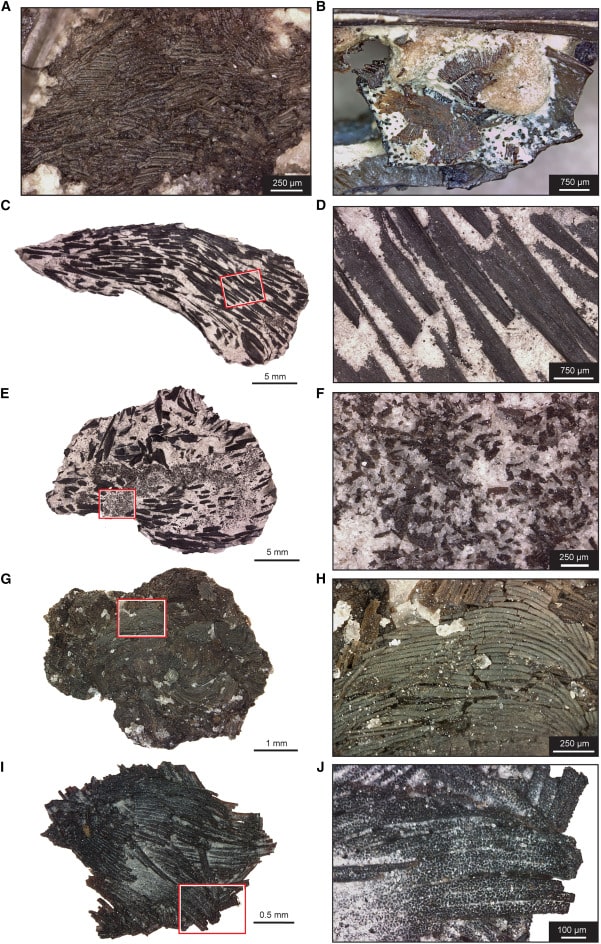
Photograph of scale impressions for (A) lepospondyl ROMVP 88279 and (B) Llistrofus OMNH 73718. Both specimens are from partially articulated skeletal remains, the latter being associated with the crania and the former with the postcranial regions (see Figure S1). Photograph of Acheloma (C) ROMVP 88276 and (D) close-up of small spicule-like structures. (E) ROMVP 88277 and (F) close-up of scales; these specimens are isolated rolled-up pieces. (G) Unknown tetrapod scales, ROMVP 88302, complete photograph, and (H) close-up of scales. This specimen is associated with vertebrae. Unknown tetrapod scales (I) ROMVP 88303, complete photograph, and (J) close-up showing unique morphology of scales; this specimen is associated with vertebrae. Photograph of OMNH 73718 taken by Diane Scott.
The Role of Oil and Low Oxygen in Fossil Preservation
One of the key factors that enabled the preservation of the skin was the presence of sticky hydrocarbons, oil-based molecules, that seeped into the cave’s sediment. These hydrocarbons created a protective coating around the remains, blocking oxygen and water from reaching microbes that would typically cause decay. Additionally, low-oxygen pockets in the cave slowed down the decomposition process, preserving the fossil for millions of years.
The researchers note that while the oil-based preservation technique protected the skin from complete decay, it also posed challenges. The presence of hydrocarbons made it difficult to analyze the chemical makeup of the skin in detail. Despite these challenges, the fossil provided enough information for the team to make significant breakthroughs in understanding early reptilian skin and its role in water conservation.
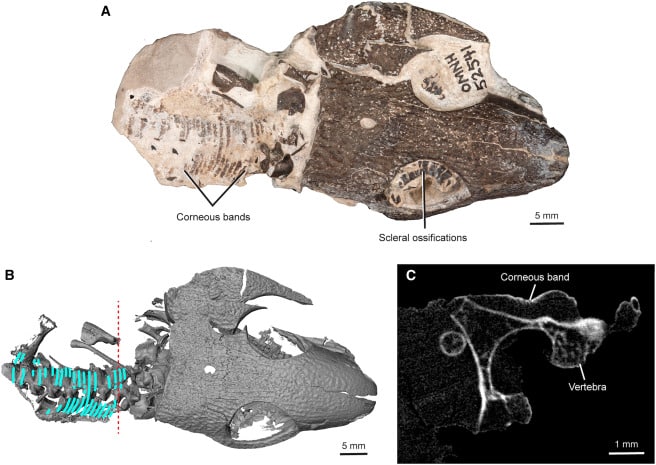
(A) Specimen photograph in dorsal view; (B) skeletal rendering showing corneous bands in blue relative to skeletal elements and the red dashed line indicating cross-section location; (C) transverse cross-sectional view of nCT slice showing cornified structures directly overlying vertebral elements. The bands are single rather than paired, and the largest appears to be approximately 9.8 mm in width and 0.5 mm in length cranio-caudally. The flexiblity of such cornifications and their concentric arrangment would accomodate typcial reptilian lateral undulating movements. The concentric banded pattern of these cornified structures is similar to the skin impressions in the early Permian synapsid Ascendonanus nestrleri from the Chemnitz locality in Germany.14 Their arrangement is similar to even-rowed dorsal scales among extant squamates like amphisbaenians (worm lizards)15 and those of many caenophidian snakes, whose vertebrae correspond to a set number of rows,16 but also superficially to the general arrangement of even-rowed ventral scales in select teiids17 and varanids.18
Next Steps in Reptilian Evolution Research
While the discovery, published in Current Biology, offers groundbreaking insights into early reptilian life, it also raises new questions. The fossilized skin was found without an attached skeleton, making it difficult to fully identify the species it belonged to. However, the team hypothesizes that the skin likely came from Captorhinus aguti, a small, lizard-like reptile known to inhabit the cave system.
Future studies will focus on linking the skin fragment to a complete skeleton, which will help researchers better understand how early reptiles developed and how their skin evolved over time. By connecting skin characteristics with skeletal traits, scientists can build a more complete picture of early amniote life on land.
First Appeared on
Source link






