


Scientists Have Discovered 1.4 Billion-Year-Old Air Bubbles Trapped in Salt Crystals
A team of researchers has successfully analyzed ancient air bubbles trapped in 1.4-billion-year-old salt crystals from northern Ontario, Canada. This unprecedented discovery has provided the first direct measurements of atmospheric oxygen and carbon dioxide levels from the Mesoproterozoic era.
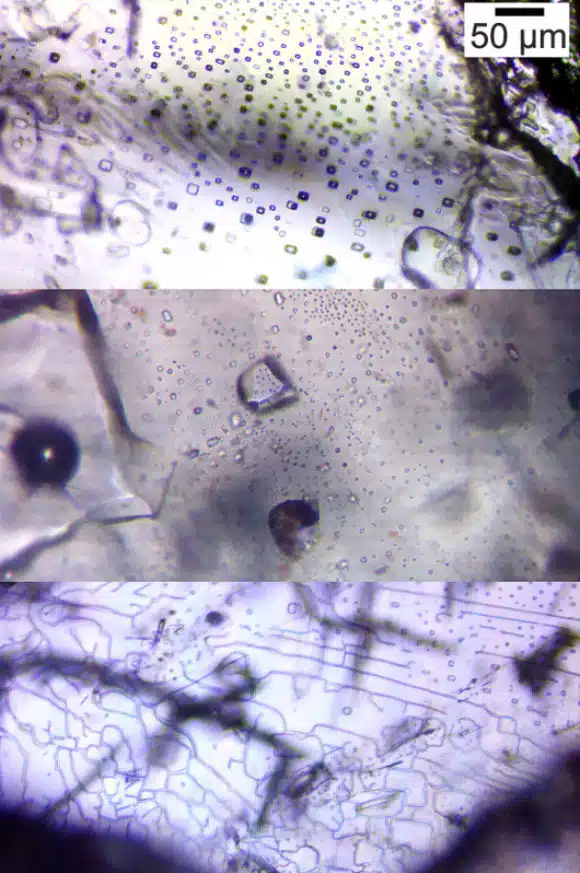
This breakthrough comes after years of painstaking research, during which scientists managed to extract and analyze gas samples from halite crystals, which contain fluid inclusions from Earth’s ancient atmosphere. These findings are transforming our understanding of the Mesoproterozoic period, a time often referred to as the “Boring Billion” due to its lack of significant evolutionary change.
The Mesoproterozoic Atmosphere Revealed
The Mesoproterozoic era, which lasted from 1.8 to 0.8 billion years ago, has long been seen as a time of little change, both in terms of geology and biology. Despite its nickname, however, the era was not without significance. During this time, the Earth’s atmosphere was already in the midst of significant changes, though the period was marked by relatively low levels of oxygen and slow evolutionary progress. Previous estimates of the atmosphere during this period were based on indirect measurements.
The findings, published in Proceedings of the National Academy of Sciences, fill a major gap in our knowledge by analyzing the ancient air trapped in halite crystals. According to the research team, the measured oxygen levels, about 3.7% of modern levels, are surprisingly high for the time.
Meanwhile, the carbon dioxide levels were found to be ten times higher than preindustrial levels, suggesting a warmer and more stable climate than previously assumed.
Unlocking the Mysteries of Ancient Air
Measuring ancient gases is no simple task. Halite crystals, which contain both air bubbles and brine, present unique challenges for scientists trying to isolate accurate gas measurements. The gases behave differently in water than in air, making it difficult to extract reliable data.
“The carbon dioxide measurements we obtained have never been done before,” said Professor Morgan Schaller, who led the study. “We’ve never been able to peer back into this era of the Earth’s history with this degree of accuracy. These are actual samples of ancient air!”
Thanks to this breakthrough, the team was able to isolate the air bubbles and carefully analyze the composition of the gases trapped inside. According to graduate student Justin Park:
“It’s an incredible feeling to crack open a sample of air that’s a billion years older than the dinosaurs”.
A Milder Climate Than Expected
One of the most significant findings of this study is the suggestion that the Mesoproterozoic climate was milder than previously thought. The high levels of carbon dioxide, combined with temperature estimates derived from the salt itself, point to a climate more similar to today’s than scientists had assumed for this ancient period. This finding challenges earlier theories that suggested the Mesoproterozoic era was marked by a cooler, less stable climate.
“Red algae arose right around this point in the Earth’s history, and they remain a significant contributor of global oxygen production today,” explained Professor Schaller.
It is possible that the relatively high oxygen levels during this period were a direct consequence of the increasing abundance and complexity of algal life. The researchers suggest that these conditions may have been crucial in sustaining life on Earth, particularly during a time when the Sun was weaker than it is today.
First Appeared on
Source link






