


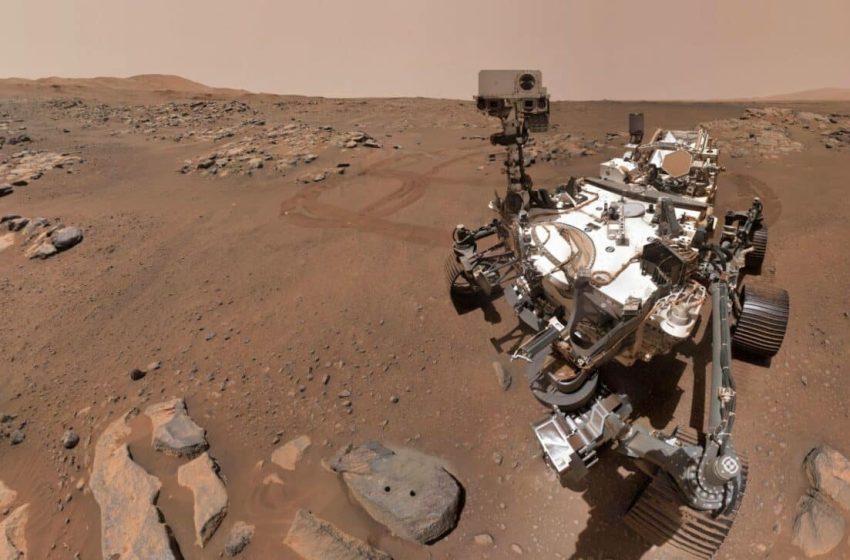
Scientists Have Released NASA Rover Photos Showing Possible Insect and Reptile Life Forms on Mars
A study of NASA’s Mars rover images has raised intriguing possibilities about extraterrestrial life on the Red Planet. Ohio University Professor William Romoser has identified what he believes to be insect- and reptile-like creatures.
For years, scientists have used the Mars rovers to look for signs of past or present life on the planet, focusing primarily on chemical signatures or microbial fossils. However, the findings present an alternative theory: that Mars could harborinsect- and reptile-like creatures. His analysis, based on images from Curiosity, suggests that some of the features seen in the photos bear striking resemblance to terrestrial arthropods and reptiles.
Insect-Like Life Forms Captured by Mars Rovers
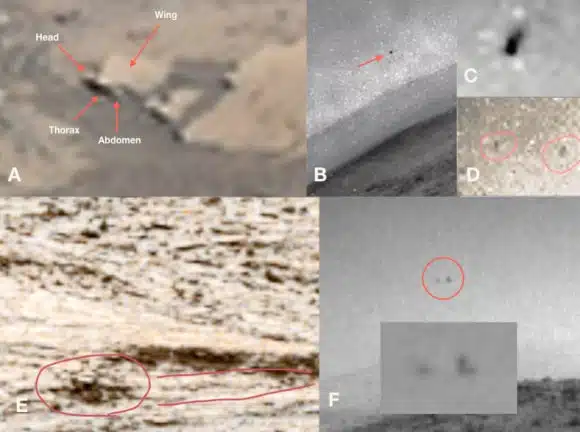
The study, focused on images from NASA’s Curiosity rover, where he claims to have identified several insect-like creatures in flight or at rest. These organisms, which Professor William Romoser refers to as“bees,” appear to possess features similar to terrestrial insects, including segmented bodies, wings, and jointed appendages. In one of his findings, a creature is seen performing an acrobatic flight maneuver, diving steeply before leveling off, much like an insect on Earth.
“The ‘bees’ appear to vary in size and type. Several characteristic insect/arthropod anatomical features were identifiable, not all on the same individual, but as a mosaic among individuals.”
The anatomical structures observed in these images, such as compound eyes and specialized legs, are consistent with arthropods, a large group that includes insects. Romoser has also noted that:
“The insect-like fauna observed appeared to be sheltering/nesting in caves, in burrows beneath the surface, and in specialized structures.”
Evidence of Reptile-Like Creatures on Mars
Romoser has also uncovered what he believes to be reptile-like fossils among the rover photos. One of his key findings involves a specimen that bears similarities to an Eastern King Snake, with a distinct head and bilateral punctate structures. The fossilized creature appears to have a large mouth capable of gaping, further supporting the hypothesis that reptile-like organisms once existed, or may still exist, on Mars.
The reptile-like forms discovered show symmetry and anatomical traits that parallel Earth’s reptiles. These observations have led Romoser to propose that Mars may have supported or may still support life forms similar to those on Earth. In some images, the reptile-like creatures seem to be preying on the insect-like organisms.
Astrobiology Just Got a Lot More Exciting
The implications of Romoser‘s research extend beyond the discovery of these life forms. He suggests that his findings could give rise to new branches of study.
“Given evidence for the presence of insect/arthropod and reptile-like organisms beyond the confines of Earth, perhaps ‘astroentomology’ and ‘astroherpetology’ will emerge as important topics within the field of astrobiology,” he stated.
Romoser’s presentation of these findings in 2019 at the National Meeting of the Entomological Society of America sparked both interest and skepticism. No matter what the final verdict is, his research is bound to stir up more conversations about life on Mars and the possibility of discovering not just microbes, but more complex organisms.

First Appeared on
Source link






