



Scientists Identify the First Branch on the Tree of Life
For decades, biologists have attempted to trace the earliest split on the animal tree of life, one that occurred approximately 600 million years ago. All living animals, from mammals to mollusks, descend from a shared ancestor. The first branching from this ancestor gave rise to two lineages: one leading to nearly all animals alive today, and another leading to just one group. Identifying which group came first has been a subject of fierce scientific debate.
Until recently, the main contenders for this primordial branch were the sea sponge and the comb jelly. These simple aquatic organisms seemed to possess traits that aligned them closely with the earliest animal forms. But their exact position on the tree remained unclear, due in part to the age and complexity of evolutionary rearrangements in their genomes.
New Technique Compares Gene Locations, Not Just Sequences
Instead of looking only at which genes an organism possesses, researchers applied a refined technique that analyzed the location of those genes on chromosomes. According to Popular Mechanics, this approach centers on the idea that as species evolve, genes on chromosomes undergo rearrangement. Once these genes move, they rarely return to their original positions, making their arrangement a reliable marker of evolutionary history.
Scientists examined how 14 specific gene groups were arranged in both sponges and comb jellies. They then compared these arrangements to those in closely related single-celled non-animal organisms. These single-celled organisms act as a proxy for the common ancestor’s original genome. In both the comb jellies and the non-animal relatives, the 14 gene groups remained on separate chromosomes, indicating little genomic rearrangement.
Sponges, on the other hand, showed those 14 gene groups combined into just 7 groups. That higher level of rearrangement suggests sponges split from the ancestral lineage later than comb jellies did. The fewer the changes, the closer an organism is to the original genetic state of the common ancestor.
Comb Jellies Take the Crown as Evolutionary Outlier
The result of the chromosome comparison is unambiguous: comb jellies branched off first. This positions them as the most genetically isolated animals alive today. The revelation not only ends a long-standing scientific dispute but also sets a new foundation for studying how complex life evolved from simpler organisms.
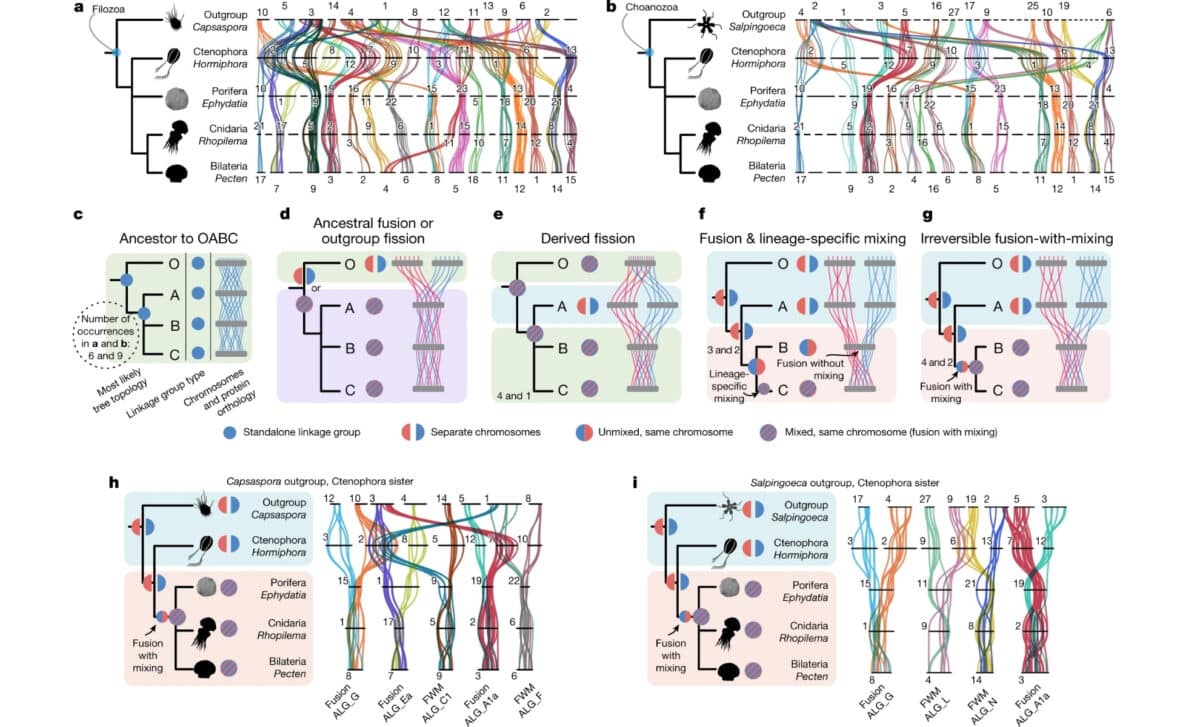
The study reveals the comb jelly as the “sister” lineage to all other animals. This means that the genes and biological structures seen in comb jellies evolved independently from the rest of the animal kingdom. Their unique traits, once considered primitive, may now be reinterpreted as evolutionary innovations.
This distinction may guide future research into how nervous systems, digestive tracts, and other complex features developed, or did not develop, along separate evolutionary paths.
Broader Implications for Understanding Evolution
The confirmation of the comb jelly’s position on the tree of life has implications far beyond taxonomy. Scientists now have a clearer lens through which to study animal evolution and the mechanisms that powered it over hundreds of millions of years. Every major evolutionary development can now be examined with a more accurate understanding of its origin point.
By focusing on gene positioning rather than gene content, researchers have opened a new avenue for evolutionary studies that could be applied to other branches of life as well. The findings also highlight the power of genome structure analysis in resolving long-debated biological questions.
First Appeared on
Source link






