


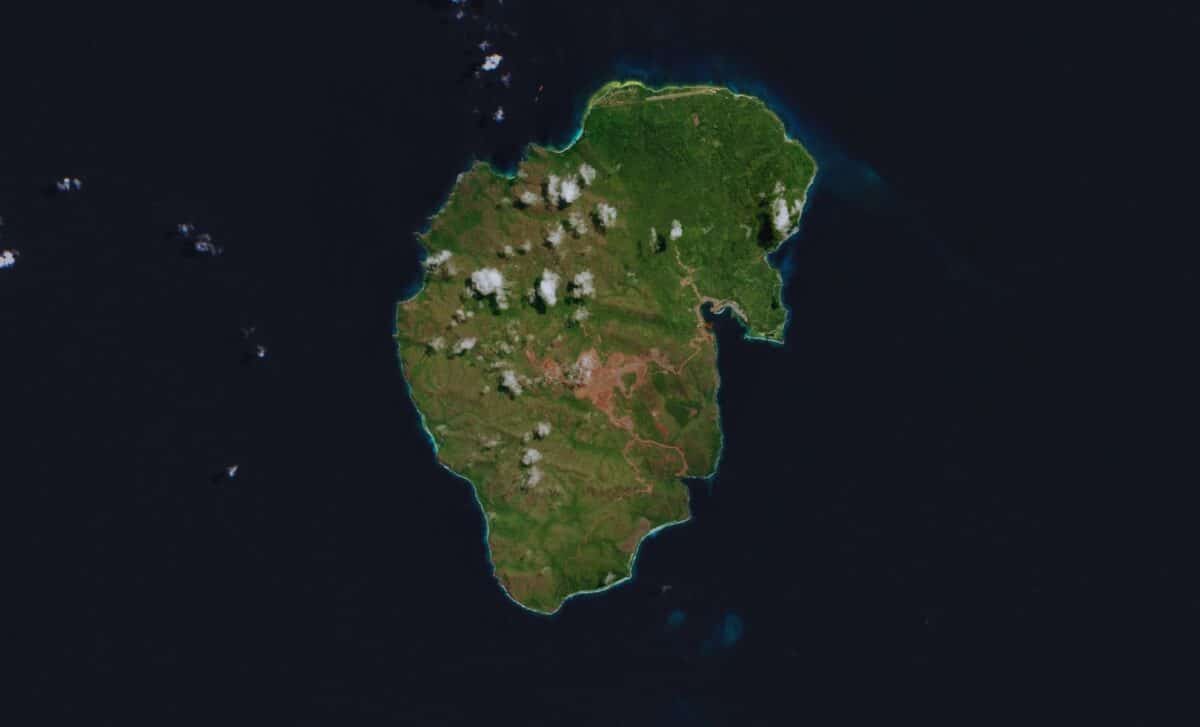
Scientists Just Found a Lost Continent That Vanished 155 Million Years Ago
Roughly 155 million years ago, a continent called Argoland broke off from what is now Australia, and then vanished without a trace. Now, after years of piecing together geological puzzles, scientists say they’ve found it: not in one place, but fragmented across the seafloor beneath Southeast Asia.
The new study, conducted by researchers at Utrecht University, challenges assumptions about how continents drift and disappear. Instead of moving as a single, cohesive landmass, Argoland splintered into multiple continental ribbons, hiding in plain sight beneath island chains like eastern Indonesia and parts of Myanmar.
Argoland’s disappearance had long puzzled geologists. When continents break apart, they usually leave behind clear evidence—rock formations, fossil trails, or mountain remnants that hint at their journey. In Argoland’s case, these signs were missing. That absence raised serious questions about its fate. Had it sunk beneath the ocean, melted into the mantle, or simply never existed in the way scientists imagined?
Argoland Didn’t Disappear — It Shattered
Rather than breaking cleanly from Australia like other ancient landmasses did from Gondwana, Argoland fragmented into smaller pieces early in its drift. These shards moved separately over time, complicating efforts to track their trajectory. “Nothing fit,” said lead author Eldert Advokaat to Live Science, referring to earlier attempts to link known geological fragments across the region.
This splintering effect made Argoland particularly difficult to identify. While parts of continents like Africa and South America show textbook examples of rift-based division, Argoland resisted the usual patterns. The Utrecht team eventually theorized that Argoland began as a loose collection of microcontinents, a hunch that proved key to solving the mystery.
According to the press release, the research revealed that most of these fragments had drifted toward Indonesia’s eastern side, with some ending up near Myanmar. That geographical spread made it difficult to view the pieces as a coherent whole—until the idea of a “ribbon continent” came into play.
Scientists Introduce The Idea Of An “Argopelago”
To better describe Argoland’s fragmented structure, the researchers coined a new term: the Argopelago. Rather than viewing the continent as a singular mass, they proposed that it should be understood as a “very extended and fragmented ensemble”, essentially, a patchwork of continental shards, each separated by ocean floor but still geologically linked.
As stated by the geologist Douwe van Hinsbergen, who co-authored the study, these reconstructions are not just about solving academic mysteries.
“Those reconstructions are vital for our understanding of processes like the evolution of biodiversity and climate, or for finding raw materials.”
The findings were published in the peer-reviewed journal Gondwana Research. The researchers emphasized that this reconstruction could not have been possible without abandoning the assumption that continents always behave as rigid blocks. In Argoland’s case, flexibility, both geological and conceptual, was crucial.
Continent Clues To Species Split
Beyond its geological implications, Argoland’s recovery may help scientists make sense of a biological mystery: the Wallace Line. This invisible boundary runs through Indonesia and separates distinct ecosystems, placental mammals like elephants and tigers to the west, and marsupials and cockatoos to the east.
The starkness of this divide has long baffled researchers. One possible explanation now lies in Argoland itself. As it drifted away from Australia, it may have transported its own faunal populations, which later interacted—though only partially—with those of Southeast Asia when the continental fragments collided with the region.
Advokaat suggested that the movement and eventual settling of Argoland could have reinforced the Wallace Line’s separation. If so, this geological puzzle may also be a key to understanding how certain species migrated, or didn’t, across ancient island chains.
First Appeared on
Source link






