


Scientists Just Found a New Fossil That Reveals Spiders Once Had Tails, And They Might Still Be Out There
A tiny spider frozen in 100-million-year-old amber is changing what scientists thought they knew about spider evolution. This prehistoric creature had spinnerets like modern spiders, but also a long tail.
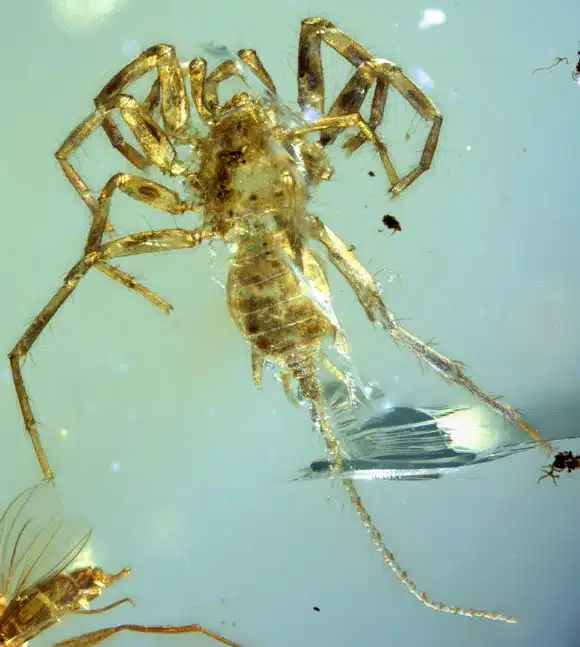
The fossil, uncovered in the dense forests of Myanmar, reveals a transitional species that blends both ancient and modern spider features. Preserved with exceptional detail in amber from the Cretaceous period, the specimen provides rare physical evidence that early spider ancestors once possessed tails, something that had only been hypothesized until now.
Tailed Spider Bridges Ancient And Modern Species
Researchers have named the creature Chimerarachne yingi, a nod to the mythological Chimera because of its unusual combination of traits. It was discovered in a region that remains largely unexplored.
The research, published in Nature Ecology & Evolution, describes a fossil that displays a combination of features never before observed in a single specimen. It features spinnerets like those of modern spiders, allowing it to produce silk, and a tail similar to that of scorpions or uraraneids, an extinct group of early arachnids. According to Dr. Russell Garwood of the University of Manchester, that:
“We have known for a decade or so that spiders evolved from arachnids that had tails, more than 315 million years ago.” he added, “We’ve not found fossils before that showed this, and so finding this now was a huge (but really fantastic) surprise.”
Despite its ability to produce silk, there’s no indication that Chimerarachne yingi used it to spin webs. Scientists believe it may have used the silk for other purposes, such as lining burrows or creating egg sacs, though no direct evidence of its behavior survives. The fossil reveals that web-building likely evolved later, after the tail was lost.
Exceptional Preservation In Amber
The creature was discovered in Burmese amber, dated to the mid-Cretaceous period, about 100 million years ago. The amber’s clarity allowed scientists to observe both external and internal anatomical features with rare precision. As noted by Dr. Ricardo Perez-De-La Fuente of the Oxford Museum of Natural History, the level of preservation.
“Chimerarachne fills the gap between Palaeozoic arachnids with tails known from rocks (uraraneids) and true spiders, and the fact the new fossils have been wonderfully preserved in Burmese amber has allowed an unmatched detail of study,”
Photographs of the specimen reveal minute hairs, legs, and the segmented tail, which would have moved freely behind the body.
The preservation was so complete that scientists could examine structures like spinnerets and tail segments under high magnification, confirming both the fossil’s identity and its place in arachnid evolution.
Species We Have Not Met
While Chimerarachne yingi is believed to be extinct, researchers are not completely dismissing the idea that similar creatures could still exist. The dense rainforests of Myanmar, where the fossil was found, are largely uncharted and biologically rich. As explained by Dr. Paul Selden of the University of Kansas, a tiny, elusive animal like this might easily escape detection.
“We haven’t found them, but some of these forests aren’t that well-studied, and it’s only a tiny creature,” Selden explained.
The suggestion is not that Chimerarachne itself survives, but that related species could persist in isolated or poorly surveyed habitats.
First Appeared on
Source link






