


Scientists Just Uncovered the Biggest Underwater Volcano Eruption Ever, Hidden for Years Beneath the Pacific
A vast eruption beneath the southwest Pacific Ocean has been confirmed as the largest volcanic event ever recorded on the ocean floor. The 2012 explosion at the Havre volcano, near New Zealand, produced an immense field of pumice and lava deposits that scientists have only recently been able to fully map.
What first appeared as an unusual floating mass spotted by mariners turned out to be the surface trace of a colossal geological event. Years of detailed seabed exploration revealed the true scale of the eruption, hidden nearly a kilometer below the waves.
Mapping An Underwater Rupture
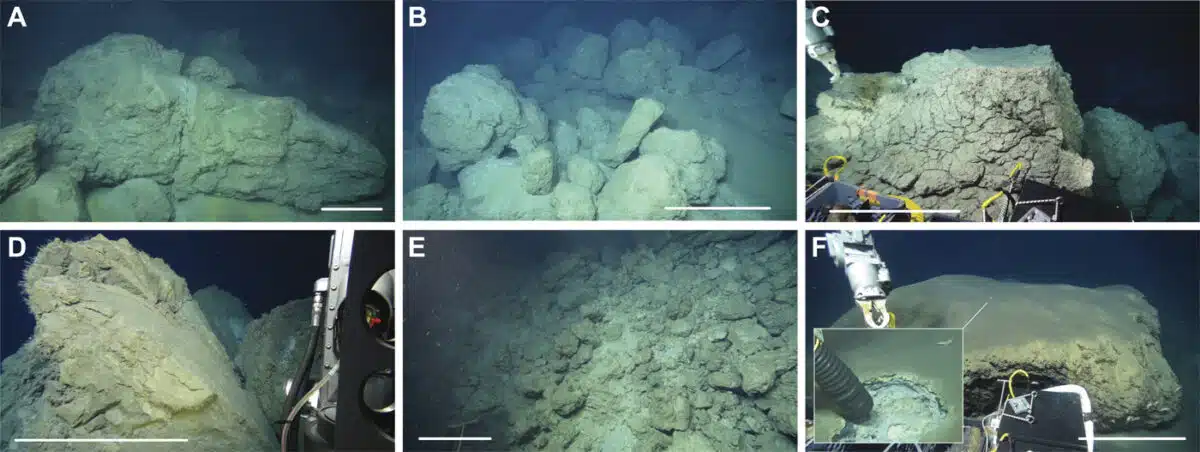
The Havre eruption involved 14 aligned vents that caused a “massive rupture” on the sea floor. The study published in Science Advances stated that scientists conducted around 12 surveys lasting 8-12 hours each to generate detailed maps of the area. These high-resolution surveys allowed the team to deploy a tethered remotely operated vehicle for direct observation of the eruption features and to collect physical samples.
The precision of these maps and observations has provided researchers with an unprecedented view of how large-scale submarine volcanic eruptions unfold. As volcanologist Rebecca Carey, from the University of Tasmani, explained:
“For the first time we are able to constrain exactly what happened, where it happened, at what depth, how much and how fast it erupted,” she explained.
Scale Comparable To The Largest Land Eruptions
the Havre eruption was roughly equivalent to the largest eruptions recorded on land in the 20th century. The eruption produced a vast pumice raft, which rose through the water column and was dispersed by wind and sea currents, spreading across hundreds of square kilometres of the ocean surface.
This event demonstrates that submarine volcanoes can produce eruptions of immense scale, challenging assumptions that such eruptions are typically smaller than their terrestrial counterparts.
“When this rock was produced by the volcano, it rose through the water column onto the sea surfaced and then it was dispersed by wind and sea currents.” said Carey,
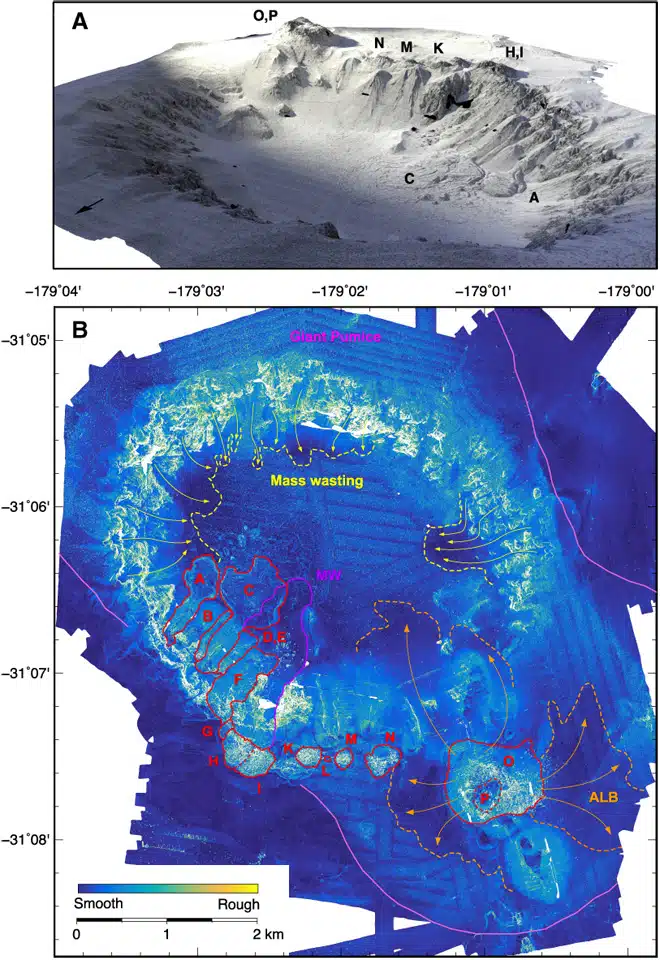
How Submarine Eruptions Shape The Ocean
Submarine volcanoes contribute both heat and chemical elements to the surrounding waters, which support diverse marine life. According to the source, studying the Havre eruption provides scientists with a detailed understanding of how these underwater eruptions affect ocean chemistry and ecosystems.
The researchers emphasized that insights from Havre will help probe fundamental questions about submarine volcanoes, including how they erupt and interact with their environment. Carey pointed out, the eruption is a “cornerstone event” because it enables quantitative analysis of underwater volcanic processes, offering a rare window into a largely hidden aspect of Earth’s geology.
First Appeared on
Source link






