


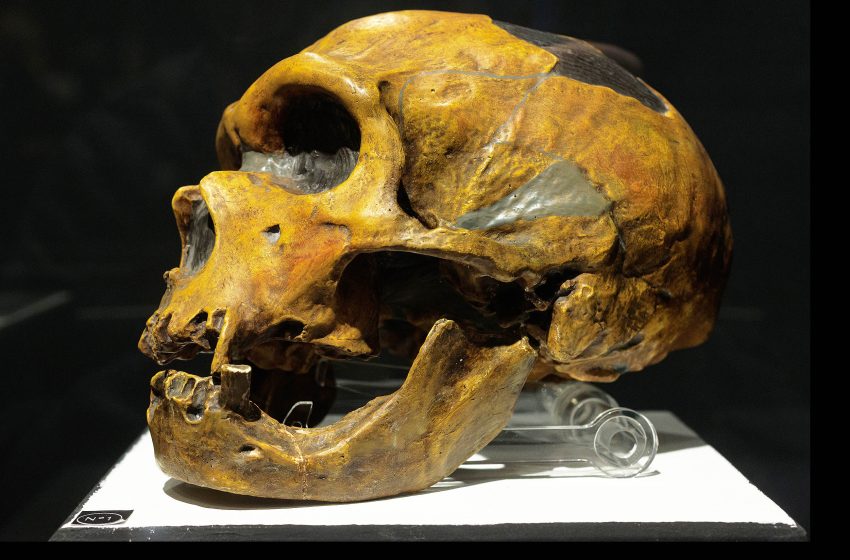
Scientists learn which Neanderthals mated with which humans
Most people with non-African ancestry carry a small amount of Neanderthal DNA scattered across their genomes. But there’s a long-standing mystery: the X chromosome is strangely empty of it.
For years, scientists assumed that natural selection scrubbed away harmful Neanderthal genes from that chromosome.
New research from the Tishkoff lab at the University of Pennsylvania points to a very different explanation – one rooted in who was mating with whom, revealing a strong sex bias in ancient interbreeding.
Rather than Neanderthal DNA being “toxic” on the human X chromosome, the pattern appears to reflect preferential mating between Neanderthal males and modern human females
The puzzle of the Neanderthal deserts
Geneticists have known for more than a decade that modern humans outside Africa inherited DNA from Neanderthals after our ancestors left the continent and met them in Eurasia.
Today, about one to two percent of the genome in people of non-African descent traces back to Neanderthals.
But that ancestry is uneven. Large stretches of the X chromosome are almost entirely missing Neanderthal DNA – regions researchers call “Neanderthal deserts.”
“Along our X chromosomes, we have these missing swaths of Neanderthal DNA we call ‘Neanderthal deserts,’” said Alexander Platt, a senior research scientist in the Tishkoff lab.
“For years, we assumed these deserts existed because certain Neanderthal genes were biologically ‘toxic’ to humans – as often happens when species diverge. We thought those genes may have caused health problems and were purged by natural selection.”
The explanation seemed straightforward. When populations remain separated for hundreds of thousands of years, genetic incompatibilities can build up.
If some Neanderthal variants disrupted fertility or health in mixed offspring, natural selection could remove them over time. The X chromosome – which plays a key role in reproduction – would be especially sensitive. But the scientists decided to flip the question.
What Neanderthal genomes reveal
If Neanderthal DNA was purged from the human X chromosome because of incompatibility, then the reverse should also be true. Modern human DNA should be rare on Neanderthal X chromosomes.
To test this, the researchers examined high-quality genome sequences from three Neanderthals: Altai, Chagyrskaya, and Vindija.
They identified segments of modern human DNA preserved in those Neanderthal genomes and compared the patterns to genomes from diverse African populations, who historically did not interbreed with Neanderthals and therefore serve as a useful control.
“What we found was a striking imbalance,” said study co-first author Daniel Harris, a research associate in the Tishkoff lab.
“While modern humans lack Neanderthal X chromosomes, Neanderthals had a 62 percent excess of modern human DNA on their X chromosomes compared to their other chromosomes.”
That mirror-image pattern is hard to square with the “toxic gene” hypothesis. If incompatibility were the problem, you’d expect both species to purge foreign DNA from their X chromosomes.
Instead, Neanderthals appear to have retained – and even enriched – modern human DNA on theirs. That result allowed the researchers to rule out simple reproductive incompatibility as the main driver.
Why mating patterns matter
The X chromosome behaves differently from the rest of the genome. Females carry two X chromosomes; males carry one X and one Y – so mating direction matters.
If a Neanderthal male mated with a modern human female, daughters inherited one X from each parent, while sons inherited their single X from the mother.
Over time, this pattern would limit Neanderthal X chromosomes entering the modern human gene pool, while allowing more modern human X chromosomes to move into Neanderthal populations.
The researchers found a clear sex bias: gene flow occurred mainly between Neanderthal males and anatomically modern human females.
This alone would reduce Neanderthal X chromosomes in modern humans without invoking harmful genetic effects.
Mathematical models confirmed that this bias could reproduce the observed genetic patterns. Other explanations – such as sex-biased migration – required more complex and shifting conditions across time and geography. Mating preferences provided the simplest explanation.
A more social view of evolution
Roughly 600,000 years ago, the ancestors of modern humans and Neanderthals split into separate lineages. Modern humans evolved in Africa; Neanderthals adapted to life in Eurasia. But the separation wasn’t permanent.
“Our ancestors evolved in Africa, while the ancestors of Neanderthals evolved in and adapted to life in Eurasia. But that separation was far from permanent,” Tishkoff said.
Over hundreds of thousands of years, populations moved, overlapped, and interbred. The new findings suggest that those encounters weren’t random.
Instead of evolution being driven solely by survival of the fittest, the researchers argue that social dynamics – who paired with whom, and perhaps why – left a lasting imprint on the genome.
In other words, some of the structure of our DNA may reflect ancient mating patterns as much as natural selection.
Uncovering ancient social structure
Now that the team has outlined the “who” and “how,” they are turning to the “why.” One clue may lie in comparing genetic diversity on the X chromosome with the rest of the genome – a contrast that could reveal patterns in Neanderthal social structure.
Did females remain with their birth groups while males moved between them? Or was it the other way around? By studying these ratios, researchers hope to uncover clues about gender roles and migration in Neanderthal society.
The larger takeaway is that the human genome is more than a biological archive. It preserves traces of social ties, movement, and encounters from tens of thousands of years ago.
The lack of Neanderthal DNA on our X chromosomes may not reflect biological incompatibility.
Instead, it could point to a consistent pattern of relationships between Neanderthal men and modern human women. Even in deep prehistory, evolution was shaped not only by survival, but by connection.
The study is published in the journal Science.
—–
Like what you read? Subscribe to our newsletter for engaging articles, exclusive content, and the latest updates.
Check us out on EarthSnap, a free app brought to you by Eric Ralls and Earth.com.
—–
First Appeared on
Source link






