



Scientists Rebuild Face Of Ancient American After 8,500 Years: The Results Are Jaw-Dropping
A newly published study in OrtogOnLineMag unveils the digitally reconstructed face of the Kennewick Man, one of the oldest and most debated ancient human skeletons ever discovered in North America. Using cutting-edge forensic techniques, researchers have pieced together the life-like appearance of a man who lived over 8,000 years ago, offering a rare glimpse into the distant past of early human migration.
A Window Into Ancient America
The Kennewick Man, named after the city in Washington State where his remains were discovered in 1996, has long stood at the center of a scientific and cultural debate. Found near the Columbia River, his bones have become one of the most complete and well-preserved skeletons from the early Holocene period. According to a detailed report by Sky News, researchers have now managed to reconstruct his facial features using digital imaging, allowing us to finally see what this ancient man may have looked like.
Lead author Cicero Moraes explains that the process involved a detailed digital analysis of the skull, guided by known averages of soft tissue thickness and anatomical data. “These references are based on large data sets, including medical imaging like CT scans,” Moraes stated. The final model was created by adapting the head of a digital donor to match the skeletal structure, a technique that results in a biologically accurate base model. As Moraes notes,
“Next, the head of a digital donor is anatomically adapted to match the structure of the Kennewick skull, allowing the face to be shaped in a way that follows realistic biological patterns. The result is a basic facial approximation.”
While the initial reconstruction is neutral and scientific, a second version includes speculative elements such as skin tone and hair to present a more lifelike vision.
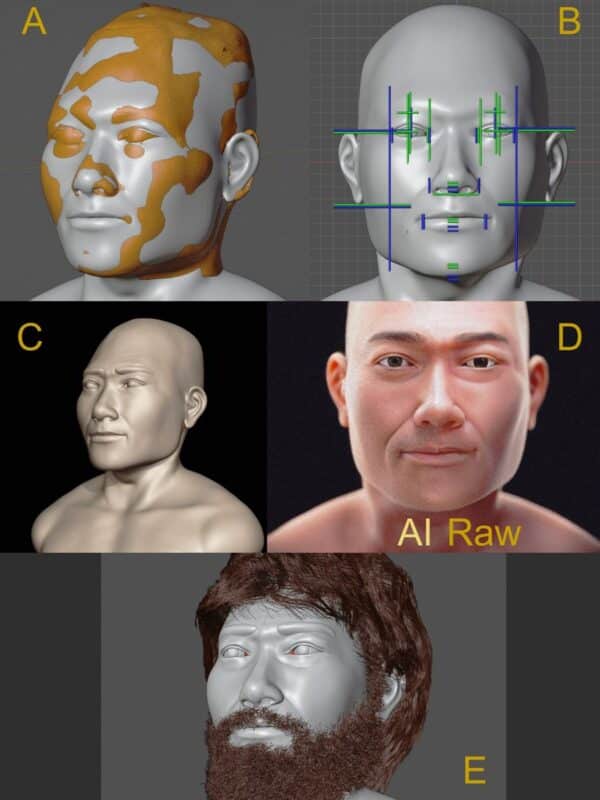
Signs Of A Hard Life
The reconstructed face tells only part of the story. What lies beneath reveals a life of hardship and endurance. According to the same study, the Kennewick Man exhibited multiple signs of serious physical trauma. “Throughout his life, the individual sustained multiple physical traumas, including a small cranial depression, fractured ribs, a fracture in the right scapula, and a significant spear projectile wound where the stone point remained embedded in his right ilium,” Moraes revealed.
The skeleton also showed signs of surfer’s ear, a condition caused by repeated exposure to cold water, suggesting that Kennewick Man regularly engaged with aquatic environments, likely as part of his survival. His teeth bore the marks of heavy wear, and his joints revealed signs of mild osteoarthritis. Yet despite these injuries, many of which occurred during early adulthood, he survived for years. The cause of his death remains uncertain, but Moraes pointed out:
“It is not known with certainty what led to his demise, but the injuries to the shoulder are identified as having occurred close to the time of death.”
These clues offer valuable insight into not only his life but the conditions faced by the earliest human inhabitants of the continent.
Rewriting The History Of Early America
The implications of the Kennewick Man go far beyond his reconstructed face. His remains have fueled a decades-long debate over the origins of the first Americans. At the heart of this discussion lies the question: were the continent’s earliest inhabitants the direct ancestors of today’s Native Americans, or were they part of a distinct and possibly extinct lineage?
Moraes suggests that this individual played a key role in refining theories about human migration in the Americas. The study, OrtogOnLineMag, supports the argument that Kennewick Man belongs within the Palaeoindian lineage, closely linked to modern Native American populations. This finding challenges earlier notions that he may have descended from an unrelated Eurasian group. As anthropologist Ann Kakaliouras noted in a 2019 article, the discovery marked “the end of a non-Indian ancient North America.”
A Glimpse Into The Past
Standing roughly 5 feet 8 inches tall and weighing between 70 and 75 kilograms, the Kennewick Man likely sustained himself on a diet rich in marine species and glacial meltwater. While many aspects of his life remain speculative, the combined scientific and forensic effort behind this study opens a new chapter in our understanding of early human existence on the continent. His 350 bone fragments now serve not just as relics, but as witnesses to a time long before written history.
The facial reconstruction may only be a digital approximation, but it draws us closer to a life lived under raw and unforgiving conditions—a face emerging from prehistory to remind us how far we’ve come.
First Appeared on
Source link






