


Scientists Reconstruct The Face of a 3.7-Million-Year-Old Human Relative : ScienceAlert
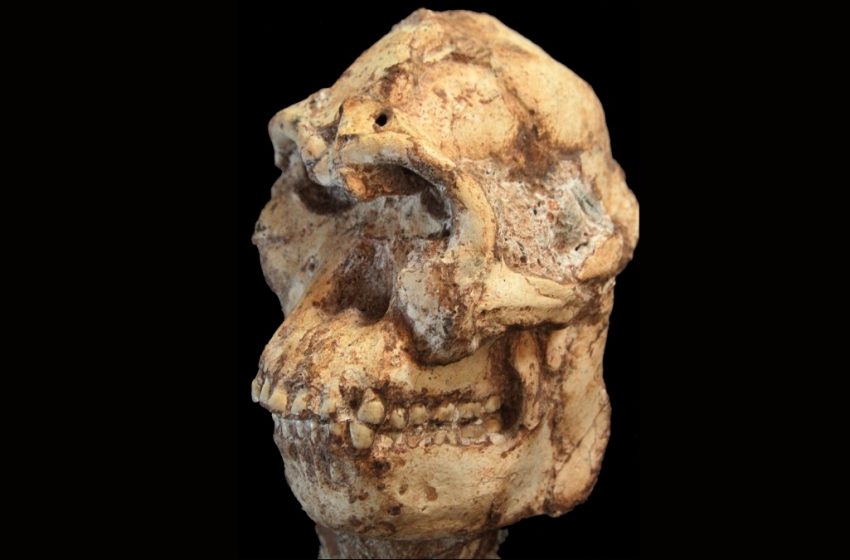
Scientists have reconstructed the face of one of the most famous hominin fossils.
Affectionately known as ‘Little Foot‘, the 3.67-million-year-old Australopithecus specimen is strikingly complete, despite the skull being crushed and deformed after eons encased in heavy concrete-like rock.
A new study, led by paleoanthropologist Amélie Beaudet at the Université de Poitiers in France, has now digitally pieced together Little Foot’s face for the first time.
The team then analyzed the reconstruction and compared it to other hominids and apes, helping to fill in some gaps in the evolutionary history of our face – and those of our ancient relatives.
Little Foot was originally discovered in 1980 in Sterkfontein Cave in South Africa. As the nickname suggests, the first traces were four small ankle bones. It wasn’t until the 1990s that scientists discovered the rest of the skeleton embedded in the cave wall – and then it took another 15 years to carefully extract it from the tough rock.
The specimen is generally attributed to Australopithecus, but it’s been tricky to pin down exactly which species it belongs to. That’s at least partly because the skull has been squashed and fractured by the movement and pressure of its rocky tomb over millions of years.
So for the new study, the team set out to return the skull to its original shape. X-ray micro-CT scans were conducted at the Diamond Light Source, a synchrotron facility in the United Kingdom, producing a digital 3D recreation with a high resolution of 21 micrometers.
Next, the bones and teeth were virtually separated from the surrounding rock. The skull was divided into five ‘blocks’ which were moved around the 3D model like a jigsaw puzzle, in the hopes of slotting them back into their original positions.
The team then identified and measured ‘landmarks’ on the reconstructed skull, analyzed the shape, and compared it to the skulls of other Australopithecus specimens, as well as modern human, gorilla, chimpanzee, and orangutan skulls.

It turns out that even though Little Foot was found in southern Africa, the size and shape of its skull have more in common with Australopithecus specimens from eastern parts of the continent.
However, it does seem to have distinctly shaped orbital regions (its eye sockets) compared to other specimens, which could tell us more about its evolutionary history.
“Evolutionary pressure might have acted specifically on the orbital region in southern African Pliocene hominins, perhaps in conjunction with environmental instability leading to food resources becoming scarce and more difficult to spot or fallback foods requiring specific visual capacities,” the scientists write.
Related: ‘Lucy’ Was Neighbors With an Even Older Human Ancestor, Fossils Reveal
But as with any research on the murky history of hominins, the team cautions that it’s tricky to draw solid conclusions, for a number of reasons.
Exactly which species Little Foot belongs to remains up for debate: it might even be a new one. There could be significant differences between males and females of the same species, which are muddying the waters in attributing specimens.
And the researchers admit that their own reconstruction “is preliminary and could likely be refined in the future,” with some deformations unable to be corrected. This kind of further work could help bring the faces of our ancient relatives into clearer focus.
The research was published in the journal Comptes Rendus Palevol.
First Appeared on
Source link






