


Scientists Say Light Particles Traveling Through Brain Tissue Could Be Carrying Consciousness
For decades, our picture of the brain has been built on two pillars: the electrical nature of nerve impulses, recognized by the late 19th century, and chemical synaptic transmission via neurotransmitters, discovered in the mid-20th century. Together, they form the foundation of modern neuroscience. But a growing body of research is now pointing toward something else entirely, a so-called biofield, generated by neurons themselves, that may also be involved in how information moves through the brain.
A Third Pathway Nobody Saw Coming
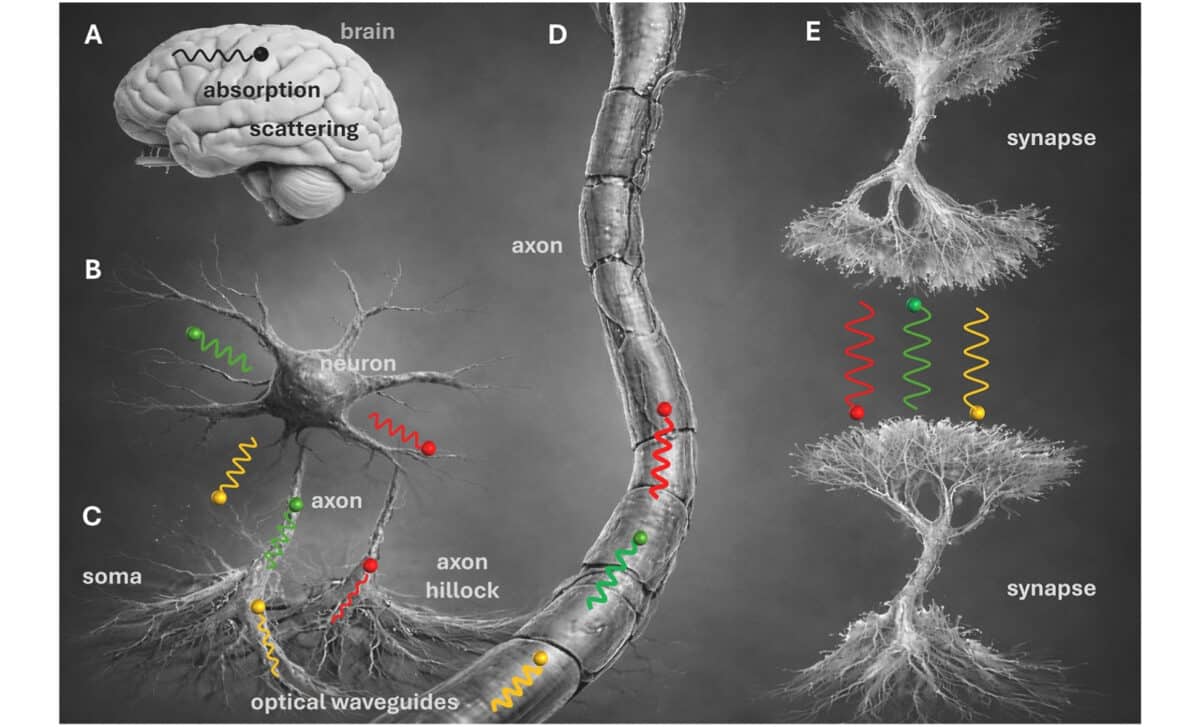
The idea that the brain might emit light sounds, at first, like the kind of claim you’d find on a wellness blog. But the science behind it is more grounded than you might expect. Nervous tissue does, in fact, emit biophotons. That much has been established. What Pospíšil and Prasad are now arguing is that these biophotons, being light, theoretically carry the same quantum properties as any other photon, superposition, coherence, entanglement and all.
According a review article published in the journal Biophysics and Molecular Biology, authored by Pavel Pospíšil and Ankush Prasad from Palacký University in the Czech Republic, “biophotons might mediate ultrafast interactions between neurons occurring at the speed of light.” If that’s true, it would represent a fundamental shift in how we understand neural communication, not a replacement of the electrical-chemical model, but an addition to it. A hidden layer that has been there all along, just waiting for the right tools to detect it.
The Quantum Problem in a Warm, Messy Brain
Here’s where things get genuinely complicated. Quantum phenomena are notoriously fragile. Nearly all quantum science is conducted at temperatures close to absolute zero, precisely because thermal noise causes decoherence, a breakdown of the quantum state. The human brain, operating at temperatures nearing the triple digits in Fahrenheit and packed with chemical and structural interference, is about as far from a quantum laboratory as you can get.
The authors don’t shy away from this. They acknowledge that “any quantum-mediated signaling in neural tissue remains highly speculative and likely limited to very short distances.” Yet they also cite experimental studies showing that polarization-entangled photon pairs can retain their quantum correlations after passing through thin slices of brain tissue up to 400 micrometers thick. It’s a narrow finding, but it’s not nothing.
The middle step, keeping quantum information intact during transit through the brain, remains the hardest to crack. Encoding information into the quantum state of a biophoton is theoretically possible. Decoding it at the other end is theoretically possible. Surviving the journey in between? That’s the part no one has solved yet.
Consciousness, the Hard Problem, and Why This Matters
As reported by Popular Mechaniscs, the reason any of this carries such weight goes back to what scientists call the “hard problem” of consciousness. Neuroscientists can explain, in impressive detail, how the brain uses electrical and chemical signals to carry out biological functions and engage in both voluntary and involuntary reasoning. What they cannot explain is subjective conscious experience, the raw feeling of what it’s like to be you, reading this sentence, right now.
This gap is old. As far back as 1989, physicist Roger Penrose hypothesized that consciousness might have an undiscovered quantum element. The debate has never fully gone away, even as critics, including Stephen Hawking, have argued that combining two scientific mysteries (consciousness and quantum field theory) doesn’t produce a scientific certainty, and amounts to a kind of Holmesian fallacy.
According to Pospíšil and Prasad, the biofield hypothesis, while admittedly speculative, holds enough scientific merit to warrant serious investigation. They call for future research that moves “beyond purely correlative observations by identifying the conditions under which biophoton emission could meaningfully influence neural activity.” The tools to do it, they suggest, may already exist, photomultiplier tubes, charge-coupled device cameras, and advanced computational modeling could all contribute to testing these hypotheses more rigorously.
Whether light really is the missing piece of the consciousness puzzle remains an open question. The science is alive, and scientists are no longer willing to assume that neurons alone hold all the answers.
First Appeared on
Source link






