



Scientists Say This Popular Gym Supplement Could Be an Unexpected Key to Fighting Dementia
A dietary supplement once confined to the world of bodybuilding is drawing attention in a completely different field: neurodegenerative diseases. A recent study suggests that HMB, widely used to enhance muscle recovery, might have unexpected effects on the brain, particularly in slowing the progression of Alzheimer’s disease.
Researchers in the United States have revealed that this compound could reduce the build-up of toxic proteins in the brain and support memory function. The results, while preliminary, offer a glimmer of hope for millions affected by dementia worldwide.
A Sports Supplement Under the Scientific Spotlight
The beta-hydroxy beta-methylbutyrate, or HMB, has long been a staple in athletic circles. Known for its muscle-preserving properties, it is frequently taken by bodybuilders and fitness enthusiasts to aid in recovery and performance. But its potential role in protecting cognitive function is a relatively new and unexpected avenue.
According to research conducted by the Rush University and the Simmaron Research Institute, HMB may help preserve regions of the brain linked to memory and learning. This finding emerged from experiments on mice exhibiting Alzheimer’s-like symptoms. The study, published in Cell Reports, showed that HMB reduced the accumulation of amyloid plaques, a hallmark of the disease. These deposits, typically associated with the decline in memory and cognitive function, were visibly diminished in the HMB-treated mice.
The lead author, Dr. Kalipada Pahan, emphasized the significance of the results, stating that this approach “could be one of the safest and simplest” ways to help slow the disease’s progression. His remarks, cited by Futura Sciences, highlight the low-risk profile of the supplement, which is already considered safe for long-term use in humans in the context of muscle development.
How Hmb Acts on the Brain
The therapeutic interest in HMB lies in its dual action. First, it enhances the production of neurotrophic factors, proteins that ensure proper neuron function and are typically found in lower quantities in Alzheimer’s patients. Second, it targets the physical markers of the disease. According to the same study, the supplement led to a reduction in both amyloid plaques and neurofibrillary tangles, the twisted fibers that also characterize Alzheimer’s degeneration.
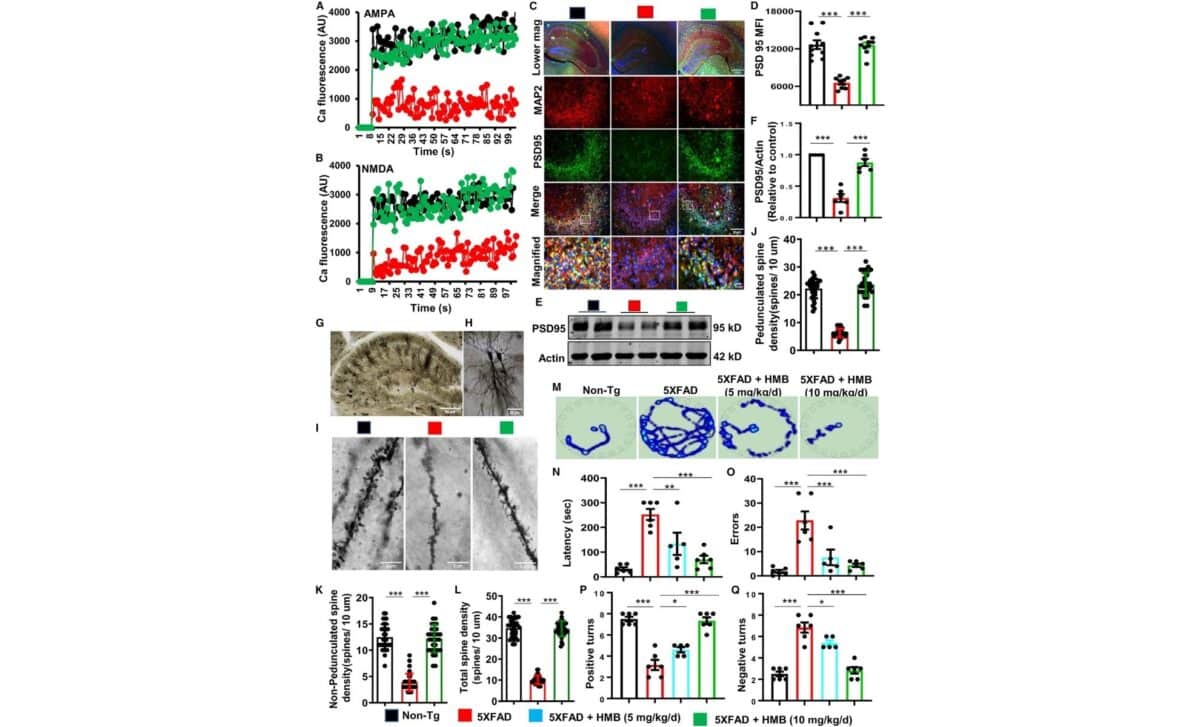
Dr. Pahan explained that the supplement, when administered orally, reaches the brain and directly stimulates the production of beneficial proteins. These proteins play a key role in restoring neural connections and improving both learning and memory capabilities in the test subjects.
Another interesting mechanism involves HMB’s interaction with PPARα, a receptor involved in the brain’s fatty acid metabolism. This interaction, as outlined by the researchers, might be one of the underlying processes explaining the observed neuroprotective effects. This aspect of the supplement’s action adds another layer of scientific interest and strengthens the case for future human trials.
Caution and the Next Steps in Research
While the study’s findings are promising, the researchers are careful not to draw premature conclusions. HMB’s positive effects have so far only been observed in animal models, and significant work remains to be done before translating these results to human treatment. The path from laboratory research to clinical application is long and complex, requiring extensive validation.
Still, the fact that HMB is already widely used and deemed safe gives it a head start. Its accessibility and existing approval for other uses could simplify the regulatory steps needed for testing its impact on cognitive disorders. According to the team behind the study, future investigations will aim to better understand the mechanisms at play and to determine the optimal dosage and treatment duration for potential use in patients.
First Appeared on
Source link






