


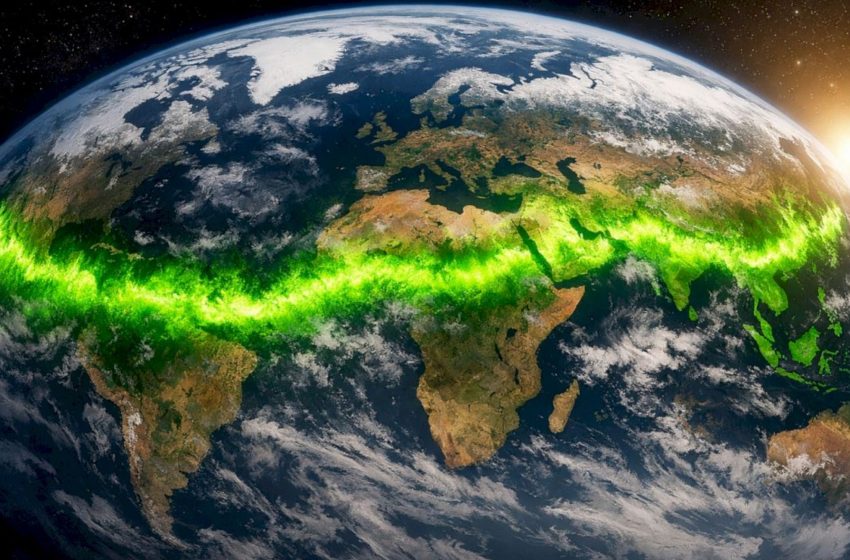
Scientists ‘weighed’ Earth’s total vegetation with disturbing results
Earth’s vegetation has shifted measurably northeast over recent decades, relocating the global center of the planet’s seasonal green growth.
The finding reveals that the living surface of the planet is reorganizing in response to environmental change, altering where the biosphere’s yearly pulse now concentrates.
Earth’s vegetation is moving
Decades of satellite observations show that the planet’s annual wave of plant growth forms a moving balance point across continents and seasons.
Analyzing that shifting balance, Prof. Miguel D. Mahecha, an environmental data scientist at Leipzig University, demonstrated how the center of global vegetation has steadily migrated northeast.
Year by year, the position of this global green center has drifted farther from its earlier trajectory while maintaining the same seasonal cycle between hemispheres.
That steady displacement compresses a complex planetary pattern into one measurable signal, opening the door to explaining what forces are pushing the biosphere’s center of activity across the map.
Where the wave travels
Each year brought Earth’s vegetation balance point north in summer and south in winter, tracing a regular loop over land.
Seasonal sunlight drove the green wave, the planet’s yearly sweep of leaf growth, from north to south and back.
Mid-July put the balance point near Iceland, while late February, sometimes early March, parked it off Liberia on Africa’s west coast.
Because that loop stayed measurable, the new metric could reveal subtle changes even when local greening looked noisy.
Turning leaves into mass
To make the motion comparable across years, the team treated leafier areas as heavier parts of the planet.
That weighting created a center of mass, a balance point if all leaves had weight, for every day in the record.
“If you then carefully place this globe into calm water, the centre of mass will always point downward,” said Mahecha.
Once the team had that daily point, they could compare seasons, decades, and even different vegetation measures on the same map.
An eastward surprise
Beyond the north-south swing, the center’s route also moved east over time, pointing toward a changing global pattern.
Greening hotspots in India, China, and Russia added extra pull in that direction, because dense leaves tipped the balance.
Mahecha later said the persistent eastward movement of the vegetation center surprised the research team because the trend remained consistent across multiple datasets and seasonal cycles.
Untangling why the eastward pull grew will take deeper regional work, since farming, forests, and climate all play roles.
CO2 feeds Earth’s vegetation
One satellite-based analysis linked recent global greening, a rise in vegetation density seen from space, to higher CO2.
Extra CO2 can let plants make more sugars during photosynthesis, because carbon becomes less scarce inside leaves.
Longer growing seasons and intensive land management also raised leaf cover in many regions, especially where water stayed reliable.
Those boosts came with limits, since drought, wildfire smoke, and extreme heat can slow growth or kill plants outright.
Northern lands dominate
Northern Hemisphere land makes up most of the planet’s vegetated area, so its changes weigh heavily on the global balance.
A recent report described widespread earlier spring growth and later fall slowdowns as temperatures rose.
In the new tracking work, the green center kept moving north even during the Southern Hemisphere summer, not south.
That one-sided pull helps explain why the north-south swing has started shrinking, which could affect seasonal timing worldwide.
The pace speeds up
Recent decades showed the fastest motion, with the green center racing north during the months it usually sits farthest south.
From 1983 to 2021, the long-term northward drift ran roughly 1 to 1.5 miles each year. After 2010, the southern-season position jumped north by about 9 miles per year, far above earlier decades.
Such acceleration means farms, forests, and wildlife face faster calendar changes than planners expect, raising flags for models and monitoring.
What models show next
To see where the compass might point next, the team ran the same tracking method on climate simulations.
Six Earth system models, computer simulations linking climate with land and oceans, reproduced the broad north-and-east drift.
Higher-emissions futures pushed the track farther east than north, suggesting regional leaf gains could outweigh pure temperature effects.
Wide gaps between models remained, so the compass will need real-world observations to stay honest.
The same math could track more than greenery, since any global map with ups and downs has a balance point.
Ocean color, snow cover, and heat patterns could each form their own moving center, letting scientists compare systems side by side.
Linking that motion to droughts, fires, or grazing could show which pressures nudge the global signal most.
As the data stream grows, a single moving dot may become a quick health check for the planet’s living surface.
Watching a living planet
Following the moving center turns the planet’s yearly plant rhythm into something you can track in miles and direction.
Better local measurements and sharper models will decide whether the northeast drift keeps accelerating or starts to stall.
The study is published in Proceedings of the National Academy of Sciences.
—–
Like what you read? Subscribe to our newsletter for engaging articles, exclusive content, and the latest updates.
Check us out on EarthSnap, a free app brought to you by Eric Ralls and Earth.com.
—–
First Appeared on
Source link






