


Should kids miss school for travel? Inside the growing parenting rebellion over perfect attendance.
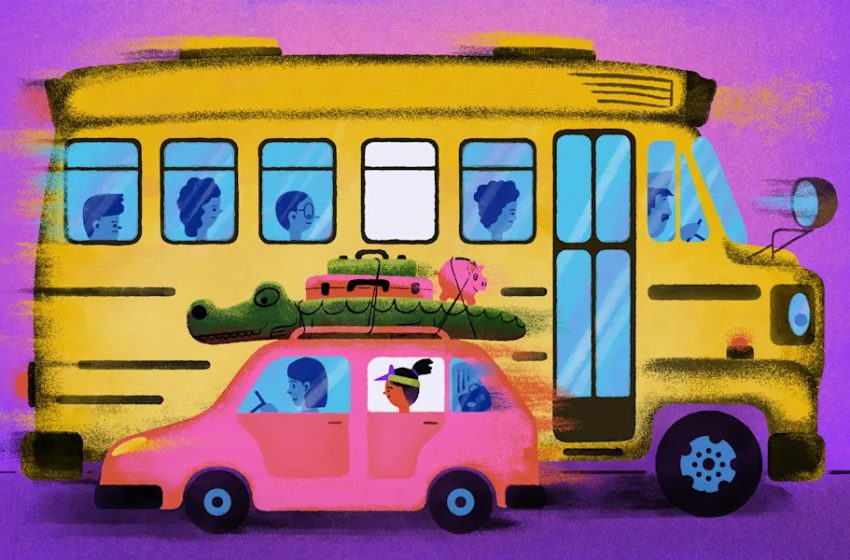
School is in session. Some families are going on vacation anyway. (Illustration: Golden Cosmos for Yahoo News)
Walk around Disneyland or Dollywood during a weekday in, say, early November, and you’ll see school-age children seemingly everywhere. With no school holidays in sight, how could this be? Are they playing hooky? School trip? Nope: It’s parents pulling their kids out of school — and picking experiences and good deals over perfect attendance.
More parents than ever (myself included) take their kids out of school multiple times per year in order to travel. For me, it’s not about theme park trips; it’s about education that goes far beyond the boundaries of our school zone or even our state. I have brought my kids to Morocco in October, Iceland in mid-March and Portugal in November. And I’m not alone in prioritizing school-year travel: A 2025 report from the travel company Zicasso found that more families than ever are booking trips (largely educational ones) during the school year. Requests for family trips in May, for example, more than quadrupled between 2023 and 2025, according to their data.
But school-year travel isn’t just for enrichment; it’s also because the modern school calendar has become financially (and, frankly, emotionally) unsustainable for many parents. With peak holiday airfare and hotel costs pricing families out of travel during school breaks, many find that a midweek break in early February might be the only affordable option. A spring break trip in 2025, for example, cost an average of $8,306, more than twice the price in 2019, according to Bloomberg.
Still, this travel trend comes with plenty of pushback over unexcused absences. (I, for one, bargained with my son’s public school attendance counselor by doing a presentation for the kids about travel journalism as an unofficial makeup for his too many absences.) Attendance rules are in place for a reason, which is largely to protect the most vulnerable students and ensure they have access to essential services. And chronic absenteeism — which, according to the American Enterprise Institute’s June 2025 report, has increased by 57% since the pandemic — can become a real problem.
But is perfect attendance still the benchmark for success? Is pulling a child out of school for travel a meaningful rejection of achievement culture, or just another form of privilege dressed up as enrichment?
Ahead, parents explain why they’re opting out of perfect attendance, as educators wrestle with the consequences for classrooms.
The logic behind attendance rules
Hezekiah Herrera, who holds a doctorate in education and works as a K-12 special education teacher, tells Yahoo that truancy laws were created to protect children from being forced to work, often in exploitative conditions, “and to ensure that children from marginalized communities were not quietly removed from the educational system.” He believes that the school-year-travel trend is “weakening those standards for the sake of vacation,” which could potentially “undermine the legal leverage that ensures vulnerable students attend school to receive the meals, safety and support services they rely upon.”
“In theory, travel is a way to break the mold of traditional education,” Herrera adds. “In reality, however, for many affluent families, travel has become yet another component of the ‘arms race’ of childhood achievement.”
Early childhood specialist and educator Janice Robinson-Celeste isn’t quite convinced. She’s a mom and grandmother and also runs the magazine Successful Black Parenting. “The fairness debate is complicated,” she admits, “because attendance rules weren’t designed with families vacationing in Egypt in mind. They grew out of concerns about lower-income children who need access to school-based meals, transportation and supervision. Those are real needs.” That said, “punishing a kid who was abroad learning ancient history firsthand with ‘no ice cream social for you’ feels antiquated.”
In theory, travel is a way to break the mold of traditional education. In reality, however, for many affluent families, travel has become yet another component of the ‘arms race’ of childhood achievement.
Why parents pull kids out of school to travel
While attendance regulations are in place for good reason, parents and educators alike agree that there should be exceptions. For example, no student should be penalized for taking mental health days or having a chronic medical condition that necessitates multiple absences. Nor should parents be pressured to push kids to attend school while sick, simply in hopes of achieving that sought-after, totally arbitrary perfect attendance award. To this list, many parents would like to add the argument that available learning opportunities outside school walls should count as excused absences, too.
“When done thoughtfully, missing some school for travel can be incredibly educational,” says Robinson-Celeste. Even as an educator, she is not immune to the school-year-travel pull: “We’re ‘guilty’ too,” Robinson-Celeste admits; she’s about to take her granddaughter out of school for a pre-spring break trip. Why is it worth it? “Children who experience new cultures in real time expand their vocabulary, curiosity and confidence in ways that are hard to replicate in a classroom,” she says. “They’re not just reading about history or geography; they’re walking through it, tasting it and talking to it. For me, opting out of perfect attendance is worth it when the trade-off is meaningful, once-in-a-lifetime learning. (Whether or not a visit to the “It’s a Small World” boat ride at Disney World counts as essential cultural exposure is open to discussion.)
And school-year travel means more affordable travel. “We take our kids out of school for one week every year,” says stay-at-home mom of three Christina Mott. “I’m not interested in paying peak prices and spending the day standing in long lines. When we go in February or March, it’s a completely different experience. … We get value for our money, and with how expensive everything is right now, that matters.”
Robinson-Celeste agrees, noting that school-break price hikes from airlines and hotels “penalize families who follow the school calendar. Midweek travel in January isn’t rebellion; it’s affordability. The travel system and the school system weren’t built with real family budgets in mind.”
The downsides
Of course, there are pitfalls to this approach, many of which are practical: Editor and mom of two Sarah Stocking says her school-year kid trips mean that they’ve “missed fun school events that weren’t scheduled yet when travel was booked.” I’ve experienced this myself: My son’s school kindly allowed him to participate in his school spelling bee over Zoom from Maui at 4 a.m. (alas, he did not win). Writer Joy Ramirez, a mom of one, says she used to do school-year travel, but now that her high-school age daughter has more academic demands, “there are repercussions. … I don’t think she can do it anymore.”
Then there’s the equity issue. While in theory Herrera is not against the “worldschooling” trend, it “is creating a new disparity in privilege,” he tells Yahoo. “When we allow students to opt out of school attendance based solely on parental wishes, we overlook the protections that attendance policies provide to some of our most vulnerable students.” Meanwhile, “affluent students can use a buffer of wealth (i.e., access to tutors/highly educated parents) to mitigate the lost learning from a week of school in Greece, while low-income students cannot.”
I’m not interested in paying peak prices and spending the day standing in long lines.
Herrera adds that, for students with disabilities or learning difficulties, the fallout from missing school means they’re also missing speech therapy, occupational therapy and more. “When a family pulls a child with an IEP [individualized education plan] out for a week of travel, they are not simply putting their child’s education on pause; they are essentially resetting their child’s educational progress,” says Herrera. “The amount of time that it takes to recoup the losses experienced by students with intellectual disabilities is time that they cannot afford to lose.”
But perhaps the most unexpected outcome of kids missing school for travel is the spillover effect of “classroom churn.” Research conducted by Michael Gottfried in 2019 demonstrates that absenteeism has had a negative impact on the education of students who are present in the classroom. This, Herrera explains, is largely “because the instructional time is spent on remediation when a teacher has to reteach material to a student who returns from a trip.”
This can be additionally problematic because, of course, the students most entrenched in poverty often can’t afford to travel at all. In that way, “travel experiences of affluent families are often framed as a superior form of learning that converts missed school time into cultural capital,” says Herrera, while “families who depend on the school system for basic literacy and child care are left in a fractured educational setting.”
Herrera urges parents to remember that, “if we believe in the value of public education as a collective good, we need to admit that choosing to opt out of school, even for educational travel, undermines the system for students whose families cannot opt out.”
Finding a middle ground
So, with so many of us feeling conflicted on the benefits vs. pitfalls of school-year travel amid rising costs, where do we go from here? Herrera has some ideas. “Rather than blaming parents for seeking out ways to travel affordably, districts should explore balanced school calendars (e.g., 45 days of school followed by 15 days off),” he suggests. A more balanced calendar could distribute breaks throughout the year so that families can travel during the “offseason” without losing instructional time or competing with all other families for travel opportunities during the same summer weeks.
Overall, parents and educators alike are rethinking what a good education means, says Robinson-Celeste. “Between academic pressure and post-pandemic mental health concerns, families are asking, What will my child actually remember 10 years from now?” And for many who are lucky enough to have the means to travel, even on a budget — myself and Robinson-Celeste included — perfect attendance isn’t usually the answer. “Experiencing another culture or mastering a subway system in a foreign country might be,” she concludes.” And kids come back more confident, more flexible and more socially aware.”
Ultimately, Robinson-Celeste says, “schools were built to serve children and communities, not the other way around.” If colleges can award credits for experiences such as study abroad, shouldn’t we be able to imagine some version of that for K–12 students?
First Appeared on
Source link






