


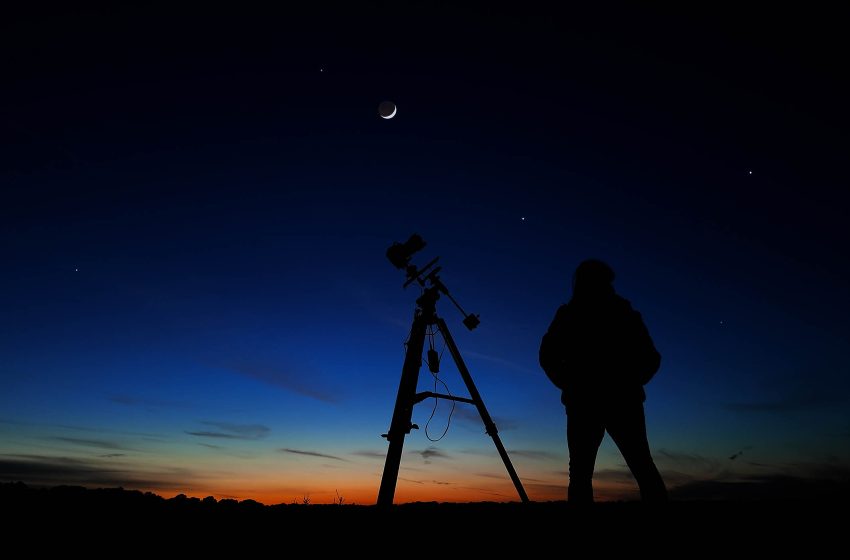
Six planets will align in a rare ‘planetary parade’ tonight
Skywatchers have an unusual opportunity this weekend to observe six planets positioned so they rise above the horizon at the same time.
Often called an planetary parade, the event will appear just after sunset on February 28, 2026. This configuration is uncommon, though not exceedingly rare.
“On most nights, weather permitting, you can spot at least one bright planet in the night sky,” noted NASA.
“While two or three planets are commonly visible in the hours around sunset, occasionally four or five bright planets can be seen simultaneously with the naked eye.”
What is a planetary parade?
A planetary parade happens when several planets appear close together in the sky from Earth’s point of view.
The planets do not actually move into a straight line in space. Instead, the alignment is something humans see because of the angle from Earth.
Dr. Becky Smethurst, Royal Astronomical Society Research Fellow at the University of Oxford, told BBC that the planets “will be in a straight line, but it’s a straight line on a curved sky, all the planets orbit in the same flat plane.”
“If you think about taking a bowl of pizza dough and setting it spinning above your head, it flattens out.”
“That’s what happened to the gas cloud around the Sun that ended up forming the planets, and why they’re all in the same flat plane.”
So, the parade is really about perspective. Earth’s position makes the planets look grouped together, even though huge distances still separate each world in space.
Which planets will be visible?
Six planets will be visible in the evening sky. Mercury, Venus, Saturn, and Jupiter will be bright enough to see with just your eyes.
Uranus and Neptune will be much dimmer, so binoculars or a telescope will make them easier to find.
Right after sunset, look toward the western horizon. Mercury, Venus, Saturn, and Neptune will appear low in the sky.
Make sure you have an open view, especially for Mercury and Venus, because both will sit very close to the horizon.
Uranus will appear higher in the sky in the constellation Taurus and will stay visible until about midnight. Jupiter will be the easiest to see. It will shine brightly in the constellation Gemini and remain visible for most of the night, even in places with city lights.
It’s not a single-day event
“Planet parades aren’t single-day events, as the planets move too slowly for that. Generally, multi-planet viewing opportunities last for weeks to a month or more,” noted NASA.
According to the Star Walk app, the planets will appear most closely grouped on February 28, although the best date depends on your location.
“We will have lost Mercury in early March, but on March 7 and March 8, Venus and Saturn are going to be very close together on the sky, making it easier to spot both of them,” Dr. Smethurst told BBC.
A seven-planet parade, which includes all major planets visible at once, is much more rare. One took place in February 2025, and another will not happen for many years.
Viewing the planetary parade
The planets will trace a gentle arc along the ecliptic – the same path the Sun follows across the sky – so a location with an unobstructed view to the west is essential.
Beaches, hilltops, open fields, or rooftops away from tall buildings and trees will give you the best chance of spotting the lower planets, especially Mercury and Saturn, which will sit closest to the horizon and set quickly.
Arriving 20 to 30 minutes after sunset strikes a good balance: the sky will be dark enough for planets to stand out, but not so dark that the lowest ones have already dipped below view.
You won’t need special equipment to see the brightest planets. Venus and Jupiter will shine clearly to the naked eye, easily outshining surrounding stars.
However, binoculars will dramatically improve the experience, helping you pick out dimmer worlds like Uranus and Neptune and revealing more detail in the brighter ones.
If you use a smartphone astronomy app, switch to its red-light mode to preserve your night vision. Give your eyes at least five to ten minutes to adjust to the dark before scanning the sky.
—–
Like what you read? Subscribe to our newsletter for engaging articles, exclusive content, and the latest updates.
Check us out on EarthSnap, a free app brought to you by Eric Ralls and Earth.com.
—–
First Appeared on
Source link






