


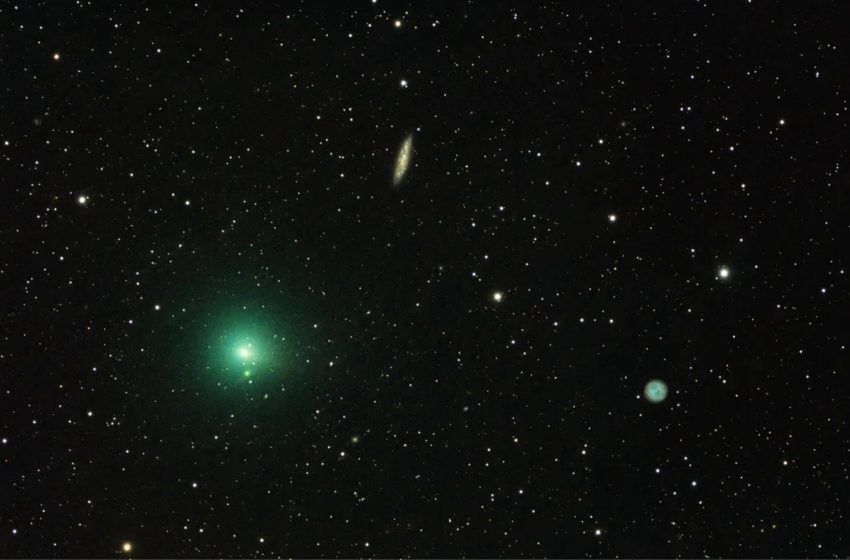
Small comet seen stopping its spin, then restarting in reverse
Scientists have observed a small comet (Comet 41P) that stopped spinning completely and then started up again, but in the opposite direction.
This unexpected reversal reveals how quickly these icy space objects can change, and it may help explain why some small comets eventually break apart and vanish.
Hubble sees Comet 41P flip
Archived images from the Hubble Space Telescope, a powerful observatory that orbits Earth and captures detailed images of distant objects in space, tracked Comet 41P/Tuttle-Giacobini-Kresak as it brightened and dimmed on a steady schedule.
By timing repeats, Dr. David Jewitt at the University of California, Los Angeles (UCLA) built a rotation clock from the changes in brightness.
Jewitt’s preprint reported a 14.4-hour period for the comet in December and placed the spin stall in early June 2017.
Brightness cycles alone cannot reveal spin direction, so only new observations can confirm which way the comet now turns.
Numbers that broke records
Ground-based telescopes watched the comet’s spin stretch from 20 hours in March 2017 to more than 46 hours by May.
A letter reported that the slowdown in 60 days was more than ten times larger than seen in any earlier comet spin cases.
Earlier, another comet set the benchmark when its rotation period stretched from 17 to 19 hours over 90 days during detailed imaging.
“It’s not uncommon for a comet’s rotation to change,” said Dr. Jewitt.
Spinning core of Comet 41P
At roughly 0.6 miles (0.97 kilometers) across, the comet’s solid body offered little resistance when jets started pushing on it.
Each burst of gas delivered torque, a twisting force that changes spin speed, because the escaping flow did not balance out.
Less mass meant the same twisting force changed the rotation far faster than it would on a larger comet.
Over time, that sensitivity can turn a small core into an object that either calms down or tears itself apart.
Sunlight makes gas jets
Sunlight warms the surface and drives ice to vanish into gas, feeding the plumes that stream off active comets.
Scientists call that escape sublimation, ice turning straight into gas without melting, and it begins when the surface warms.
Along with gas, the jets carried dust, and the flow pushed back, adding twist whenever vents aimed off-center.
Unlike a solid rock asteroid, a loosely packed comet can respond so strongly that its spin state changes in weeks.
Comet spin and active vents
Active vents were not spread evenly, so the strongest jets pushed from one side and set the twisting direction. As the comet turned, sunlight moved across cliffs and pits, turning some jets on and others off.
When most thrust worked against the existing spin, the rotation slowed, and a later realignment could rebuild spin the other way.
Even small changes in where sunlight hits can flip the sign of the twist, making predictions hard from Earth.
Fast spin can break a comet
Rapid changes in spin can do more than confuse astronomers – they can strain a comet until it cracks.
With each faster turn, material near the surface feels a stronger outward pull, and weak rubble can start sliding.
In the new analysis, the measured torques were strong enough that the comet could break into pieces within a few decades.
Once fragmentation starts, the gas and dust cloud can hide the surviving core, leaving observers unsure what is actually left.
Old surfaces change torque
Past trips near the Sun likely carved away ice from the comet and left a tougher crust that redirected where gas escaped.
By 2017, far less of the surface seemed to vent strongly than in earlier returns, which changed the balance of jets.
One possibility fits the numbers and the look of the comet: that Comet 41P is a surviving shard from a larger parent.
If that history is correct, the same thinning process may feed weak, off-center vents that keep changing the spin state.
2028 return of Comet 41P
Another close pass will arrive in 2028, giving astronomers a chance to check whether the comet kept changing.
That moment is called perihelion, the closest point in orbit to the Sun, and heat-driven jets usually peak then.
Worse viewing angles may hide the solid core in its gas cloud, but large telescopes can still track changes.
Clear measurements in 2028 would show whether the forces faded after 2017, or whether the comet is still unstable.
A clue for lifetimes
Spin-driven stress offers a practical way to lose small comets, even when their orbits keep them returning for centuries.
In Jewitt’s view, the wear-out time from spin-up looked much shorter than the time 41P had stayed in place.
For sky surveys, that mismatch means many small comets may vanish before anyone measures them well enough to model.
Future monitoring could sort out whether Comet 41P is an oddball, or whether rapid spin changes quietly shape the comet population.
Next tests and risks
Seen end to end, the comet’s spin story ties tiny size, uneven jets, and fragile structure into one chain reaction.
Repeated checks at the next return will show whether this behavior fades, or whether 41P is headed toward breakup.
The study is published in The Astronomical Journal.
Photo credit: Kees Scherer/Flickr, CC0
—–
Like what you read? Subscribe to our newsletter for engaging articles, exclusive content, and the latest updates.
Check us out on EarthSnap, a free app brought to you by Eric Ralls and Earth.com.
—–
First Appeared on
Source link






