


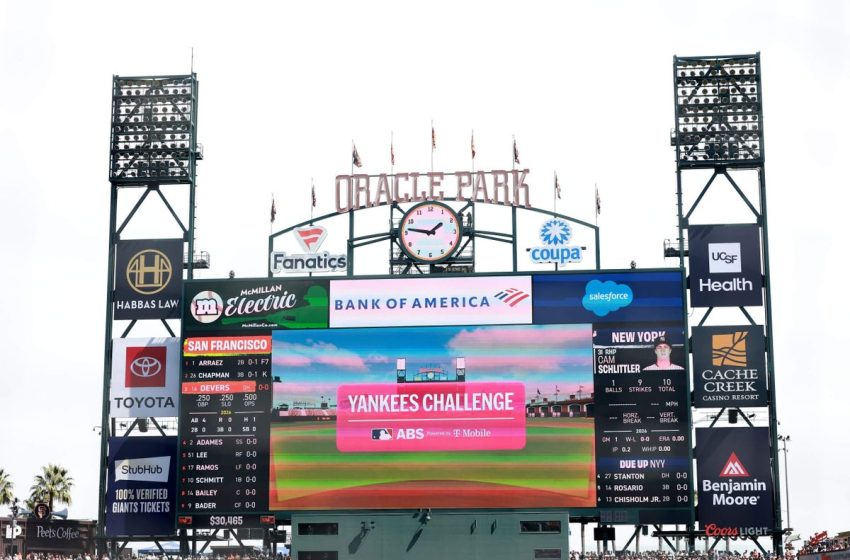
So far, MLB’s highly-riveting ABS is proving to be a good call
Now that we’ve seen the entertainment value of the Automated Ball-Strike system (ABS), here’s a suggestion for Major League Baseball:
Bring Ángel Hernández out of retirement to work the plate at the All-Star Game.
The Midsummer Classic would turn into a head-tapping challenge-fest, with fans at Citizens Bank Park in Philadelphia roaring with every ball-strike call that gets overturned.
It will never happen. MLB in May 2024 reached a financial settlement with Hernández so he could retire at 62. But I’m not sure even commissioner Rob Manfred imagined the robo umps could be this riveting — and at least in the early returns, this good for the game.
ABS introduces new forms of scrutiny, new ways to talk baseball, new strategies to debate. Numerous players already have expressed remorse about using questionable judgment. Some reacted too passively, failing to seize an opportunity for a reversal. Others responded too aggressively, knowing each team in the first nine innings can miss on only two challenges.
Let ‘em fret. The rest of us can just enjoy the show.
Granted, this is the shiny new toy phase, the robots at their most romantic. Moments of exasperation are inevitable. Perhaps when a game ends on an overturned ball-strike call. Perhaps when an outcome turns over a difference of a tenth of an inch. But the ABS process is quick and definitive. And fans already are getting into it.
One of the most memorable sequences of the new season occurred Saturday in Cincinnati, when the crowd at Great American Ballpark roared successively louder when the Reds’ Eugenio Suárez had consecutive strike-three calls by CB Bucknor overturned.
John Sadak, the Reds’ television play-by-play man, called it as if Suárez had just smacked a walkoff homer in the ninth.
“The loudest cheers of the game — the Reds have hit two homers — come on back-to-back challenges!” Sadak cried.
Sadak’s call was appropriate, considering the way the crowd erupted (Suárez, who batted with two outs and the bases loaded, ultimately grounded out). Bucknor had a rough day, with eight calls challenged and six overturned. The first reversal on Suárez, though, was on a pitch only three-tenths of an inch off the plate. As Reds TV analyst Barry Larkin noted, “It’s amazing how minuscule the misses are, but these guys just know it.”
They don’t always know it. Sometimes, they’re just making educated guesses. But pitchers today throw harder than ever. Their breaking balls move like never before. Most umpires are quite good at calling balls and strikes, even as pitches whiz toward them. But the technology offers a way to correct their mistakes while also demonstrating they’re right most of the time.
Through 35 games, the challenge rate — defined as the percentage of challenges initiated out of takes that a) come with at least one challenge available and b) resulted in calls that went against the challenging team — was 2.4 percent. The sample size obviously is quite small, but at Triple A last season, the challenge rate was comparable —3 percent.
The disruption, then, is minimal. And while some within the sport are bracing for unintended consequences, we’ve already seen unexpected developments that were rather interesting.
We saw a hilariously confident challenge Saturday from the Seattle Mariners’ Randy Arozarena, who, after a 3-2 pitch, jogged several steps to first before even tapping his helmet, then removed his shin guard and elbow protector with the challenge in progress — and was proven correct by two-tenths of an inch.
We even saw our first robot-related ejection Sunday when Minnesota Twins manager Derek Shelton argued that Baltimore Orioles closer Ryan Helsley waited too long to request a challenge.
Derek Shelton is the first ABS-related ejection in MLB history.
“I didn’t think Helsley tapped his hat quick enough. Maybe he did, maybe he didn’t. I didn’t feel he did. I feel like it’s got to be something within three seconds and I didn’t think it was.” pic.twitter.com/3cBG8ppmiX
— Aaron Gleeman (@AaronGleeman) March 29, 2026
So much for the concern that ABS might end the days of managers getting tossed. As the Yankees’ Aaron Boone told The Athletic’s Jayson Stark this spring, “I actually think it adds another component to get ejected.” An umpire added, “Oh, don’t worry. They’ll find something. They have to vent.”
Sure enough, both Boone and the ump already are being proven right.
Fun stuff. Fascinating stuff, too. Some of the game’s biggest stars have already voiced frustration over trying to outthink the robots.
On Saturday alone, both the Philadelphia Phillies’ Kyle Schwarber and Boston Red Sox’s Roman Anthony regretted burning challenges, and the Detroit Tigers’ Spencer Torkelson regretted not using one.
On the flip side, there was the New York Yankees’ Aaron Judge, the player who, since the start of his career in 2017, has had the most low strikes called against him. Judge on Friday changed a 1-1 count to 2-0 on a called strike that was a tenth of an inch below the zone, then hit his first home run on 3-2.
The decision for players, though, is not as simple as “to tap or not to tap.” Reds catcher Jose Trevino on Saturday refrained from challenging two called third strikes, one of which was egregious. Perhaps he just wanted to avoid the risk of the Reds running out of challenges early. But he also might have sensed Bucknor was frustrated, and knowing he would be working closely with the umpire all game, figured discretion was the better part of valor.
Players and teams will adjust the way they always do whenever change is introduced, figuring out how to make the system work for them. Consider the San Francisco Giants’ Patrick Bailey, the top framing catcher last season by a wide margin. He has gradually softened on ABS, in part because he now sees how he can use it to his advantage.
In the spring of 2025, Bailey said he was “not a fan at all” of the system, lamenting that it would diminish the value of defensive catchers. At the end of last season, he maintained it was a “bummer,” but reversed course on its potential impact, saying it wouldn’t take away the value of framing. Now he says, “I’ve definitely changed my opinions on it a little bit,” adding with a smile, “Obviously, I was forced to.” And on Saturday against the Yankees he was adept at working the technology, twice succeeding in turning balls to strikes.
Over time, some fans likely will call for “full ABS,” in which the robots make every ball-strike call and the plate umpire is rendered obsolete. Bad idea. The human element is part of what makes the challenge system so captivating. Framing remains important. The plate ump does, too.
Full ABS would remove the decision-making element inherent in the challenge system, eliminating a layer of strategy that already is adding to the conversation around the game. If anything, MLB should pursue additional ways to spark such conversation, off the field as well as on. Allowing teams to trade draft picks, for example, would create new choices for front offices. So would a second trade deadline at the end of the winter meetings. But those are innovations for another day.
Whether the challenge system proves as big a win for Manfred as the pitch clock remains to be seen. But the game is supposed to be fun. ABS so far is delivering fun.
Who would have thought robots could be so charming?
First Appeared on
Source link






