


Sony’s new True RGB TV looks amazing in action, but is it an OLED killer?
Sony has just officially announced its first RGB Mini LED TVs, under the punchy name ‘True RGB’.
Actually, that’s not entirely true: what Sony has announced is the ‘True RGB’ name and some broad info on the technology, such as the fact it features true, independently controlled red, green and blue diodes, and that it will feature “new backlight drive” technology.
What Sony hasn’t announced is specific models, specs, release dates or pricing – that info will come at a later date.
Article continues below
Despite that rather odd situation, I have actually already seen the flagship Sony True RGB TV in action at Sony’s Tokyo HQ – and in quite some detail.
Sony True RGB vs the Bravia 9
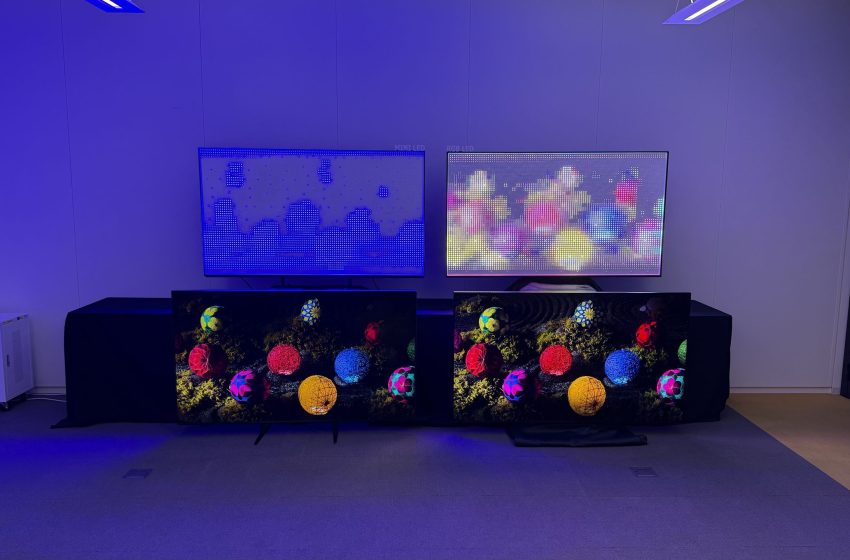
The first stop on our True RGB test tour was the room you can see in the image above.
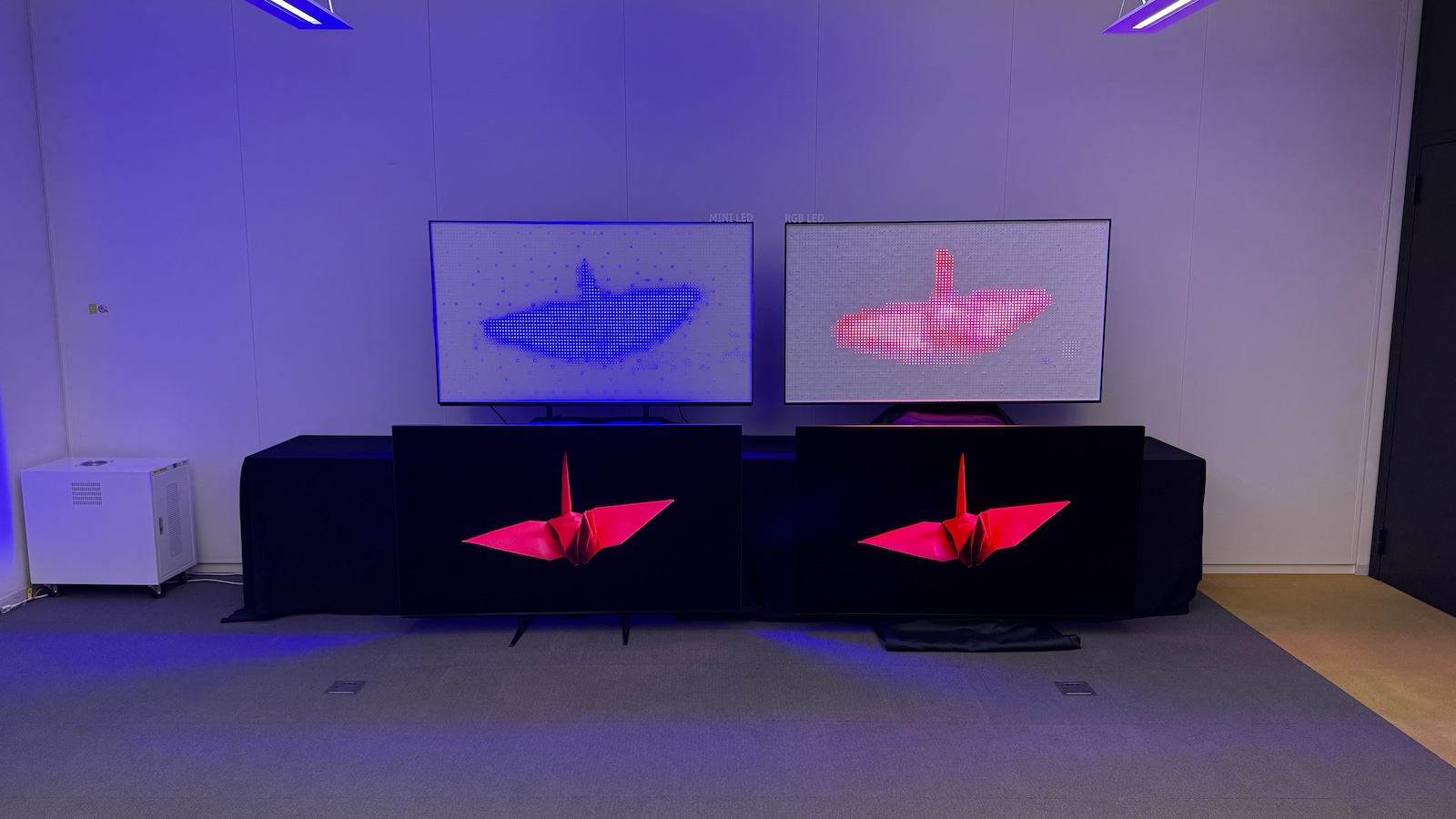
Here, a 75-inch Bravia 9 was placed on the floor alongside a 75-inch True RGB TV. Above each was a sample with the LCD layer removed, revealing the backlight.
Hopefully, you can easily see the profound difference in the way the backlights work.
With the Bravia 9, on the left, you can see that the backlight is only contributing differing amounts of blue light. Shapes are fairly vague, as they largely blend into one another.
With the True RGB TV on the right, the expression of colour from the backlight alone is exceptional, and when combined with granular brightness control, this makes the shapes of the image much clearer.
The way this translates to the actual picture performance is in punchier, richer and more consistent colours. The image from the True RGB model is generally brighter, too, with no discernible loss of black depth.
Sony played demo clip after demo clip, and the degree to which I could discern what was in each image by looking at the True RGB backlight alone was never less than extremely impressive. Take another look at the photo at the top of this page for another great example.
Sony True RGB vs rivals
The second True RGB demo session was all about comparisons with rival RGB Mini LED TVs. I’m not permitted to mention the competitor brands, let alone the specific models, but let’s just say they’re all pioneers of RGB Mini LED tech – even though they might not use that term in their branding.
Sony’s goal here was to illustrate one of its key True RGB claims: that “performance depends on LED density and algorithm, not LED size”.
At the sort of density it has achieved with its True RGB TV – around 1cm between LEDs – even a 100 micrometre reduction in size would have “no meaningful impact on picture quality”, according to Sony.
Furthermore, the new backlight drive that controls how the LEDs perform is what Sony says really sets its True RGB solution apart from its competitors.
To illustrate this, Sony ran various test clips through its True RGB TV and two of these competitors, with a patch of the backlight of each TV exposed.
With one of the competitors, the backlight would switch from full colour to white once the size of the on-screen image was reduced from 100 per cent to about 80 per cent.
This model’s backlight also struggled to express colours during real-world footage. Frankly, most of the time, it was barely more colourful than white.
It also allowed the background colour of an image to badly affect the element in the centre, so a man’s face would change colour significantly, based on whether the rest of the image was red, green, blue, etc.
The other competitor fared better in these tests, but it was still far from perfect. Its biggest issue was inconsistency in its handling of different colours: green and red, for example, looked perfect, but colours such as cyan and pink were very pale.
This second competitor’s backlight also struggled to express convincing colours with real-world content, though less so than the first.
The Sony True RGB TV performed impeccably through all of these tests. Each bold colour was delivered accurately and consistently, regardless of window size, and the expression of colour with real-world content was stunning.
The “colour shift” was practically non-existent in the image of the man against the various coloured backgrounds, too, and through every demo, the Sony was brighter as well as more consistent and vibrant in its colours.
Sony claims that its True RGB tech is also superior in terms of viewing angles, and this is where the third competitor set came in.
This rival suffered badly with blooming and a loss of vibrancy when viewed off-axis, whereas the Sony remained punchy and controlled at even wide angles.
Sony True RGB vs a mastering monitor
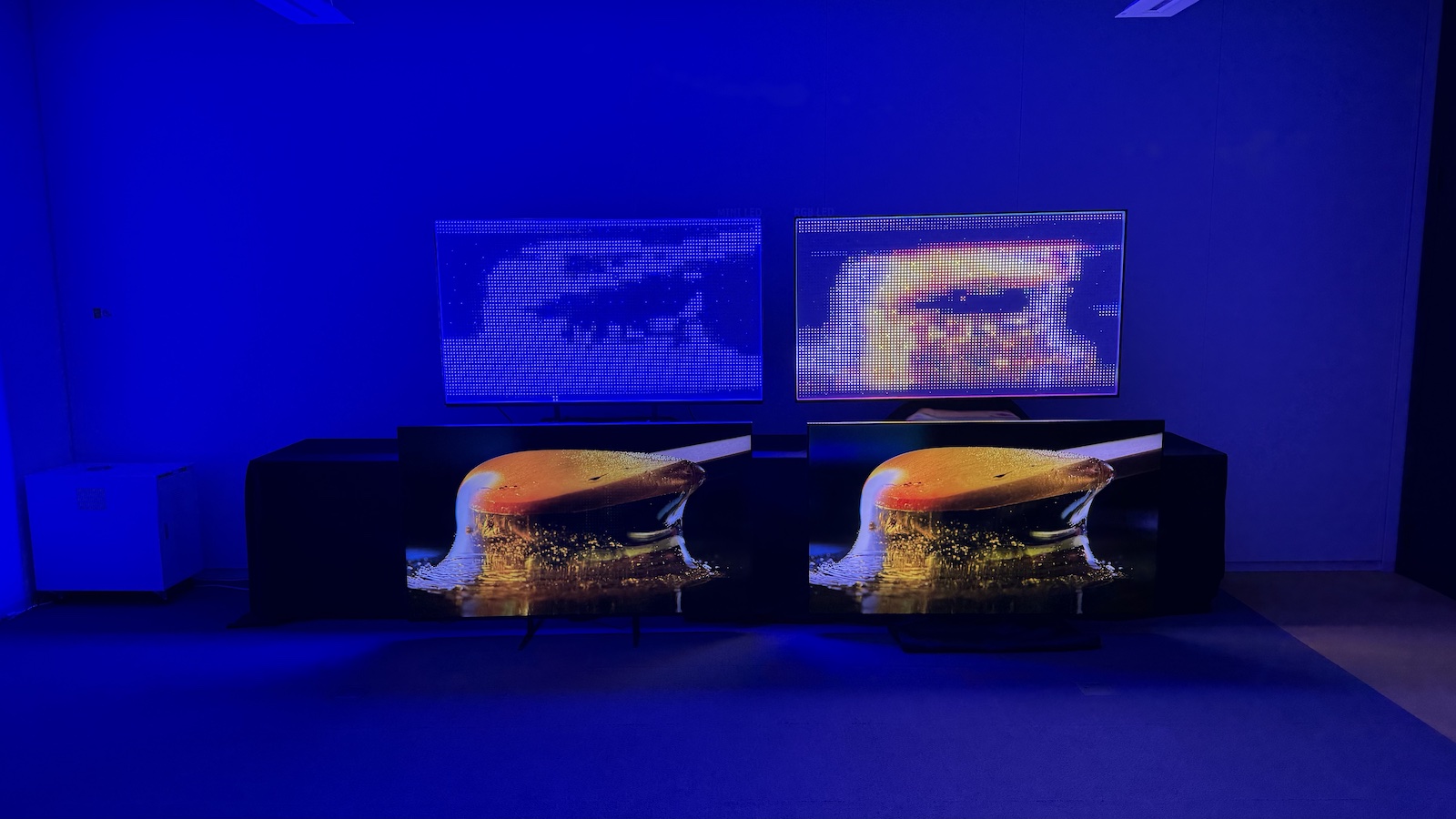
Our final stop on the Sony True RGB tour was a blacked-out room containing the True RGB TV, a Bravia 9 and a Sony BVM-HX3110 mastering monitor. No exposed backlights, no demo material – just real movie content split across the three screens.
Both TVs were in their ‘Professional’ preset, which is essentially Sony’s equivalent of Filmmaker Mode, and is designed to deliver the most accurate picture possible, which really means getting as close to the mastering monitor as possible.
In that regard, the True RGB TV was a clear winner. Its colours were far closer to those of the BVM-HX3110, its viewing angles were much better than those of the Bravia 9, and its blooming was almost non-existent.
The blooming point is an interesting one, I think. While the Bravia 9 is very controlled, the fact that it uses white LEDs means you can get a bit of a white glow around intense coloured highlights on a very dark background, such as the red light in a dark room in Black Widow.
But because the True RGB TV uses coloured light, any glow around highlights is in the same colour as the highlight itself, resulting in a far subtler and more natural effect.
Overall, it was deeply impressive how closely the new True RGB TV emulated the performance of the mastering monitor, while boosting it to a far larger scale, but I do still have a couple of minor concerns about its performance.
First, when Lewis Empson and I reviewed the Bravia 9, we noted that, as a whole, it lacked the solidity, density and three-dimensionality of OLED, and nothing I’ve seen so far suggests that the True RGB TV is better in this regard.
Ultimately, I strongly suspect these characteristics come from OLED’s pixel-level contrast control, which a backlit TV will simply never be able to match.
It’s also the case that while the new True RGB TV appears to be able to produce deeper blacks in tricky mixed light images than the Bravia 9 can, it still doesn’t seem able to match an OLED here, either.
Many will argue that True RGB’s advantages over OLED outweigh its disadvantages, and they could well be right. That’s something I’m very much looking forward to putting to the test when we get a final production sample in for comparative testing.
Early verdict
It is worth bearing in mind, of course, that Sony’s True RGB TV hasn’t even been named yet, so there’s likely lots more refinement to come before it hits shops – and before we fully review a production sample in our dedicated test rooms.
And, even at this stage, it looks like a deeply impressive technical achievement that adds ‘true’ RGB LEDs and next-gen colour control to the envelope-pushing backlighting of the Bravia 9.
Is True RGB an OLED killer? I’m not yet entirely convinced by that, but it certainly appears to take backlit TVs to new, super-vibrant heights – and Sony bringing its picture processing magic and cinematic authenticity to bear in the realm of RGB Mini LED TVs is something to be very excited about indeed.
MORE:
Sony’s ‘True RGB’ TVs are coming – and they were 20 years in the making
Here are all of the best TVs you can buy right now
First Appeared on
Source link






