


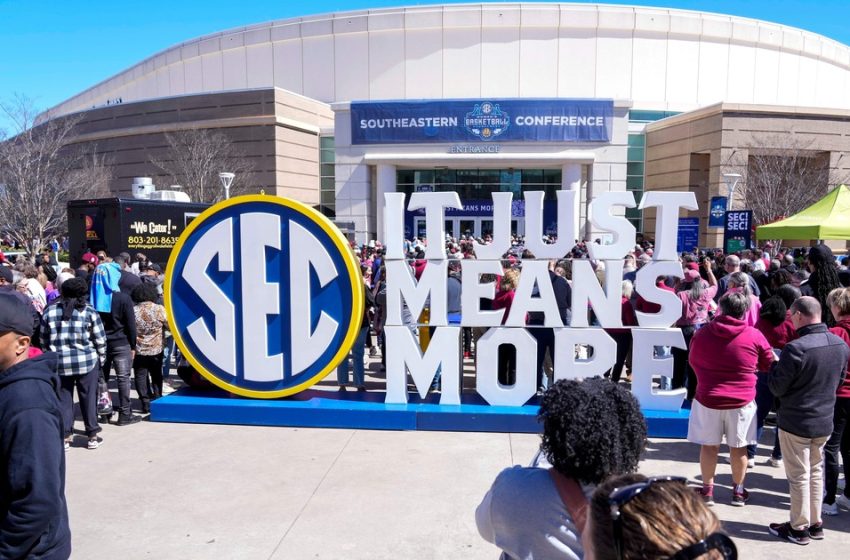
South Carolina women’s basketball: Some coaches want to move the SEC Tournament from Greenville, but finding an alternative site isn’t easy
The 2026 SEC women’s basketball tournament tips off Wednesday morning in Greenville, starting another memorable weekend of basketball. But not everyone is excited.
The games played on Wednesday were once derisively referred to as “play-in games.” But now the SEC is so deep and talented that the first game of the tournament features Kentucky, a team in contention for a top 16 seed in the NCAA Tournament.
For fans, for broadcasters, and for teams needing Quad 1 wins to boost their NCAA Tournament resume, the SEC Tournament is a jackpot. But some coaches dread the weekend by the Reedy River.
NEW! Message board for South Carolina Women’s Basketball! 🏀
“It’s brutal, it really is,” Kentucky coach Kenny Brooks said. “I love the SEC Tournament, but it is hard, it really is. (…) If you gave me a truth serum pill, I might say something different.”
“I wish we didn’t have the conference tournament. Because all we do in the SEC is beat each other up. If you look at the history of our league, we always have four to five to six teams in the Sweet 16,” Ole Miss coach Yolett McPhee-McCuin said. A week later, after losing at South Carolina, McPhee-McCuin added, “The SEC tournament is grueling, kind of like this, but at least it’s not anybody’s home site. Yeah, it’s in South Carolina, but it’s a difference when you’re here versus where we’ll be going.”
“I’d love to see it go to some different cities,” Texas coach Vic Schaefer said. “It’s not really that big of a feat if you have it in your backyard every year. That’s really hard for the rest of us. For a school like Texas, (Texas) A&M, Arkansas, Missouri, that’s really a long way for our fans to have to travel over there. I’d like to see us spread it around.”
Schaefer’s comments require some context. First of all, they are merely the latest in a long list of grievances this season, including multiple complaints about the location of the tournament.
He also claimed that the SEC has a “vendetta” against Texas, that tipoffs are too late, that tipoffs are too early, that his players are soft, that fans are too hard on coaches, and that he has sacrificed being able to spend time with his daughter, Blair, who is his assistant coach and former player, because he is a head coach.
And second, Schaefer has never liked the SEC Tournament. His previous complaints include the tiebreaking coin flip, playing the weekend that daylight saving time begins, higher seeds getting the preferred schedule, playing the championship game on Sunday, early tipoffs, late tipoffs, and the quick turnaround from playing on consecutive days. Those are all complaints from just his last two SEC Tournaments.
So it’s likely that Schaefer would complain even if Texas were told to stay home and awarded the SEC Tournament title in absentia (by the way, his only SEC Tournament title came in Greenville).
LSU coach Kim Mulkey also wants to hold the SEC tournament in other locations, but she sees the big picture.
“South Carolina and Greenville, they have invested in that, and they keep bidding on it, and they keep saying, ‘Hey, we’ll show up, and they do,’” Mulkey said. “And that’s how you get it. I would think that competitors want it in other places closer to their fans, but, hey, get off your rump and bid on it. We’d like to have it in New Orleans. Somebody bid on it, let’ss go to the Smoothie King (Arena). I’m sure Texas would like to have it in Texas, but South Carolina is stepping up to the plate, and they are committed to it. And kudos to them. How can you say anything negative if nobody else is going to bid on it and nobody else is going to step up and try to compete for it?”
Mulkey has made no secret of the fact that she finds conference tournaments pointless. She also seemed to be the only one aware of the entire situation. Namely, that for the SEC to move the tournament out of Greenville, there needs to be a compelling alternative.
Before Greenville
In the early days, before the SEC even sponsored women’s basketball as an official sport, the tournament was played at on-campus sites. Beginning in 1987, the tournament was played at neutral sites.
At first, the tournament had semi-permanent homes in Albany, GA, and then Chattanooga, TN. Beginning in 2001, the tournament rotated annually, with stops in Memphis, Nashville, North Little Rock, Greenville, Duluth, GA, and Jacksonville.
It was a well-intentioned effort to bring the showcase event to all corners of the SEC, but attendance suffered significantly. After four years in which total attendance topped 30,000 just once, and just barely, Bon Secour Wellness Arena in Greenville was awarded the 2017 tournament. With the 2018 tournament already slated for Nashville, it was essentially an audition for the upstate.
The SEC had already decided to make Nashville the semi-permanent home of the men’s tournament. The decision was so successful that it later became the permanent home through the end of the decade. The league wanted to do the same thing for the women’s tournament, and with a total attendance of 34,322, Greenville’s audition was successful.
Eight of the 10 tournaments since 2017 have been in Greenville, and the tournament will stay there until 2028.
Why Greenville?
In a nutshell, the partnership has been fantastic for both the SEC and the city of Greenville.
The 2023 SEC Tournament demolished the old attendance record, drawing a total attendance of 57,801. That record was demolished in 2024, and then again last year, with a total attendance of 71,910.
In 2025, officials in Greenville reported $12.4 million in direct spending as a result of the SEC Tournament, with a total economic impact of $19.5 million and nearly 4,000 jobs supported. For comparison, the 2022 NCAA Men’s Tournament in Greenville was responsible for just $5.6 million in direct spending.
Organizers aren’t resting on their laurels, either. Local governments are finalizing plans to spend an estimated $282 million renovating the arena complex, including $193 million for Bon Secours Wellness Arena itself.
Why move?
It’s possible that bringing the league’s showcase event to other venues might help grow the sport. South Carolina fans dominated crowds in Jacksonville and Nashville, so they will travel.
As the nearest team to Greenville, South Carolina fans have the easiest travel, and Gamecock fans fill the stands. Greenville is a difficult trip for fans of teams like Missouri, Arkansas, Oklahoma, Texas A&M, and Texas.
Why stay?
In this era of college sports, that’s life. If Texas is so concerned about short travel, it should have stayed in the Big 12 instead of becoming the westernmost university in the SEC. Putting the tournament somewhere in Texas might help Longhorn fans, but it would shut out the majority of fans of the other members.
Attendance is still the driving factor. In the past three years, the total attendance was 194,616. During the six years from 2013 to 2018, when the tournament was moving around, total attendance was 185,807.
With the men’s tournament also staying put, the SEC clearly believes that staying in one place is the best decision. As noted above, Greenville is also committed to being a first-class host.
🏀 GamecocksW newsletter: WBB coverage delivered straight to your inbox!
Where else could the tournament be played?
That is the $20 million question. It’s not as easy as pointing at a spot on the map and saying, “Let’s play here.”
Cities not only have to want to host the SEC tournament, but they have be capable of hosting.
The SEC did not respond to GamecockCentral’s request for hosting requirements, but we have access to the NCAA’s requirements for hosting tournament regionals. The requirements may not be identical, but the events are similar in size and setup, so they should be similar.
Many of the requirements are common-sense factors that any modern facility would provide, such as playing equipment, internet, and broadcast capability. Some are more selective (the NCAA requires that venues provide recycling containers for plastic, paper, and aluminum, for example).
For the host venue, the NCAA requires at least four locker rooms for teams, four dressing rooms for coaches, and two locker rooms for officials. There must be media seating for 125 people, a media workroom that can seat 150 people, a separate interview room for 70 people (often this is just a draped-off area, but it works), a holding area, a separate photo workroom, and so forth.
There are requirements for the host city as well. These include a nearby airport with “appropriate frequency and quality jet airline service,” off-site practice courts, nine full-service hotels within 30 minutes of the arena (officials may not stay at the same hotels as teams, and ideally multiple teams should not stay at the same hotel. It’s not explicitly stated, but it’s understood that the city has to be reachable by interstate.
There are also some more intangible factors, like attendance potential and community interest.
So are there alternatives?
Yes, but probably not as many as you think.
Let’s set some basic parameters:
1. A host city must be in the SEC’s geographic footprint, so a state with a member university or a border city (Charlotte would be acceptable, for example).
2. No on-campus or home arenas. The arena must seat at least 12,000 in tournament-style configuration (bands and cheerleaders get end zones and media gets sideline seats, plus room for a stage setup for the SEC Network/ESPN).
3. It must meet the NCAA requirements for a regional host listed above.
4. There must be butts in seats.
(Brief aside: Next season, the Big Ten Tournament will be in Las Vegas. Everyone will be watching closely to see if fans will travel to a tourist destination outside the conference footprint.)
Potential hosts
Cities in the geographic footprint include Atlanta, Birmingham, Charlotte, Dallas/Fort Worth, Greenville, Houston, Jacksonville, Kansas City, Louisville, Memphis, Nashville, New Orleans, Oklahoma City, Orlando, San Antonio, St. Louis, Tampa, and Tulsa.
There are surely some other cities that would be interested, but that list is limited to cities that have previously hosted NCAA tournament games. They have the capability to host, should they be interested.
Of that group, Nashville is booked for the men’s tournament. Even though the men’s and women’s tournaments don’t overlap, the SEC is unable or unwilling to play them back-to-back. Kansas City is booked through 2031 for the Big 12 tournaments.
A few more can be eliminated. The arena in Jacksonville was inadequate 10 years ago. Charlotte seems committed to the ACC.
Louisville and Orlando have hosted NCAA Tournaments, but never a major conference tournament. St. Louis and Tampa have hosted the men’s tournament, and everyone hated it.
Butts in seats
With the explosion of interest in women’s basketball, especially SEC programs, the tournament has clearly outgrown some of its traditional locations. But unlike men’s basketball, where the television rights deals drive decision making, women’s basketball doesn’t make enough from TV to displace attendance as the biggest moneymaker.
Despite its growth, women’s basketball isn’t fully a mainstream sport, so the tournament risks getting swallowed up in major markets. At the 2023 Final Four in Dallas, which was the most-hyped Final Four up to that point, my Uber driver was confused when I said I was in town for the Final Four. “I thought that was in Houston,” he said.
I explained that the men’s tournament was in Houston and the women’s tournament was in Dallas. “That’s cool, I guess,” he said.
There is a benefit to being in slightly smaller cities. That same conversation seems likely in Atlanta, Houston, and, obviously, Dallas.
At the same time, consider the ridicule the ACC is getting for playing in Duluth this year. If you go too small, it looks like you don’t care about women’s basketball. And SEC fanbases care a lot about women’s basketball.
If Tampa and St. Louis were despised tournament sites, Tulsa and San Antonio would be too. Dallas/Fort Worth, Oklahoma City, and Houston would be too, but they are at least close to member programs. New Orleans has hosted three SEC men’s tournaments, which doesn’t seem like that many for a major destination.
For many years, Birmingham was almost exactly at the geographic center of the SEC. When Texas A&M and Missouri joined the conference, the center moved to northwest Alabama. It shifted to northeast Mississippi when Oklahoma and Texas joined, but Birmingham remains the major city closest to the geographic center of the conference.
The fan center is different. It lies at about the spot where the Smoky Mountains become the Blue Ridge Mountains.
South Carolina has led the nation in attendance for the last 12 seasons. Before that, Tennessee led the nation for 11 consecutive seasons. Since 1995, Tennessee and South Carolina have led the nation in attendance every season except for two (UConn, 1996 and 2003).
Those fan bases are the ones that drive tournament attendance. Greenville is about three hours from Knoxville and less than two hours from Columbia, and that is a major factor in the record-setting attendance. If you are interested in hosting the SEC Tournament, the first thing you have to do is explain how fans of the Lady Vols and Gamecocks are getting to your town.
At this point, we have eliminated everyone except Birmingham, Fort Worth, Greenville, Memphis, and Oklahoma City.
Fort Worth, which is hosting an NCAA Regional at Dickies Arena this year, and Oklahoma City might be acceptable for the occasion tournament, but they are much too far away from the majority of the SEC to host more than once every four or five years.
That leaves Birmingham, Greenville, and Memphis.
Memphis has the arena, the FedEx Forum, and a history of hosting NCAA Tournament games. Memphis doesn’t have a lot of SEC ties and has hosted just three combined tournaments out of nearly 150 chances.
Legacy Arena in Birmingham was renovated about five years ago and successfully hosted the NCAA regionals last year. It’s easy to get to from Knoxville and Columbia, but the home of the SEC headquarters has yet to host either the men’s or women’s tournament.
That leaves … Greenville.
At this point, you are probably thinking, “Of course you support Greenville, you are writing for a South Carolina site.” Fair enough.
It wasn’t on purpose. Birmingham and Memphis seem like fine hosts. And without the track record of success, I would argue that Bon Secours Wellness Arena is only a few years away from becoming outdated.
But there was one other criterion the NCAA uses in selecting host sites that also applies here: “History of serving as host.”
That matters. I have covered events in over a dozen cities, and they are not the same. Some hosts just know what they are doing. Greenville knows how to host.
First Appeared on
Source link






