


‘Stressful, chaotic, never-ending:’ DoD employees face mounting strain as Middle East conflict widens
As the conflict in the Middle East widens by the hour following the U.S. and Israel’s launch of “major combat operations” against Iran on Feb. 28, Defense Department employees say the demands of a new war are exacerbating challenges the Pentagon has faced over the past year, including workforce shortages, plunging morale and eroding trust in leadership.
Since the start of President Donald Trump’s second term, the Pentagon — along with other federal agencies — has been navigating a number of significant internal changes, including organizational restructuring and reductions to its civilian workforce. A recent Federal News Network pulse poll of DoD personnel indicates that the conflict in the Middle East is adding strain on an already stretched workforce supporting critical missions as operational tempo rises quickly across the enterprise.
“With the convergence of organizational changes, staff reductions, and a war in a resource-constrained environment, it feels almost impossible to sustain the mission,” one Defense Department employee told Federal News Network.
“We used to have four times the number of people and the workload keeps increasing with calls for increased production and a war currently on,” another DoD worker said.
“Recent personnel changes have stretched everyone thinner and then we were informed about upcoming significant funding realignments that will further hamper our execution accomplishments,” another DoD employee said. The current military operations in Iran, the employee said, are what is driving the realignment, redirecting funds away from their day-to-day operations.
The pulse poll, conducted online between March 5-12, asked DoD employees about the impact the U.S. and Israeli war with Iran — now in its fourth week — is having on mission, operational tempo, resources and morale. Survey respondents were self-selected, and they self-reported information to verify their status as current DoD employees.
Mission impact
Many respondents pointed to the department’s widespread personnel cuts and loss of institutional knowledge as key factors affecting their organizations’ ability to accomplish their missions.
One respondent said the department’s efforts to shrink its workforce through tools such as the deferred resignation program and early retirements have constrained the office’s ability to execute acquisition support and expand outreach to small businesses that bolster the defense industrial base.
“DRP losses in addition to manning level supplements as recommended by 2019 Manpower Determinant not being met, have essentially hamstrung the Air Force Small Business Program,” the respondent said.
Another employee at the Defense Contract Management Agency, which ensures that weapons delivered to warfighters meet all performance requirements, said budget cuts and workforce reductions are undermining the organization’s mission, warning that DCMA is “failing and it is only getting worse.”
The same employee said they are too often performing duties outside their primary role due to staffing shortages and that operational tempo at DCMA has increased significantly over the past month.
“We are asked to do more, but cannot. Something will eventually fail and fail badly,” the employee said.
‘Leadership has not shown leadership’
Federal workers have previously said morale and trust in leadership were at an all-time low. “Everything about being a federal employee in 2025 has destroyed workforce morale,” one employee told Federal News Network in November.
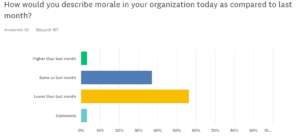
In the past month, however, DoD employees said the conditions have only worsened, with most respondents reporting a further decline in morale.
“Leadership has not shown leadership. The lack of morale will bite them if/when we need to go to a wartime pace. The workforce will not elevate the level of effort,” one DoD employee said.
“These guys are living in fantasy land,” another DoD employee said.
One employee said operations in Iran have so far only affected morale, but warned that workload and operational tempo would most likely increase if the war drags on.
‘Stressful, chaotic, never-ending’
For many Defense Department employees, the immediate impact of current military operations is showing up in longer hours and shifting responsibilities as they get pulled away from their primary duties to cover work generated by the conflict.
“As an EA for a senior Navy official, I am responsible for managing their day-to-day activities. The calendars have become more volatile and difficult to manage because of rapid changes and shifts in priorities,” one DoD employee said.
“Just more work for less people,” another employee said. “Everything is done too fast without thinking through the consequences.”
Many respondents said they have experienced increased stress and anxiety since the beginning of the conflict. “People seem tired and scared,” one DoD employee said. “Stressful, chaotic, never-ending.”
“It’s very stressful. People are scared to be on base. Even getting on base is taking a half hour due to heightened force protection protocols. We don’t want to be there. But we show up and do our best anyway,” another DoD worker said.
At the same time, not all employees reported direct changes to their daily responsibilities. Some respondents said the conflict has had little to no impact on their day-to-day so far.
If you would like to contact this reporter about recent changes in the federal government, please email [email protected] or reach out on Signal at (301) 830-2747.
Copyright
© 2026 Federal News Network. All rights reserved. This website is not intended for users located within the European Economic Area.
First Appeared on
Source link






