


Strike call upheld in MLB’s first ABS challenge in Yankees-Giants season opener
SAN FRANCISCO — In the first-ever ball-strike challenge, the robot umpire actually proved the human had it right.
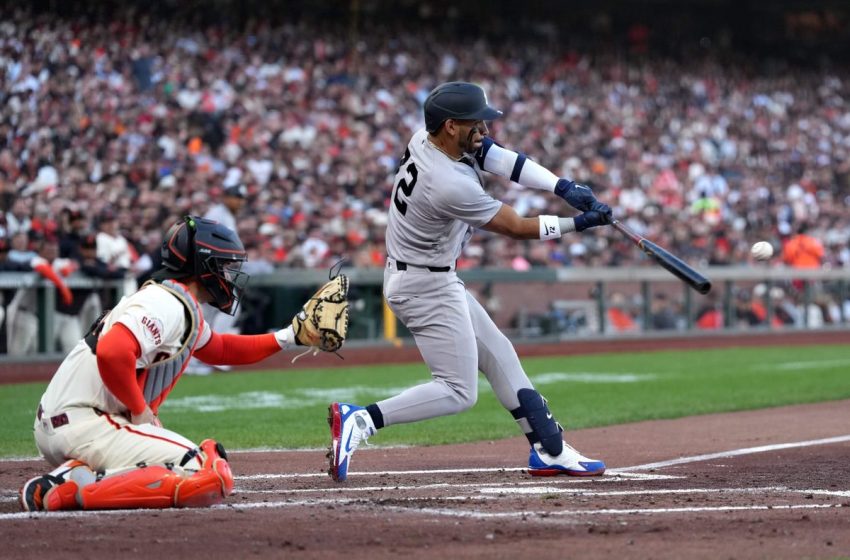
Home-plate umpire Bill Miller’s strike call was upheld when New York Yankees shortstop José Caballero challenged it in the first use of the Automated Ball-Strike (ABS) system in MLB history, in the fourth inning against the San Francisco Giants on Wednesday night at Oracle Park.
Giants starter Logan Webb’s 90.7 mph sinker clipped a sliver of the strike zone in the upper-left corner on the first pitch of the at-bat. It was the 99th pitch of the game. The Yankees were ahead 5-0 and went on to win the season opener 7-0.
After the pitch, Caballero backed out of the batter’s box and used his right hand to tap the side of his helmet. That initiated the challenge, which confirmed the call of Miller, who has been a big-league umpire since 1997. The Yankees lost the challenge, leaving them with one remaining, but neither team summoned the robot umps for the rest of the game.
The Netflix broadcast appeared unprepared for the moment. It happened as sideline reporter Lauren Shehadi was interviewing Giants manager Tony Vitello, and the broadcast didn’t show in real time a graphic of where the ball landed in the zone after the challenge.
Caballero said he thought the pitch was actually a bit higher than it was, “but at least it was close.”
How did he feel about being a part of history as the first to challenge a call in the majors?
“It’s cool,” Caballero said. “I wish it was the other way around.”
Yankees manager Aaron Boone said he didn’t have a problem with Caballero’s challenge.
Before the game, Boone wasn’t sure if he was excited for the implementation of ABS.
“I hope so,” he said.
Boone said the Yankees held a meeting with the position players at the end of spring training, picking particular examples of challenges in spring games and detailing why they were good or bad.
“I’ve been very direct with them during spring,” the manager said, “as far as after the fact. If I thought one was really good or, conversely, if one was terrible. I’ve tried to be real direct with them and why.
“We’re going to be good at it. That’s the expectation. Again, as I’ve said with you guys, we’ll continue to evolve with it. My thoughts on it now maybe are a little bit different than even at the start — I mean, somewhat. So, I would imagine, as the season unfolds, those things will continue to evolve and we’ll try to exploit it the best we can.”
This spring, the Yankees weren’t shy about challenging. Their 48 total challenges tied the Cleveland Guardians for the most in the league. The Yankees won the most challenges (24) and had the third-most lost challenges (24).
The Chicago Cubs’ 62 percent (18-for-29) challenge success rate was the best in spring training; the Detroit Tigers’ 31 percent (4-for-13) mark was the worst. League-wide, batters had a 46 percent success rate while players on defense — catchers and pitchers — were successful at a 60 percent clip overall.
Under the new rules, each team gets two challenges per game, and if teams get a challenge correct, they keep it. Only hitters, pitchers and catchers can request a review, and they must do so within two seconds of the call. To indicate a challenge, a player must tap their helmet or hat, though they have also been encouraged to verbally challenge the call to minimize confusion. Players have to make their challenges without any assistance from teammates or coaches, and an umpire can deny a challenge if they deem assistance occurred.
The challenge system was used for the past two years in Triple A and during big-league spring training.
The ABS strike zone has been determined as follows:
Width: 17 inches, or the distance from the inner edge to the outer edge of the plate.
Height: The top and bottom of the zone are based on a player’s height. The upper edge of the zone is 53.5 percent of their height. The bottom edge is 27 percent of their height. For example, for 6-foot-7 Aaron Judge, the strike zone is 1 foot, 9 inches of his height.
Depth: 8 1/2 inches from the front edge of home plate.
MLB first began testing the ABS system in the minor leagues in 2022 and announced its planned implementation for 2026 last September.
If a game goes into extra innings, a team that has already used all of its challenges will get one challenge for the 10th inning. If it exhausts that challenge, it will get another challenge for each inning until the game ends.
First Appeared on
Source link






