


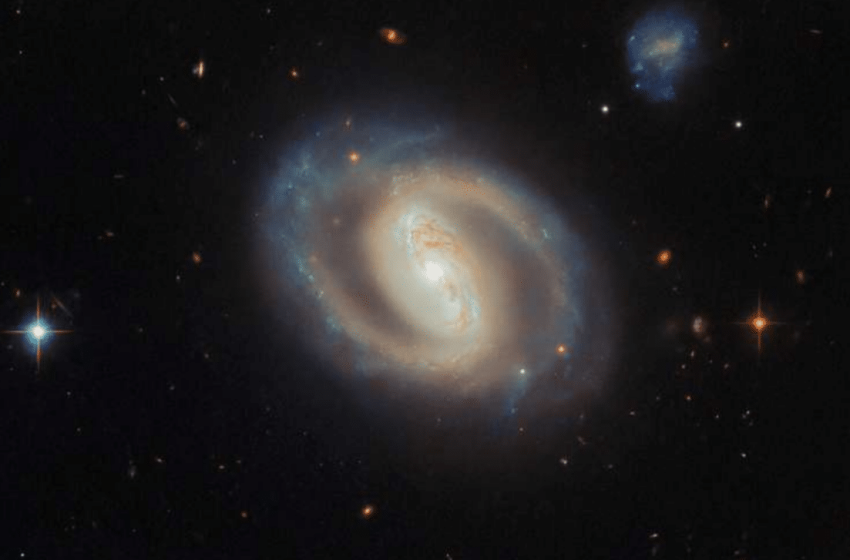
Stunning Hubble Image Reveals the Birthplace of Stars in the Barred Spiral Galaxy IC 486
A breathtaking new image from the Hubble Space Telescope unveils the secrets of IC 486, a barred spiral galaxy 380 million light-years away, showcasing the dynamic interplay between star formation and the enigmatic power of a supermassive black hole. This discovery, part of a major study by the European Space Agency (ESA), offers unparalleled insights into the processes that shape galaxies and their central structures.
A New Look at a Distant Galactic Giant
The image of IC 486, captured by the Hubble Space Telescope, provides a detailed and vibrant portrait of a barred spiral galaxy. At first glance, the galaxy appears as a luminous swirl of stars, with spiral arms unfurling gracefully around a bright central bar. But beyond its aesthetic beauty, IC 486 is a goldmine of scientific discovery. It is a galaxy where the light of stars, the birth of new celestial bodies, and the powerful forces of a supermassive black hole all converge.
IC 486 lies in the constellation Gemini, around 380 million light-years from Earth, and represents a typical example of a barred spiral galaxy. This structure, where a central bar of stars links to the spiral arms, provides astronomers with valuable clues about the dynamics of galactic evolution. The galaxy is shaped by powerful forces that continue to shape its growth, from the birth of new stars to the intense activity around its supermassive black hole.
ESA/Hubble & NASA, M. J. Koss, A. J. Barth
Hubble’s New Insights: Star Formation and Active Galactic Nuclei
One of the key findings in the new Hubble image is the contrast between the galaxy’s older stars and the regions where new stars are being born. The central region of IC 486 is dominated by older, yellowish stars, creating a pale glow. But around the spiral arms, faint bluish hues indicate regions rich in molecular gas, the raw material for new star formation.
This combination of star types, old and new, highlights the ongoing lifecycle of stars in IC 486. The image also captures wisps of dust threading through the galaxy, further indicating regions where new stars are likely to form. In a galaxy like IC 486, these star-forming regions are vital for understanding how galaxies grow and evolve over billions of years.
However, the most striking feature of IC 486 is its active galactic nucleus (AGN). At the center of the galaxy, the bright white glow is not from the stars themselves but from the AGN, which is powered by a supermassive black hole. This black hole, weighing more than 100 million times the mass of our sun, consumes vast amounts of gas and dust, creating an accretion disk that radiates intense energy. This radiation, including X-rays, can outshine the galaxy itself.
The Supermassive Black Hole at the Heart of IC 486
IC 486’s supermassive black hole is a key player in the galaxy’s dynamic behavior. While nearly every large galaxy harbors such a black hole, not all are as active as the one in IC 486. The intense gravitational pull of the black hole draws in material from the surrounding galaxy, causing it to spiral inward in a disk. As the material accelerates and heats up, it emits light across the electromagnetic spectrum, including X-rays, which are some of the most powerful forms of radiation in the universe.
This process of material accretion, often referred to as feeding the black hole, can have dramatic effects on the surrounding galaxy. In the case of IC 486, the energy emitted by the AGN impacts the galaxy’s core and may even influence star formation in the surrounding regions. The black hole’s immense power is a reminder of the hidden forces at play within the universe, far beyond what the human eye can typically observe.
The Role of Citizen Science in Understanding Galaxies
This stunning image of IC 486 is not just a product of traditional astronomy; it also represents the power of citizen science. ESA’s study of IC 486 involved not only expert astronomers but also public participation through the Galaxy Zoo project. Through Galaxy Zoo, members of the public help classify galaxies, enabling researchers to build large datasets that can be used to study galaxy formation and evolution.
The study, led by astronomers M. J. Koss and A. J. Barth, aims to understand how the large-scale structures of galaxies, such as bars and spiral arms, are linked to activity in their nuclei. By combining Hubble’s sharp imaging with citizen science contributions, this research is making strides toward understanding the complex processes that govern galactic growth.
First Appeared on
Source link






