


Super Bowl 2026 had one big takeaway, and you’re not going to like it.
Seattle Seahawks running back Kenneth Walker III won MVP honors coming out of Super Bowl LX on Sunday. In a way, this was thrilling. Walker toted the pigskin for 135 yards. It was the first time someone had cleared 130 in this game since Terrell Davis did it for the Denver Broncos in January 1998, two years before Walker was born. There is a particular joy in a running back winning Super Bowl MVP in a time of vile, anti-tailback discrimination. You know the story: For a decade and change, NFL teams have been paying running backs less, drafting them later, and finding new ways all the time to tell them they don’t matter. It’s been such a tough scene that a handful of running backs have toyed around with the idea of starting their own union, even though they’re all represented by the NFL Players Association. Walker, a pending free agent, will soon have to contend with this ruthless devaluation of his talents.
So I hate myself for what I am about to do: Try to take Walker’s MVP away from him and award it to one of the Seahawks’ defensive players or, dare I say, the team’s punter. I take no pleasure in this, but Walker should at least do the honorable thing and invite a few of his teammates to Disney World with him. The NFL hates running backs, as evidenced by none winning MVP in the 28-year spell between Davis and Walker. But it hates recognizing defensive and special teams excellence even more, and this was the time to rectify that.
If it were me—and not a panel of sportswriters, with an additional fan-vote component—doling out the award, I would’ve thought long and hard about giving the award to a Seahawks special-teamer. Probably not the one you’re thinking, though. Kicker Jason Myers had a historic night, becoming the first man to make five field goals in a Super Bowl and setting the game’s kicking points record at 17. He beat the Patriots (13) all by his lonesome. Myers was very good, but I’m not so interested in a kicker nailing five kicks at 33, 39, 41, 41, and 26 yards. Very good but not a big jolt, as NFL kickers now connect at 90-plus-percent rates from those distances. .
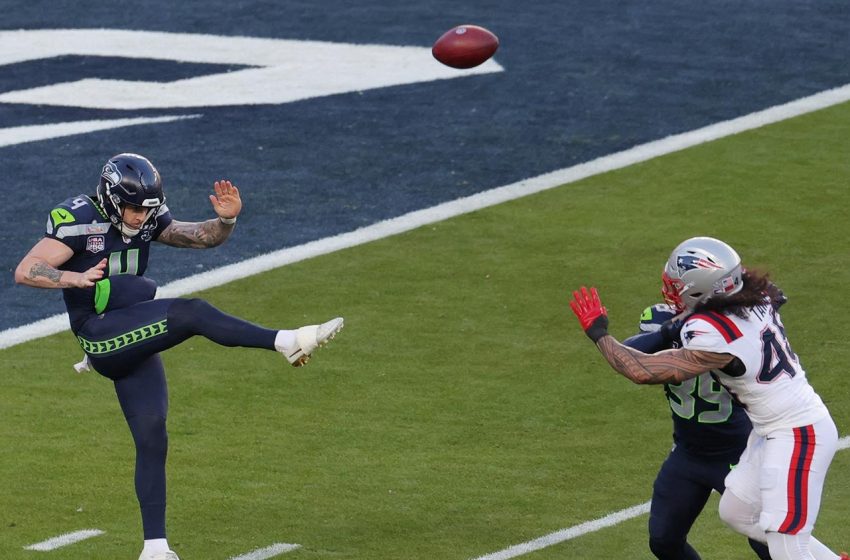
Myers gets a pat on the back for a job well done, but if you’re hunting a hipster MVP pick, look to his holder. I really think Sunday was the time to honor special-teams excellence in the form of Seattle punter Michael Dickson, who—in addition to saving one of Myers’ kicks by corralling a low snap—put on one of the great punting performances in football history. On a night when the Patriots’ offense could not move the ball against a brutal Seattle defense, it was Dickson who ensured New England never had a reason to feel hopeful. He punted seven times, and every one of them sapped more energy from the Patriots than the last. The typical NFL punt nets about 41 yards, the field position gain for the punting team after the kick is returned (or not). On this night, Dickson averaged an obscene net of 47.3 yards, a figure that would have easily led football if carried out over a full season. This included three punts downed or out bounds inside the New England 7-yard line, each of them evoking the following feeling: “Lol, Drake Maye is going to have to drive these guys 93 yards against this world-beating defense.” One of those drives ended in a punt, another in an interception, and another in the clock mercifully expiring on Seattle’s 29-13 win.
Dickson even got a tackle! The Patriots successfully returned just one of his punts, and Dickson both ended that play with a tackle and still generated good field position because the return was nullified for an illegal block in the back. The 30-year-old Aussie was once the best punter in college football, a savant for the University of Texas. He finished his college days by punting so expertly in Texas’ bowl game that organizers named him game MVP. I believe that in a world that properly recognized the value of an exceptional punter, Dickson would have received eternal glory for his efforts on Sunday.
Honestly, the voters could have bestowed the award on any number of Seattle defensive stars. The Seahawks finished with six sacks, one off the Super Bowl record. Cornerback Devon Witherspoon had two sacks and forced the fumble that led to the most exciting play of the game—at least, before a scoring decision recast that play as an interception. Defensive linemen Byron Murphy and Derick Hall went into the history books with two sacks apiece. It would have been a nice testament to the Seattle defense to give MVP honors to one of those guys, but such is the challenge of defensive players trying to get award recognition. The Cleveland Browns’ Myles Garrett just had quite possibly the best individual season in NFL history at any position, posting a record 22.5 sacks. He got zero MVP votes, which was fine, because quarterbacks are clearly the most valuable people on a football field. But a running back (Christian McCaffrey) getting votes while Garrett did not was a radicalizing moment for me in the struggle for defensive recognition.
This is the history that Kenneth Walker III carried around with him as he stepped onto a podium in Santa Clara, Calif., and received Super Bowl MVP plaudits from commissioner Roger Goodell. And, look: It’s not Walker’s fault that he happened to share a field on Sunday with a punter putting on a virtuoso performance and with a defense capping off one of the great unit-wide seasons in league history. It’s not even Walker’s fault that his QB, Sam Darnold, turned in such a nondescript performance that a Slate writer and editor had decided midway through the third quarter that the most incisive, readable commentary on the game would be a blow-by-blow of the race for MVP.
But Sunday was a clarifying moment. Defensive players have won 10 MVPs in the 60-year history of the Super Bowl. Only one special-teams player—punt returner Desmond Howard in 1997—has ever taken home the trophy. But no defender has won it since Broncos edge rusher Von Miller in 2016, and after both the Seahawks’ punter and whole defense were shut out a decade later, we have to grapple with the possibility that no defender ever wins Super Bowl MVP again and that no kicker or punter ever does. We may have finally identified a class of football players treated even more harshly than the tailbacks.
First Appeared on
Source link






