


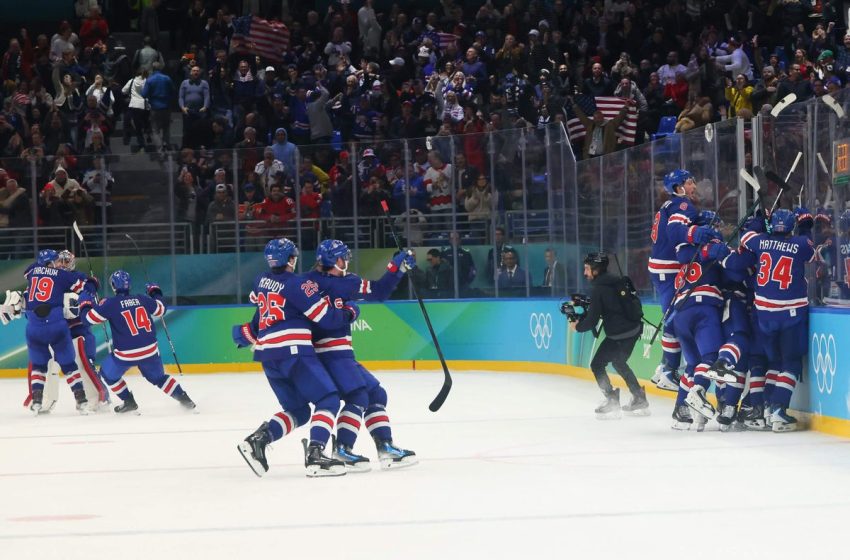
Team USA knocks out Sweden in overtime to reach Olympic men’s hockey semifinals
MILAN — This was hardly the first time these players had victory so rudely and suddenly snatched out of their grasp, so close to the finish line only to blow a tire and skid off into a ditch.
It happens all the time in hockey. Six-on-five goals are deflating, sure, but this is nothing new. Wins become ties, then the game starts anew with the drop of the puck in overtime. That ability to bounce back is hard-wired into a professional athlete’s brain, entwined in their DNA. Short memories. Sharp focus. Move on.
“If you dwell on it, it’s not going to be good,” Carolina Hurricanes defenseman Jaccob Slavin said. “We’ve played in the NHL a long time now, and everyone knows you have to focus on the next shift. If you start dwelling on the past, the past can mess with your game, mess with your confidence. It’s just, move on, keep chugging along.”
But this isn’t some mid-February NHL game, a regular-season affair where two standings points just became one.
This is the Olympic Games. The quarterfinals. Do or die. After 12 agonizing years away, the United States was 91 seconds away from playing for an Olympic medal. Then, in a flash of Mika Zibanejad’s stick, they weren’t. They were tied. They had lost momentum. To Sweden, no less, one of the three hockey superpowers.
How do you mentally reset after that?
Well, you just do. And then you throw Quinn Hughes over the boards and let him do his thing.
Hughes’ overtime goal turned Zibanejad’s dramatic equalizer into a mere footnote and gave the Americans an unbearably tense 2-1 victory in the Olympic quarterfinals. The United States moves on to face upstart Slovakia, the ninth-ranked team in the world with just seven NHL players, only one of them who could be classified as anything close to a star — Montreal Canadiens forward Juraj Slafkovský. It’ll be no cakewalk, not with the joy, confidence and structure the Slovaks have been playing with in this tournament. But Team USA is now a heavy favorite to advance to the gold-medal game, where either Finland or arch-rival Canada will be waiting.
One step closer to the matchup so many have been wanting to see since last year’s stirring 4 Nations Face-Off, which Canada won in overtime.
“I’m just pumped we get to keep this going,” said Devils forward Jack Hughes, Quinn’s younger brother. “You don’t want to end it in the quarters. That’s a great team over there, and I don’t think anyone saw us playing them in the quarters at the start of the tournament. Whoever it was, a great team was going to be eliminated tonight, and we wanted to keep this thing going. It’s the best hockey, the Olympics. It’s fun to keep it rolling.”
Fun now. Harrowing for a while there.
In a fierce and physical tight-checking game, the U.S. led 1-0 on Dylan Larkin’s goal midway through the second period. The Americans were smothering the Swedes, with only Lucas Raymond able to break through for a few high-quality scoring chances, and goaltender Connor Hellebuyck up to the challenge each time. The Americans clogged lanes, harassed puck-carriers, and broke up pass after pass with quick sticks. For 58 minutes and 29 seconds, the tenacious Swedes kept hacking their way through the jungle, only to be smacked back by a stray twig each time.
They stayed patient. They played their game.
“The problem is, if you become impatient, then they’re going to make sure that you pay for it,” Zibanejad said. “We had to keep playing, keep playing, keep putting pucks behind them, keep working them and eventually get our chances. And we did. It wasn’t enough.”
Indeed, with Jacob Markström on the bench for an extra attacker, Sweden finally broke through. And even then, just barely. Zibanejad’s sharp-angle one-timer off a Raymond feed trickled through Hellebuyck and into the net. The ever-so-quiet Zibanejad looked to the heavens, pumped his fists and unleashed a primal scream, exulting to the rafters.
And after making it through that final minute and a half, the Americans regrouped. They’re hockey players. It’s just what they do.
“You’ve got to pick yourself back up,” Quinn Hughes said. “We’ve got guys that have won Cups and gone deep in the playoffs, superstars in the league. So I feel like it’s a resilient group (with) a lot of experience. You just pick yourself back up, get ready to go. I felt like we had an attack mindset in overtime.”
The bench wasn’t terribly animated between the end of regulation and the start of overtime. Frustration? Sure. Panic? Never. Business as usual.
“There was stuff said on the bench, but it’s not like we (were histrionic),” Matthew Tkachuk said. “For a lot of guys on the team, we’re pretty even-keeled. A lot of guys that have played in big games.”
Few bigger than this one. Even when you’ve won the last two Stanley Cup championships, as Tkachuk’s Florida Panthers have. The Olympics are a different beast.
But so is Quinn Hughes. And a little more than three minutes into overtime, Hughes took a pass from his Minnesota Wild teammate Matt Boldy, wheeled around along the blue line, went right up the gut and unleashed a wicked shot right through Swedish captain Gabriel Landeskog and right past Markström, who had done so much to keep his team in the game.
Hughes, because of injury, wasn’t on the 4 Nations team that narrowly lost to Canada. But he’s on this one. And even on this stage, perhaps especially on this stage, it’s a little easier to withstand the stomach-punch of a last-minute equalizer when he’s on the bench — someone who can snatch victory right back.
He’s the kind of player who can be the difference between winning and losing, between believing and doubting, between a second-place finish last year, and a gold medal this year.
“He just was, right?” Slavin said. “We definitely missed him last year at 4 Nations. He’s here, he’s doing his thing, and it definitely makes our team better. It’s unbelievable.”
Larkin scores first Olympic goal
Larkin is four goals from a fifth straight 30-goal season for the Detroit Red Wings team he captains. Yet he had gone without a goal in the first three games of the tournament and didn’t have a lot of chances after being one of the United States’ best players at the 4 Nations.
Wednesday, his line was by far the Americans’ best line, with Tage Thompson getting an abundance of chances and Larkin finally snapping a 0-0 second-period tie with a nifty redirection of Jack Hughes’ one-timer from the point after Larkin, the best faceoff man in the tournament, won the draw.
“He always shows up in big moments,” Brady Tkachuk said. “It’s just the type of player that he is and it’s so fun to be on the same team, he’s such a great player. He just stepped up. He’s always the X-factor. He’s playing PK, he’s a great five-on-five player, and he scored a big goal for us. He’s just a fantastic player.”
It was a cool moment for Larkin and the Hughes brothers, all Michigan residents who teamed up on the scoring battery. The Hugheses, Larkin, Zach Werenski, Hellebuyck, Jake Sanderson and Kyle Connor are part of a star-studded summer group that skates almost daily in Plymouth in a session run by Jim Hughes, dad of the Hughes brothers.
It was a cool moment for Larkin, Hughes and his brother Quinn, all Michigan residents who teamed up on the scoring battery. The Hughes brothers have combined for nine points in four games, but more notably, the Hugheses, Larkin, Zach Werenski, Connor Hellebuyck, Jake Sanderson and Kyle Connor are part of a star-studded summer group that skates almost daily in Plymouth in a session run by Jim Hughes, dad of the Hughes brothers.
“Those skates, we’re talking really high-end players, so it’s a great tune-up for the season,” Werenski said.
Quinn Hughes picked up his fifth assist in four games to tie Brian Leetch (2002) for the most assists by an American defenseman in an Olympic tournament with NHL participation. Hughes’ four-game assist streak is now the longest run by an American player in an Olympics featuring NHLers. He also tied Nicklas Lidstrom (2002, Sweden) for the longest assist streak by a defenseman in an Olympics with NHLers.
Markström starts second game in a row
Despite playing the night before in a qualifying-round win over Latvia, New Jersey Devils netminder Jacob Markström got the start for the Swedes. And he didn’t look any worse for the wear.
Markström made 37 saves and was the biggest reason Sweden remained in the game into the third period. The only goal he gave up to that point was one he didn’t have a chance on, as Larkin — left almost completely unchecked by Rasmus Dahlin in front of the net — tipped Jack Hughes’ shot. Dahlin was standing next to Larkin, but didn’t put his body or his stick on him, allowing him a clean look for the tip.
Markström was flawless otherwise. One of his best saves came midway through the second period, when Auston Matthews made a slick touch pass off a Matt Boldy centering feed to Jake Guentzel, who was racing in alongside him. Markström coolly slid to his right and made the stop. Markström also made two point-blank saves on Tage Thompson during an American power play late in the second period.
Filip Gustavsson started the tournament in goal for Sweden but struggled so dramatically he was scratched for a second game in a row with his Minnesota Wild backup, Jesper Wallstedt, backing up Markstrom. Gustavsson entered as Sweden’s No. 1 but went 1-1 in the tournament with a 2.55 goals-against average and .889 save percentage.
Hellebuyck wins battle with Raymond
Hellebuyck wasn’t tested quite as much as Markström was, but he had quite the game-long duel with Sweden’s Lucas Raymond, who finished the game with five shots on goal, three of them dangerous chances.
Late in the first period, Oliver Ekman-Larsson sprung Raymond for a breakaway right up the gut, and Hellebuyck calmly made the save. Then, early in the second period, Gabriel Landeskog found Raymond at the back door with a brilliant no-look backhand pass through four bodies, but Hellebuyck — never out of position — got his left pad on it. Later in the second, Hellebuyck denied Raymond again, shrugging off a hard shot off the rush.
He played a strong game before his shutout was ruined by Zibanejad’s extra-attacker goal. He couldn’t believe the puck had made it through him, but like his teammates, he had to mentally reset in a hurry.
“I guess you could say mentally strong, but you’re playing a good game, you feel like you deserve to win,” Hellebuyck said. “It’s hockey. You don’t shut out every single night. If you’re playing the right way and feel like you should win, you usually get the result.”
Hedman hurt
As one of the three premier teams in the tournament, the Swedes were never supposed to play in the qualification round. But — and he was almost ashamed to admit it — Victor Hedman was almost glad they did. Hedman missed nearly two months with an elbow injury, returning to the Tampa Bay Lightning for just the last three games before the Olympic break. He needed all the action he could get in order to reach midseason form in a hurry.
“Being a little selfish, for me, to get this extra game was huge,” the big defenseman said after a 5-1 win over Latvia on Tuesday. “I haven’t played a whole lot this year. Get the timing, get the legs into it, get ready for tomorrow.”
Unfortunately for Hedman — and for Sweden — Hedman never got a chance against the United States. Coach Sam Hallam said Hedman suffered a lower-body injury during warmups. Hedman stayed in uniform and sat on the bench to support his teammates, but did not play.
“I was hurting for him,” Landeskog said. “I really was. And I still am. I know how long he’d be working toward this and looking forward toward this. That sucks.”
Interestingly, Jesper Bratt, one of New Jersey’s best forwards, was also on the bench and didn’t play a single shift until the third period after being scratched against Latvia. This, despite the fact Hallam scratched Marcus Johansson.
Bratt scored the winning goal for Sweden to beat the U.S. in last year’s 4 Nations round-robin.
First Appeared on
Source link






