


Tesla to Increase Dashcam Recording History, Keeping Up To Last 24 Hours of Footage
By Karan Singh
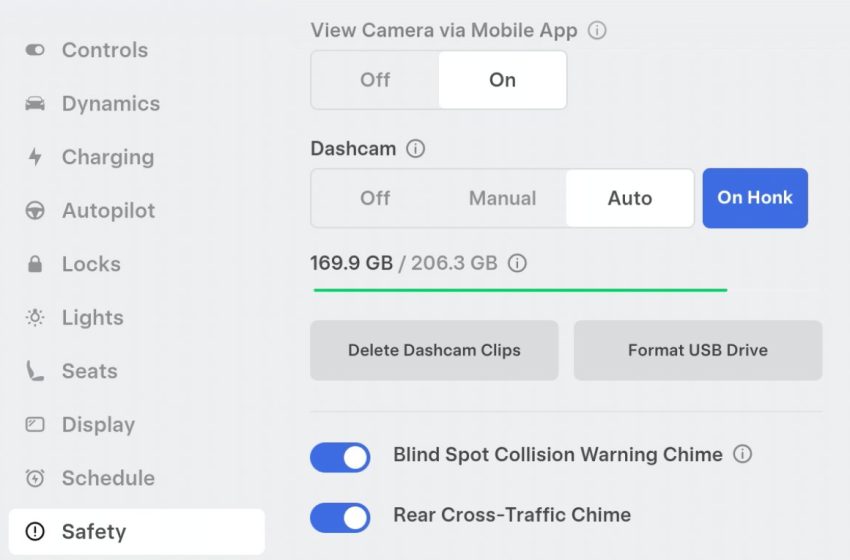
One of the longest-standing frustrations of Tesla’s Dashcam feature is the arbitrary one-hour limit on rolling dashcam footage. Regardless of the USB drive plugged into your vehicle, whether it’s a 128GB flash drive or a 2TB SSD, the vehicle only retains the last 60 minutes of driving before overwriting it.
That means if you forget to save footage within the hour, it’ll get overwritten with new footage. What’s worse is that the vehicle records any time it’s awake, meaning that even after you park, the vehicle is still recording and overwriting data.
That is finally changing, according to the release notes for an upcoming software update in China. Tesla’s Dashcam feature will now support dynamic recording durations.
How Dynamic Recording Works
Instead of a hard cap of one hour, your vehicle will now look at the total storage capacity of your connected USB drive and scale the Recent Clips buffer accordingly.
The updated logic follows these benchmarks: With a 128GB drive, you’ll now retain up to 3 hours of rolling footage, based on available storage space (with saved Dashcam/Sentry footage counting against it, primarily). With a 1TB Drive (or larger), you’ll now have up to 24 hours of rolling footage.
This change allows users to retain video for much longer before it is overwritten. Even for smaller USB drives, the 3-hour limit is a significant increase over the previous 1-hour limit for rolling footage.
Release Notes
The translated release notes in the update state:
Dashcam Dynamic Recording Duration The dashcam dynamically adjusts the recording duration based on the available storage capacity of the connected USB drive. For example, with a 128 GB USB drive, the maximum recording duration is approximately 3 hours; with a 1 TB or larger USB drive, it can reach up to 24 hours. This ensures that as much video as possible is retained for review before it gets overwritten.
Advantages
It also offers a distinct advantage for owners who use larger drives. Up until now, larger drives have meant you could keep more saved footage, but most of the drive still went unused. Now, the vehicle will take advantage of the larger drive and overwrite data less frequently.
For owners on long road trips or dealing with incidents that weren’t immediately noticed, this 3x-24x increase in retention is a significant upgrade. If you notice damage to your vehicle, even up to 24 hours later, you may still be able to see footage of the incident.
While 1TB drives will be able to hold up to 24 hours of recording, they must meet Tesla’s sustained write speed requirements of at least 4 MB/s to prevent footage corruption, so you’ll want to invest in a quality SSD that’s also capable of enduring hot and cold conditions as they happen in your region. We love the Samsung T7 SSD drives, available in 1TB and 2TB capacities.
The “Why” Behind the Change
Historically, Tesla limited dashcam storage to 60 minutes, likely due to a mix of privacy regulations (particularly in Europe) and processor overhead for managing large file structures on slow USB sticks.
However, as the majority of the fleet transitions to AI4 and AMD Ryzen MCUs, more cars than ever are capable of managing significantly higher data throughput. By linking retention to drive size, Tesla is finally rewarding owners who invest in high-end SSDs over the basic drive included in your Tesla.
Supported Vehicles
It’s not clear yet which vehicles or regions will support the dynamic recording duration feature.
Legacy Intel Atom owners may not be able to benefit from the full length of changes to Dynamic Recordings, but we’ll keep a close eye on this feature and let you know what to expect once it begins rolling out to users.
Release Date
The feature just started rolling out to employees in China. It may take a few weeks for this feature to roll out for Chinese users. However, we expect this feature, along with the new custom Automations feature, to roll out to other regions in a future Tesla update.
Ordering a New Tesla?
Use our referral code and get 3 months free of FSD or $1,000 off your new Tesla.
By Karan Singh
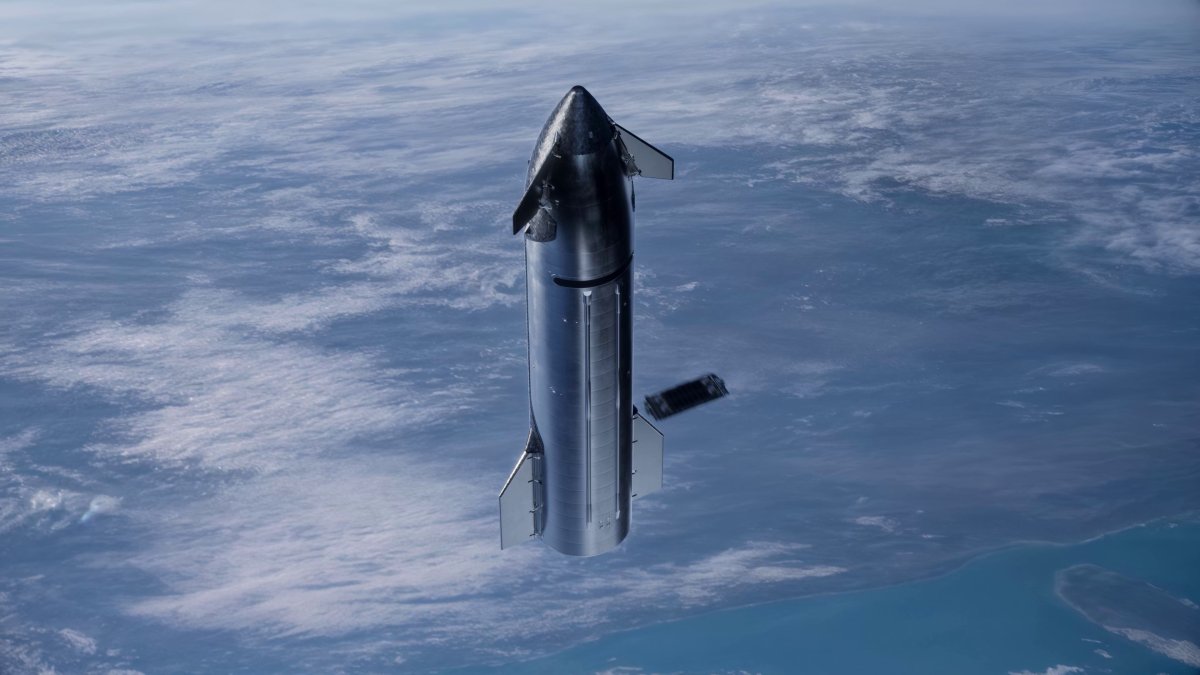
In a move that could redefine the future of artificial intelligence and space exploration, SpaceX has officially acquired xAI, forming a vertically integrated super-entity aimed at launching the world’s most powerful AI compute into orbit.
Elon Musk’s audacious plan of putting massive amounts of AI compute into orbit to solve the problems of terrestrial power grids and cooling systems would be a pipe dream… for anyone but Elon. The solution lies with SpaceX, building a constellation of orbiting data centers powered by the Sun, transforming SpaceX from a launch provider and exploration company into the backbone of truly off-world AI infrastructure.
Musk’s xAI is valued at approximately $250 billion, while SpaceX was valued at about $1 trillion before this transaction.
Tesla’s Stake in an Orbital Future
The implications for Tesla, Elon’s other major venture, are fairly significant. Just last month, Tesla invested $2 billion in xAI to acquire Series E Preferred Stock. With xAI now fully absorbed into SpaceX, Tesla effectively gains a look-through stake in what has instantly become one of the most valuable private companies globally.
This investment now positions Tesla with direct access to one of the most advanced general-purpose AI (Grok), as well as the launch capacity to build the future space-based datacenters that Elon Musk has proposed. This ensures that FSD (and, by extension, Optimus) will have an unrestricted supply of compute for training and deployment.
From Earthbound Data Centers to Sentient Suns
Elon’s vision, outlined in SpaceX’s updates page, is nothing short of a leap towards a Kardashev Type II civilization – a society that’s capable of harnessing the energy of its entire home star.
The plan involves launching a massive constellation of Orbital Data Centers (ODCs) that draw continuous power from direct solar exposure, eliminating constraints such as land, cooling, and grid demand.
The sheer scale of this is staggering. SpaceX is aiming to launch 100GW of AI compute capacity annually into orbit via Starship. Each Starship flight will eventually be capable of carrying 200 tons of these specialized compute satellites.
Within 3-5 years, the SpaceX plan estimates that these ODCs will become the lowest-cost method for generating AI compute. This is primarily due to the elimination of infrastructure costs and the virtually free and inexhaustible energy of the sun.
The long-term vision extends further, incorporating electromagnetic mass drivers on the Moon to launch 500-1000 TW of AI satellites into deep space.
Starship’s Tempo is Key
Just as Starlink provided the imperative for Falcon 9’s rapid reusability, the demand for orbital AI compute will be the ultimate forcing function for Starship’s operational tempo. To deploy the necessary megatons of hardware, Elon and SpaceX are targeting unprecedented flight rates – potentially hourly Starship launches – bringing space launch from a once-a-month milestone to an airport-style logistical operation.
A Unified Front for Amazing Abundance
The merger of xAI and SpaceX, with Tesla’s strategic tie-in, is a nod towards Elon’s Amazing Abundance mission. Grok is already slated to be the coordinating AI for Tesla’s future autonomous fleet of cars and robots. Now, Grok’s brain will be literally powered by energy in space, allowing for cheaper and more rapid scaling.
The new unified xAI and SpaceX entity promises to accelerate humanity’s transition into an AI-driven, multi-planetary future, so we’ll have a lot to look forward to in the next decade as things (literally) get off the ground.
By Karan Singh
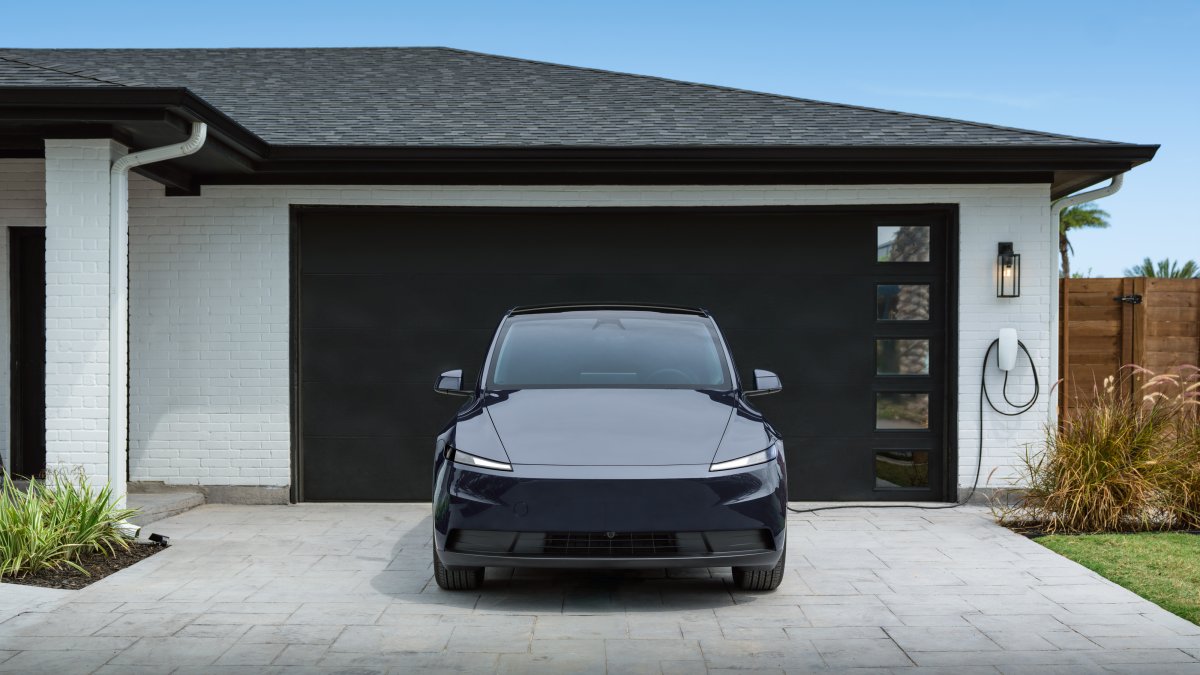
Tesla has revamped the Model Y lineup in the United States, introducing a new entry-level Model Y AWD variant and officially retiring the new “Standard” name in favor of the RWD, AWD, and Premium variant branding.
Here’s a quick table to help you visualize the new lineup:
|
Trim |
Drivetrain |
Range (EPA) |
0–60 MPH |
Price |
|---|---|---|---|---|
|
Model Y RWD |
Rear-Wheel Drive |
321 miles |
6.8s |
$39,990 |
|
Model Y AWD |
All-Wheel Drive |
294 miles |
4.6s |
$41,990 |
|
Model Y Premium RWD |
Rear-Wheel Drive |
357 miles |
5.4s |
$44,990 |
|
Model Y Premium AWD |
All-Wheel Drive |
327 miles |
4.6s |
$48,990 |
|
Model Y Performance |
All-Wheel Drive |
303 miles |
3.5s |
$57,490 |
AWD, But Not Premium
Tesla’s new addition to the lineup is a Model Y AWD priced at $41,990. This variant fills a gap for buyers who need all-weather traction, but don’t want to pay the $7,000 premium for the higher-end Premium trim.
While it features the same 4.6-second 0-60 mph time as the Premium AWD, its range is slightly lower at 294 miles, likely due to the smaller battery size in these non-Premium models.
In addition, this model lacks the same Premium interior features of the original Standard RWD. It includes fabric seats, 7-speaker audio, manual steering column adjustment, no rear screen, no ambient lighting, indirect TPMS, and simplified acoustic glass, among other changes. We have a list of all the changes between the regular and Premium trim.
This helps keep costs down and provides a lower-cost, entry-level option in Tesla’s lineup.
Retiring the Standard Branding
Tesla has officially moved away from the Standard nomenclature that was introduced with the launch of the cheaper Model Y and Model 3. The entry-level model is now simply the Model Y RWD. The RWD model remainst he most affordable way to get into the Model Y, priced at $39,990, while the non-Premium AWD version costs $2,000 more.
Premium Branding Stays
The Premium branding remains the differentiator for Tesla’s higher-volume, feature-rich variants. The Model Y Premium RWD and Premium AWD offer the full Tesla interior suite, including a new, larger 2K QHD primary display, an 8” rear touchscreen, frequency-dependent dampers, and Tesla’s signature glass roof.
Launching Soon
New Model Y AWDs will be available for shipping in most regions in the United States within 2-3 weeks, based on Tesla’s ordering page. Production is expected to begin shortly, if it hasn’t already.
First Appeared on
Source link






