


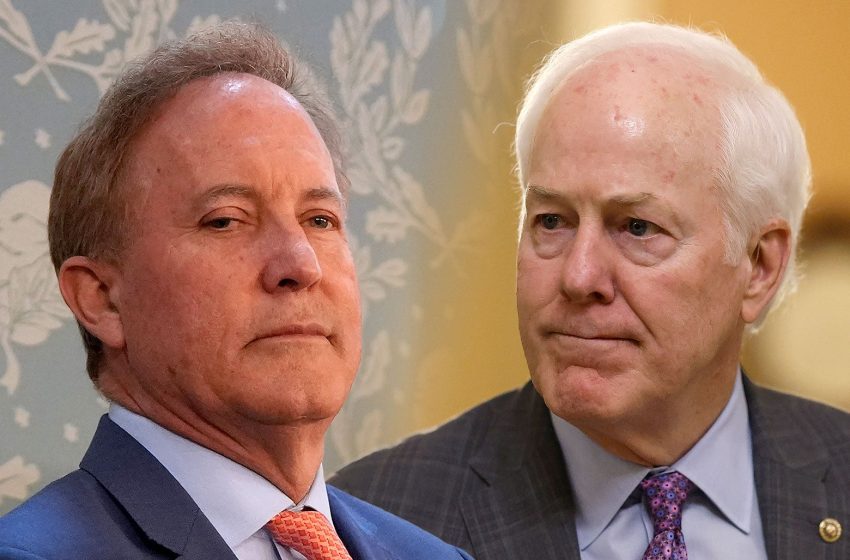
Texas Senate Republicans primary: Who’s the favorite?
Sign up for the Slatest to get the most insightful analysis, criticism, and advice out there, delivered to your inbox daily.
Primary season for the 2026 midterms kicks off Tuesday with all eyes on Texas.
Much of the coverage of Texas has followed the Senate Democratic primary between state legislator James Talarico, the latest Texas Democrat to win the hearts and minds of glossy magazine editors in New York, and Rep. Jasmine Crockett, the partisan warrior familiar to regular viewers of liberal cable news. It’s news on its own terms for Democrats to have a high-profile, close, and frequently ugly statewide primary in Texas. But the primary earned even more national attention last week amid a dust-up between late-night host Stephen Colbert and CBS lawyers over the airing of a Talarico interview. It’s a far cry from the typical Texas Democratic primary, as, usually, someone just volunteers to lose to Republicans in November.
This year could be different, however, because of what’s going on in the Senate Republican primary. On that side of the aisle, the race has been ugly and expensive—and the GOP appears ready to make a move that would give the Democrats a real chance at a competitive general election. And Tuesday’s voting is just the first round of it, for Republicans, before an expected runoff.
Which Republicans are running?
Texas Sen. John Cornyn, who’s held the seat since 2002, who had served as Mitch McConnell’s deputy for a number of years, and who only narrowly lost a race to Sen. John Thune to replace McConnell as Senate Republican leader after the 2024 election. The incumbent has a pair of primary challengers: Ken Paxton, who’s served as Texas’ attorney general for 11 exciting years, and sophomore Rep. Wesley Hunt from Houston.
Why is Cornyn in jeopardy?
Cornyn has never smelled right to MAGA. He’s a governing, establishment conservative who came up in George W. Bush’s Republican Party. Like many Republicans of his era and mannerism, he expressed initial skepticism of Trump in 2016 and rejected Trump’s efforts to overturn the 2020 election, although he has hardly ever voted against the president’s agenda. He is also, in his words, “guilty of actually talking to a Democrat from time to time—and even worse, working with Democrats when it’s in the best interests of our state and my constituents.” Most notably, he was a lead GOP negotiator on a 2022 gun safety bill signed into law by President Joe Biden. This earned him boos at a state party convention and a censure from the Collin County GOP.
What’s the deal with these two challengers?
Ken Paxton does smell right to MAGA. He is a polarizing showman who exists to serve Donald Trump. He filed the premier gobbledygook lawsuit challenging the 2020 election results that December, a case that was dismissed by the Supreme Court for being stupid. At the time, his filing of the lawsuit was seen as a move to curry favor with Trump for a pardon, which gets us to Paxton’s other problem: baggage. This is a man who’s been impeached (though not convicted) for abusing his office, had been under state and federal criminal investigation for almost his entire time as AG, and was divorced by his wife last year on “biblical” (cheating) grounds. I don’t like writing about Paxton because it’s hard to remember all this stuff, and surely I’ve forgotten much, much more.
Hunt, meanwhile, entered the race relatively late, positioning himself as someone who could straddle the middle ground between the “establishment” Cornyn and the ever-investigated Ken Paxton. In other words, he’s competing for MAGA voters as the more electable of the two non-Cornyn options. He describes himself, delightfully, as “the first person in the entire country to endorse President Trump,” as he issued his endorsement of Trump’s third campaign before Trump had even finished his announcement speech in November 2022.
How has Cornyn tried to save himself?
By spending comical amounts of money. North of $60 million, mostly in outside money from national party groups and super PACs, has been spent on the save John Cornyn project. That’s either been to highlight Cornyn’s positive attributes, discuss Ken Paxton’s divorce, hit on Hunt for things like missing votes in the House—whatever shows promise in the focus groups. (My personal favorite back and forth: The Cornyn campaign has run ads about how Hunt voted for Hillary Clinton in the 2008 Democratic presidential primary. Hunt’s explanation is that he did so only as part of a Rush Limbaugh–led operation to sow discord into the primary race. I have been covering political bullshit long enough to know exactly what Hunt’s referring to. But he may sound like a crazy person explaining this to normal human beings.)
Has all this money helped Cornyn?
I mean, if I pocketed a five-dollar bill on the sidewalk right now, it would “help” me in my quest to become a billionaire. And while the money did close some of the early, yawning deficit Cornyn was facing against Paxton in preliminary polling, it hardly has put his opponents away. The donors who’ve been forking it over are questioning whether Cornyn has plateaued. Keep in mind, too, that Paxton has spent barely anything to get where he is and didn’t start running ads in earnest until February. Cornyn has been advertising heavily since last summer.
Are you going to tell us what the polling says or what?
Yes! On average, polls show Paxton narrowly ahead of Cornyn, with Hunt in a consistent but not distant third. That’s been the order since tracking of the race began, with no candidate—whether they’re spending $60 million or not—able to achieve any sort of escape velocity.
So after Tuesday, will we know the GOP nominee?
Probably not. The immediate question for Tuesday is not really who “wins,” but which candidate comes in third. In Texas, if no candidate clears 50 percent of the vote, the top two candidates proceed to a runoff on May 26. That runoff is almost certain if the polling, which shows the leader of the three-way race only managing to get into the 30s, is correct.
This near-certain extension of the primary until the end of May, by the way, is a big part of why the National Republican Senatorial Committee, the Senate GOP’s campaign arm, which exists to defend the party’s seats, was openly furious with Hunt for entering the race in September: The big primary spending will have to continue for another few months. Democrats, meanwhile, have a good chance of selecting their nominee—and then pivoting their resources to the general election—on Tuesday.
If Paxton and Cornyn are so close in these polls, then why is there all this doom and gloom out there about Cornyn’s chances of surviving?
Cornyn may be hanging within a few points of Paxton in the three-way race, but the runoff dynamics—should Cornyn make it to the runoff—could bode poorly for him. Generally speaking, if an incumbent like Cornyn can only scratch his way into the high 20s or low 30s after $60 million in advertising, it may be a sign that the electorate isn’t that into him. Plus, Paxton and Hunt have been fighting over the MAGA vote, so one might expect more of Hunt’s supporters to fall to Paxton. And lastly, the crowd that turns up to vote in runoffs can be a little more die-hard—in this case, more MAGA—than those who turn up to vote on primary day.
What if the runoff is Paxton vs. Hunt?
Hunt does a little better against Paxton—though still trails him—in speculative head-to-head runoff polling. The NRSC and other big donors concerned about electability would determine whether Hunt is close enough to Paxton that he’s worth investing in ahead of the runoff—or whether they want to sit it out and prepare for a long summer and fall of selling Ken Paxton as Texas’ greatest man.
Where’s Trump in all of this?
Trump has not made an endorsement, saying that the three candidates are “all friends of mine.” Sure, sure.
It’s a complicated dynamic. While a more reckless Trump would’ve endorsed Paxton in a heartbeat—and doing so would, effectively, end this primary—he also wants Republicans to keep the Senate. John Thune has clearly done an excellent job convincing Trump that Paxton would be a terrible nominee, so far.
As for Cornyn, perhaps Trump still harbors grudges for various heresies over the years. But even if Trump had forgotten about it all, it’s not clear that a Cornyn endorsement would get him over the hump in the primary, an outcome that Trump would find embarrassing. Similarly, with Hunt, Trump would be hesitant to endorse the third-place polling candidate.
Even if it is risky for Trump to endorse Cornyn, that might be what it takes, in the runoff, to keep Cornyn in his Senate seat. There’s just no sign Trump is willing to take that leap with Cornyn showing such little promise on the trail.
OK, whatever. Let’s get back to the big picture. Donald Trump won this state by 14 points in 2024. No one likes Sen. Ted Cruz, but he won it by 9. No Democrat has won statewide in Texas since the 1990s. Why does any of this matter? It’s Texas! Republicans win it!
I basically agree with you, interlocutor, but here’s the argument: It’s shaping up to be a strong Democratic year, generally. And Republicans have reason to be concerned that the gains they made with Hispanic voters, which shored up their standing in the state in the last election, could be collapsing. The last key for Democrats to a competitive race would be an unusually favorable matchup: Ken Paxton, one of the more polarizing figures in the states, against James Talarico, who has crossover appeal potential in a way that Jasmine Crockett may not.
I will believe Democrats can win a Senate seat in Texas when Democrats have won a Senate seat in Texas. But there sure is a lot of money flying around the Republican side this time to ensure they land their strongest nominee—and it’s not looking like they will.

First Appeared on
Source link






