


The ’80s Car Feature That Would Fit Perfectly In The AI Hellscape Of Today
According to an NBC poll conducted in 2026, when asked about artificial intelligence, 46% of respondents didn’t hold a favorable opinion of the technology. Seemingly everywhere nowadays, AI’s prevalence is causing some to conclude we’re all living inside a dystopian nightmare. Automakers are investing in AI, but no one is seeing any benefit – at least not yet.
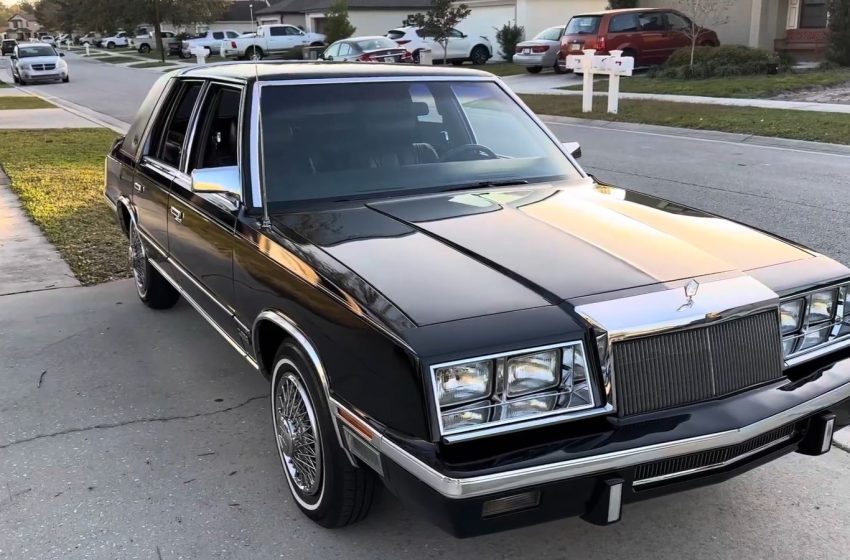
Today’s headspace is very different from the 1980s, which held a hopeful and excited viewpoint on emerging technology. In fact, back then, it was seen as highly futuristic for a car to talk to you, and that’s just what Chrysler’s Electronic Voice Alert (EVA) did. Originally launched in 1983, it included 11 prerecorded messages tied to various systems of the car and would later expand to 24. Models like the New Yorker, LeBaron, and Laser, among others, could talk to their drivers. For example, it would state “a door is ajar” if you failed to fully close your door, and to “fasten your seatbelt” if you didn’t have it on, among other messages. Although, the messages were basic and had a robotic sound quality to them — unlike modern-day assistants like Amazon’s Alexa, for instance.
With “Knight Rider” (a show about a talking car) ruling the airwaves at the time, you’d think Chrysler’s EVA would be a hit. However, it seems enough drivers found it so bothersome that the automaker decided to include a button to shut it off, hidden in the glove compartment. With the number of systems in modern cars monitoring the driver and, in some cases, ready to take away momentary control, a nagging robotic voice over the audio speakers doesn’t seem too out of place today.
Modern cars are still messaging drivers, to the annoyance of many
Chrysler’s EVA was really just a precursor to what modern cars provide today. Among the cars that Consumer Reports testers disliked most in 2025, Volvo’s EX30 had one evaluator screaming back at the vehicle, which wouldn’t stop incessantly prompting him to stay focused on the road ahead. Over the past several years, driver assistance technology has continued to advance in terms of capability. Generally known as Advanced Driver Assistance Systems (ADAS), this technology utilizes radar, cameras, and AI to help with blind spots and emergency braking.
Brands haven’t stopped adding to these systems, either, with things like driver attention warnings and lane-keeping assist functions. Government regulators are jumping on board as well attempting to make existing and even new ADAS functions a matter of law. Take a bill in California, for instance, which sought to barrage drivers with various sensory feedback when traveling 10 mph beyond the posted speed limit — although the state ultimately wussed out on putting it into effect.
Some feel this goes beyond safety and into a world where every vehicle has a built-in backseat driver, constantly scolding away. Kristin Kolodge, an executive director at J.D. Power’s Interface Research, told CNBC, these systems may “come across as a nagging parent; no one wants to be constantly told they aren’t driving correctly.” So, drivers find ways to turn off these warnings, just as they did with Chrysler’s voice assistant of the ’80s.
Chrysler wasn’t the only ’80s automaker that delivered talking cars
While Chrysler was busy implementing its EVA system, which utilized a synthesis chip, Nissan was going a different direction. For example, some early ’80s Maxima and 300ZX models, among others, featured a unique analog talking system. It used a small record player and a three-inch vinyl to emit vocal messages when triggered. Rather than the robotic male Chrysler used, Nissan opted for a more natural-sounding female voice. The messages were similar to the American automaker’s, with low fuel warnings and phrases like, “key is in the ignition.”
Oldsmobile was another brand that jumped on the talking bandwagon with its own version, the Voice Information Reminder System. Available in models like the Toronado Caliente and Oldsmobile 98, it was more advanced, enabling engineers to coax out a wide variety of messages with a deeper vocabulary. While drivers from the era found them often grating, these early voice systems from the 1980s are highly sought after by collectors today, and they really wouldn’t seem out of place in modern models.
First Appeared on
Source link






