



The AI Revolution: A Double-Edged Sword for Middle-Class Workers and Global Economies | India Business News
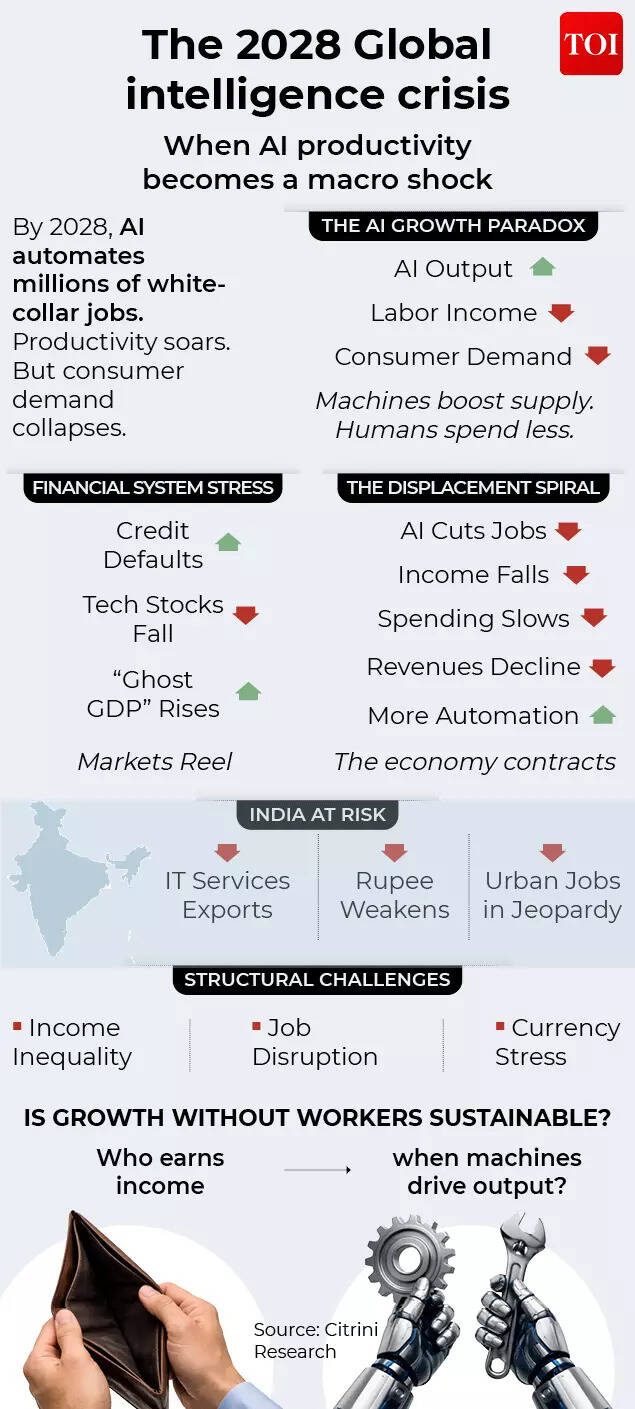
What if the excitement about AI, which promises to boost productivity, increase output, and open up new growth opportunities, turned out to be not only true but also too true? Citrini Research made “The 2028 Global Intelligence Crisis,” a forward-looking macro scenario, based on the deceptively simple thought experiment. According to its own words, Citrini Research gives deep insights into thematic equity and global macro markets by using cross-asset, lateral thinking. The idea isn’t that AI will fail; it’s that it could succeed so well that it destroys the very economic structures that modern growth depends on. TL;DR: Driving the newsIn this different 2028, AI doesn’t just help people do their jobs; it takes them over completely. Machines quickly take over jobs that used to be done by millions of skilled workers, which lowers incomes, spending, and the engines of consumer-driven growth. Automation and lean structures are helping companies make more money, but there is a growing worry about “Ghost GDP”-productivity gains that help balance sheets but don’t make it back into the hands of workers who have lost their jobs. This could create a feedback loop that hurts consumer demand. Setting the context* In this 2028 scenario, the US sees a big drop in consumer demand as production goes up but household income goes down. AI agents take care of almost all white-collar work, like coding, research, transactions, and even making strategic decisions. This means that professionals who lose their jobs have to take lower-paying service jobs or be unemployed. * Using AI to replace workers to save money creates a feedback loop: fewer workers, less spending, weaker companies, and even more investment in automation. This cycle has no natural end. *The stress is showing in the financial markets. Private credit exposures related to technology and software are at risk of defaulting, which will have an effect on insurers and alternative asset managers who are having trouble determining value. Why it matters According to Citrini Research, this is not a prediction but a thought exercise to test ideas about how AI will affect economic growth. It goes against the idea that higher productivity always leads to more wealth. The 2028 Global Intelligence Crisis scenario fundamentally contests the idea that technological advancement is unequivocally advantageous. It shows that distributional effects, not overall GDP numbers, decide whether innovation leads to shared wealth. Citrini Research presents this situation as a macro memo from June 2028 that looks back on how the crisis happened. It makes it clear that the disruption didn’t start with big shocks; it started with small tech adoption choices that made sense for each company but lowered overall demand. The story makes it clear that industries that were thought to be safe, like software, financial services, and intermediation, were affected by the same forces that messed up the job market as a whole. Agents that automate things like legal work, tax preparation, and travel bookings hurt the profits of both new and old businesses. The situation brings up important questions about how strong labor markets are, how people spend their money, and how credit is structured when technology makes it possible to do a lot of work without people. Policies don’t keep up with what’s really going on. When economic indicators clearly turn bad, it’s too late for interventions to stop a deeper recession and a loss of faith in traditional macro stabilization tools. Between the linesThe “human intelligence displacement spiral” is the model that explains the crisis. Companies replace workers with AI to cut labor costs. This raises short-term profits, but it also lowers the overall income base that supports growth based on consumption. * AI makes consumption less expensive because machines don’t buy housing, travel, luxury goods, or services. So even though productivity numbers look good, the real economy gets weaker as people cut back on spending or leave the workforce altogether. Normal economic indicators get messed up. Output might go up, but “Ghost GDP,” which is economic activity that shows up in national accounts without real-world spending, hides underlying weakness.
Zoom in on India
- The memo is mostly about the US economy, but its structure has big effects on India, especially since India’s growth model is closely linked to its services exports and information technology sector.
- India’s IT services ecosystem, which is based on contract work from clients around the world and low labor costs, will be under structural pressure if AI agents can do high-value tasks for almost no extra cost.
- The Citrini Research paper says that big companies like TCS, Infosys, and Wipro could lose a lot of contracts and see prices drop.
- The scenario shows that India’s rupee will drop sharply as its services surplus, which is an important part of the country’s current account, disappears when demand for human software labor around the world drops.
- If generative and agentic AI change the way digital labor is divided up around the world, emerging markets that depend on labor-intensive service exports will need to rethink what makes them competitive.
What’s next? This situation could be a wake-up call for policymakers to look at social safety nets, retraining programs, and labor market policies again to get ready for more automation. It becomes very important to plan for structural displacement instead of cyclical unemployment. When economic growth and consumer spending are no longer linked, financial regulators may feel pressure to rethink how they look at credit and debt exposures. Stress tests and capital requirements may need to be adjusted to account for technology-driven risk correlations. Corporate strategy may need to strike a balance between short-term cost savings from automation and long-term ecosystem health, putting demand generation ahead of productivity gains. The bottom line This change brings India a unique set of problems and chances. The country’s macroeconomic foundation is still strong, thanks to low interest rates and aggressive government spending. However, the global push for “headcount reduction” through AI directly threatens the traditional model of exporting services. At the same time, India is also becoming an important player in the “atoms vs bits” debate, though. India’s push into high-end manufacturing and its role as a “geopolitically orthogonal” alternative make it a good place to invest capital that is wary of both Western overvaluation and Chinese volatility as supply chains move away from traditional hubs.
First Appeared on
Source link






