


The angelic Meloni behind a fresco fiasco
Unlock the Editor’s Digest for free
Roula Khalaf, Editor of the FT, selects her favourite stories in this weekly newsletter.
Just a stone’s throw from Italy’s parliament stands the Basilica of San Lorenzo in Lucina, one of Rome’s oldest churches and home to art by the 17th-century Baroque masters Gian Lorenzo Bernini and Guido Reni.
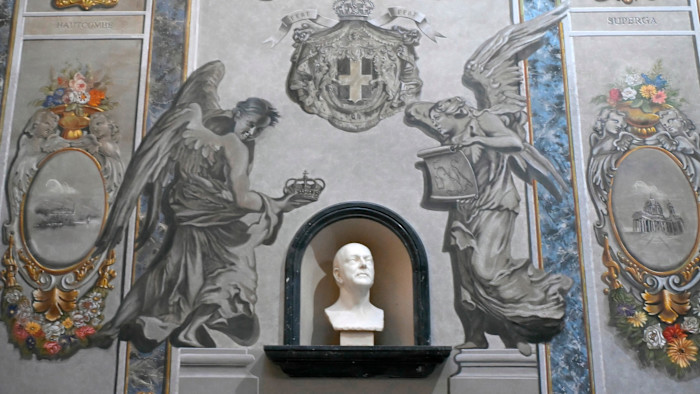
In recent days, though, the visitors streaming inside are not there to admire the historic paintings and sculptures but to gawk at a newer fresco: an angel with the unmistakable face of Prime Minister Giorgia Meloni.
It was originally painted in 2000 in a chapel dedicated to the memory of Italy’s last king, Umberto II. At the time, the angel — holding a map of Italy — looked like an ordinary cherub.
But the fresco emerged from a recent renovation with a distinctive new visage, though it escaped the notice of locals and tourists alike until La Repubblica newspaper revealed the resemblance last weekend, unleashing a national uproar.
“The deification of the sovereign was widespread in antiquity, legitimising absolute earthly power,” former Forza Italia lawmaker Elio Vito fulminated on X. “This is not a joke; it is a sign of the dark times.” The opposition Democratic Party demanded an investigation, calling the fresco “unacceptable”.

Monsignor Daniele Micheletti, the parish priest, says he was unaware of what the painter had done while renovating the water damaged chapel, but admitted he was pleased with the surge in visitors.
“I see nothing wrong with it,” the cleric told reporters. “If the result is bringing together people who don’t usually come to the basilica and getting them to pray, I’m happy.”
The self-taught restorer, Bruno Valentinetti, 83, was ambiguous about whether he intended to paint Meloni or not. He insisted he merely refreshed the original fresco, but also said he was free to paint who he wanted — just as Caravaggio tucked his own self-portrait among the characters portrayed in his biblical scenes.
Sharing the image on social media last weekend, Meloni, an avid collector of angel figurines, commented, “no, I definitely don’t look like an angel.” But the curious visitors who streamed into the church had little doubt.
“The face is her face,” said Marco Musso, 27. “It seems like something done on purpose.” His father, Francesco, a retired police officer, expressed dismay. “It’s not a good image for Italians,” the elder Musso said. “She should stick to politics.”
The Catholic Church was not amused. “Images of sacred art and Christian tradition cannot be misused or exploited as they are intended exclusively to support liturgical life and personal and community prayer,” said Cardinal Baldo Reina, Pope Leo’s vicar for Rome.
Depicting rich, powerful individuals in Catholic art is a long-standing tradition in Italy. Renaissance artists like Giotto painted their patrons in works financed by the Church.
“Places of worship were the privileged spaces where governors, princes and kings had their images entered into sacred history,” says art historian Jacopo Veneziani, a professor at Milan’s IULM University. “It was an effective way of legitimising power by placing it in a religious context.”
More recently, fascist dictator Benito Mussolini was depicted as a peasant, bundling wheat behind the Virgin Mary, in a mosaic on a church exterior in Sabaudia, the beach town he founded in the 1930s.
Today, politicians are fixated on social media, which is why Veneziani believes Meloni’s depiction as an angel sparked such a furore. “We are no longer used to seeing the faces of power appear in a sacred space,” he said.
With the growing crowds threatening to overwhelm the solemnity of church, Valentinetti late on Tuesday night bowed to pressure from the Vatican and covered the angel’s face with white paint.
Andrea Mammone, a professor at Sapienza University, said the Catholic Church had to insist that Meloni’s face be scrubbed — lest it become a magnet for her zealous supporters.
“The church had to do something to avoid this becoming a sort of cult site for political activists,” he said. “You need to separate religion and politics as much as possible.”
First Appeared on
Source link






