


The Best and Worst of USA Hockey’s Brotherhood, All at Once
A few minutes after he scored the overtime 2-1 game-winner over Canada to give the American men’s hockey team its first Olympic gold medal in 46 years, 24-year-old forward Jack Hughes was interviewed on NBC. With several teeth missing, blood dripping from his mouth, and an easy smile regardless, Hughes looked like a cross between a Pictionary scrawl of a hockey player and a popular jock turned vampire character from some 1980s film.
“This is all about our country,” Hughes said, air whistling through the newly jagged gap in his front teeth. “I love the USA. I love my teammates. The USA hockey brotherhood is so strong.” He would know. Hughes and his older brother, Quinn, a defenseman, were one of two sets of actual brothers on the U.S. men’s hockey team at the Milan Cortina Olympic Games, the other pair being the bruiser podcasters Brady and Matthew Tkachuk. The Hughes brothers were roommates in Olympic Village, as were the Tkachuks; their rooms were across the hall from each other. Jack brought along The Odyssey to read, Quinn scattered his Team USA warm-ups everywhere, and the Tkachuks’ door was, literally, always open.
In the knockout-round quarterfinals against Sweden last Wednesday, it was Quinn, 26, who scored an overtime goal to keep the Americans in medal contention in Milan, one more line item to add to his rapidly expanding lore. (Others include “sees ghosts,” “helps friends,” and “orders another.”) Then on Sunday, against Canada, Jack—whose own résumé features things like “drafted first overall by the Devils,” “sliced his hand on glass at a steak house earlier this season and missed 18 NHL games,” and “spotted with pop star Tate McRae”—broke up a pass during 3-on-3 overtime, skated into the zone, and converted a Zach Werenski setup into that most elusive, effusive of things: an American golden goal. Score another one for the brotherhood.
Actually, I should be more specific: an American men’s golden goal. Team USA’s women had already won their Olympic tournament a few days earlier, on Thursday, with a 2-1 overtime winner of their own against Canada. Trailing 0-1 with 2:04 to play in the third period, five-time Olympian (and nonchalant romantic!) Hilary Knight had tipped in a powerful shot by Laila Edwards to tie the game. In overtime, it was Megan Keller who coolly dangled her way to gold. It was the seventh meeting of these two nations in a women’s gold medal game and the third victory for the United States. (I’m still scarred from witnessing one of the losses.) After the game, Kendall Coyne Schofield brought her son on the ice. Kelly Pannek tied an “IN KELLER WE TRUST” flag around her neck like a cape. Head coach John Wroblewski lingered on the bench, his face crumpling into proud tears. Women’s hockey hadn’t been an Olympic sport back in 1980; that would take another 18 years. Which made February 2026 the very first time both U.S. hockey teams earned gold medals in one Olympics.
A hockey gold medal twofer at the Winter Games! It’s an accomplishment that should result in everyone involved absolutely draped in shared glory, basking in mutual admiration. For several precious hours on Sunday—but only for those hours—that’s exactly what happened.
On the NBC broadcast, women’s players like Edwards were shown oohing and ahhing from the stands over Matthew Boldy’s bull-in-ballet-slippers goal, and they gawked like the rest of the world at spectacular U.S. goaltender Connor Hellebuyck, who played the game of his life in turning away 41 of 42 Canadian shots. On social media, people shared delightful archival images of Ellen Weinberg Hughes, Jack and Quinn’s mother, a former U.S. national team hockey player who served as a player development consultant for this year’s gold medal–winning women’s team. And in a postgame interview, asked what person he’d thought about first when he scored his sudden-death game-winner, Jack Hughes replied: “Oddly enough, Megan Keller.”
All this synchrony was elegant and galvanizing. It made a lovely, lively conclusion to a Winter Games in which Team USA en masse earned more gold medals than ever before. And just as things were feeling really good? A shameless visitor from the United States government paid a visit to the men’s locker room, chugged a brewski, and shook up the Olympic discourse like a snowglobe.
Unfortunately, I can’t say this is the first time I’ve been jump scared by FBI director Kash Patel as it relates to the sport of hockey. (Last year, as Alex Ovechkin approached and passed Wayne Gretzky’s goal-scoring record, there were multiple games where cameras zoomed in on Patel and the Great One sitting side by side.) It also isn’t anything new for President Donald Trump to be interfacing with NHL players. (When the back-to-back champ Florida Panthers visited Washington, D.C., in January, the athletes all wore Trumpian red ties; the commander in chief called them “young, beautiful people” and added, “But I got power, too—it’s called the United States military.”) On Sunday evening, both of these forces combined to create a perfect PR firestorm for the men’s hockey team.
In videos—some posted by players onto their livestreams, some leaked to reporters—the sloppy, festive gold medalist men, many in ski goggles to protect their eyes from Champagne, welcome the thirsty Patel into their locker room to celebrate. They bounce around, they hoot and holler, they hang a gold medal from his neck. They grin in anticipation as he FaceTimes the president. Trump is in chatty mode, riffing for several mostly uninterrupted minutes, bringing the house down with lines like: “Your goalie played not bad!” He invites the team to the State of the Union address and to visit the White House, saying he’ll send a military plane. (“Close the northern borders!” one player chirps.)
Eventually, inevitably, the American president plays the hits. A little negging of the ladies, a little owning of the libs. “I must tell you, we’re gonna have to bring the women’s team,” he says about those other U.S. Olympic gold medalists. “If they weren’t invited, I do believe I probably would be impeached, OK?” Fraternal laughter all around from the USA hockey brotherhood.
There was a lot to dislike in all of this. Pick your poison. Maybe it was seeing all the athletes who are from (or play in) ICE-ravaged Minnesota just joshin’ with the powers of the state. Maybe it was the idea of Patel making the Milan trip on his FBI jet, our taxpayer dollars funding the dismantling of both our American institutions and our initially happy Sundays. Maybe it’s that tone—such merry misogyny—or maybe it is the demoralizing, chilling knowledge that to even use the word “misogyny” is enough to be immediately dismissed as hysterical or shrill. Maybe it is the dread of hearing the worst person you know react to the video by saying something like, “Ha, you think this is bad? This is nothing!” and realizing that they’re right.
Maybe it’s just the fact that everything is like this now: exhausting, rude, no big deal, and/or not a big enough deal, all of it caught in 4K. Man, and all anyone wanted to do was celebrate some kick-ass hockey games.
Watching Sunday’s gold medal matchup, from puck drop to “Star-Spangled Banner,” my mind was its usual jumble of all the brilliant and brain-dead things I wanted to share about the big game. Like how the players all looked like giant kids out there in their International Ice Hockey Federation–mandated neck guards! Or how intense the pace was without commercial breaks! Or how thoroughly it bummed me out that Canada’s captain (slash class chaperone), Sidney Crosby, was really, truly sidelined by injury in the gold medal game of what is probably his last Olympics. Or how, in response to the noises I made when Nathan MacKinnon somehow did not score a goal here, my son asked me whether I was laughing or crying—and I wasn’t sure of the answer.
I hoped to offer undying praise and thanks for American goalie (and chill bus snoozer) Hellebuyck, who stopped breakaways from Canada’s Connor McDavid (the best, most frustrated player in the NHL right now) and Macklin Celebrini (the league’s most instantly beloved) and who also pulled off a hot goalie stick save for the ages. I didn’t want to offer JT Miller and Vincent “I’m getting so fucked up tonight” Trochek an apology for my general attitude two weeks ago, but given their fine work fending off power plays, I figured I probably should. I really respected that Canada had a trio of antagonistic players whom some had started to refer to as “The Fine Line,” and that American Brock Nelson’s grandfather, great-uncle, and uncle had all won hockey gold either 46 or 66 years ago. I was all excited to share a wholesome meme in which Jack Hughes was recast as girl who is going to be OK, and to boost my buddy Craig Custance’s creepily accurate Team USA prediction from 2011.
I also reminisced about how in 2013, during the doldrums of an NHL lockout, I went to Ufa, Russia, to write about hockey’s preeminent under-20 international tournament, the World Junior Championship. At the time, the Americans had won the WJC only twice since its inception in the 1970s. Canada, by contrast, had racked up 15 golds. But in Ufa, Team USA’s top teens beat Canada’s 5-1 in a semifinal statement game, with some now familiar faces on both sides of the ice.
MacKinnon attempted three shots for Canada. Canada goalie Jordan Binnington was subbed in midway through. On the American side, Miller had a pair of assists, Trochek added another, and this fun little zippy kid from Boston College named Johnny Gaudreau scored twice and added a helper. Before facing the Americans in the final, a few players from Team Sweden held up mock newspaper sports pages that said: NO MORE MIRACLES FOR YOU!
The U.S. won that 2013 WJC gold medal game 3-1, and in hindsight, it seems like America’s journey to the 2026 Olympic medal got going in earnest that day—not just because of the players on that 2013 roster, but also because of all the ones who came up after them in USA Hockey’s National Team Development Program, learning from and striving for that kind of success. American defenseman Charlie McAvoy, as one example, crossed paths during his time in the NTDP with Zach Werenski, Matthew Tkachuk, Auston Matthews, Jack Eichel, Dylan Larkin, Tage Thompson, and Jake Oettinger—all of whom are now his 2026 Olympic gold medalist teammates, forever.
Earlier this month, McAvoy, Werenski, and Oettinger all decided to arrive early in Milan so that they could walk in the opening ceremony and do things like watch Ilia Malinin skate. Just ol’ buddies being pals. On the eve of the men’s gold medal game, during an exhibition gala, the Quad God skated to the song “Free Bird”—the men’s hockey team’s goal song—and it felt like some kind of blessing. Gotta make sure to mention that if they win, I thought to myself. Instead, Patel burst into the locker room and made a lot of people look like losers. I guess the great American poet Robert Frost was right about how nothing gold can stay.
On Monday, the women’s hockey team, now in the unfortunate position of having been roped into all of this discourse through no fault of their own, announced that they had turned down an invitation to Tuesday’s State of the Union. (No word yet on whether they’ve RSVP’d to Flavor Flav about Las Vegas.) Beyond that, the women’s players seem to be lying low. For them, Olympic gold is table stakes, not some once-in-a-lifetime opportunity.
On the men’s side, by contrast, Sunday’s win was a giant exhale, a new reality, a brisk stride past the inspiring but oppressive legacy of the Miracle on Ice. (Even 1980 team captain and pivotal goal scorer Mike Eruzione sounded almost pleading during a pregame TV interview when he predicted, of this year’s Americans: “This is their team, this is their time.”)
Both finals were fast-paced, unpredictable, best-on-best hockey, as good as Olympic competition gets. One was a sweet continuation of a bitter rivalry. The other was a glimpse into the delicious potential of showcasing NHL talent on the international stage, even if right now it has left a sour taste. In 2028, we can expect a return of the World Cup of Hockey, an NHL-owned event that the American team last won in 1996.
For the U.S. men, winning Olympic gold this weekend overwrote the annoyance of last year’s OT loss to Canada in the final of the surprisingly heated, glorious 4 Nations Face-Off tournament, even as it also created new distractions. And the win helped ensure that in the future, American hockey success won’t take some miracle on ice—it’ll just be what’s expected. The victory reflected not only the work of the brothers brothers on the American roster but also the closeness of the many other players who have been growing up together in one big USA Hockey family for quite some time. And when it comes to family: Sometimes your people will embarrass you, and sometimes they’ll make you proud.
For weeks now, my younger and more irascible son had been asking when he’d get to see “Canadian tears.” (Apparently that Jon Hamm commercial, jinxy as it felt, really resonated with the 8-year-old set.) But when the time finally came early on Sunday morning to neener-neener the losers, he changed his tune. “I kind of feel bad for them,” he admitted as stone-faced Canadians did their best not to rip those little stuffed mascots to shreds. I did, too.
And anyway, I was the one already crying. After Hughes’s golden goal, as the American men skated around the ice draping themselves in the Stars and Stripes, someone unfurled an even more precious item. It was a no. 13 Team USA jersey that said GAUDREAU on it, in memory of the late, great All-American known as Johnny Hockey, who in August 2024 was killed alongside his brother, Matty, when they were struck by an impaired driver as they bicycled home from their little sister’s rehearsal dinner in New Jersey. Once upon a time, I’d marveled at Gaudreau’s play for Team USA in Ufa, Russia. On Sunday, as the American captains held his jersey up between them, it was a reminder that he should and would have been on this roster, too.
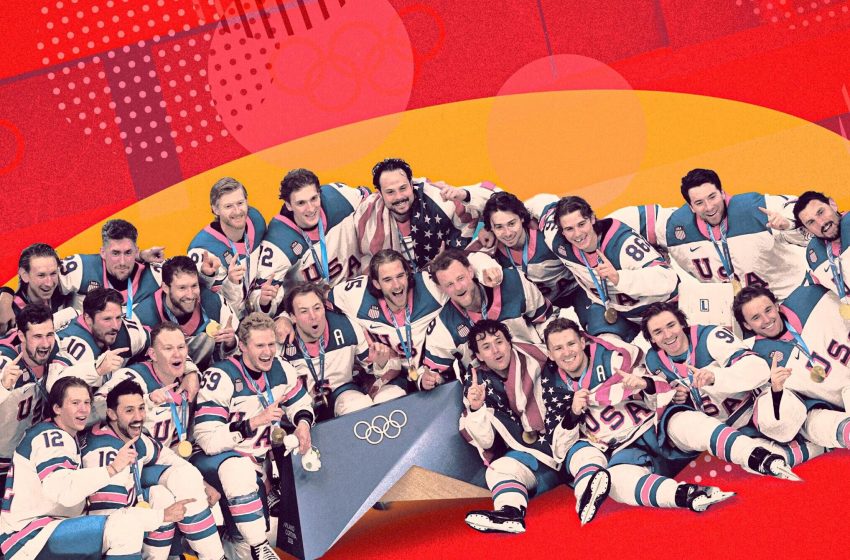
As Team USA gathered on the ice for a group photo after the game, they asked the photographer to wait for a minute so that they could make sure the most cherished siblings in the American hockey family were present, too. Larkin and Werenski skated over to gather two of Johnny Gaudreau’s toddlers, Noa and Johnny Jr., in their arms. (His third child, Carter, was born seven months after his death.) The no. 13 GAUDREAU jersey was held front and center. All that locker room machismo bullshit—boys will be boys in its most pathetic form—was hours in the future. For now, what was on display was the true strength of that USA hockey brotherhood, the one the smiley, bleeding Hughes had shouted out after his game-winner.
I thought about how U.S. men’s hockey assistant coach John Tortorella had reached out to Guy Gaudreau following his sons’ death to invite the grieving father to come help out at Philadelphia Flyers practice. I thought about how at the Gaudreau brothers’ funeral, John’s widow, Meredith, drew some real hearty laughter when she paused to highlight just how proud her 5-foot-9 husband was to be the dad of a chunky-as-hell, 93rd-percentile baby boy whom they sometimes called Bubba.
It’s one of life’s great privileges to become a part of something much bigger than you. I’m not certain that the 2026 Olympic men’s gold medalists have fully grasped the enormity of their accomplishments yet or the responsibility that accompanies them. But perhaps, given enough time and space, they can move the puck ahead.
Katie Baker
Katie Baker is a senior features writer at The Ringer who has reported live from NFL training camps, a federal fraud trial, and Mike Francesa’s basement. Her children remain unimpressed.
First Appeared on
Source link






