


The DART mission changed how two asteroids orbit the sun
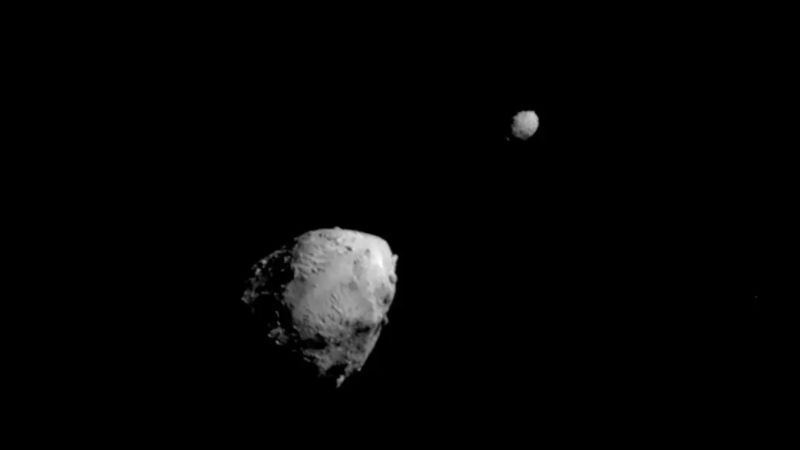
In 2022, a NASA spacecraft intentionally barreled into the tiny asteroid Dimorphos during a planetary defense test. The objective was to assess whether humanity could protect Earth from cosmic threats, such as space rocks. New observations now reveal that the planetary defense test was a success, altering the orbit of Dimorphos as well as that of a larger asteroid called Didymos.
Dimorphos and Didymos are a binary pair, meaning that the asteroids orbit one another while also circling the sun — and a measurable change for one will affect the other.
The new data show that the time required for Didymos and Dimorphos to complete one solar orbit, which takes about 770 days, permanently decreased by less than a second after the Double Asteroid Redirection Test, or DART, according to a study that published Friday in the journal Science Advances.
“The change in the binary system’s orbital speed was about 11.7 microns per second, or 1.7 inches per hour,” said lead study author Dr. Rahil Makadia, a planetary defense scientist who worked on the DART team and recently completed his PhD in aerospace engineering at the University of Illinois Urbana-Champaign, in a statement. “Over time, such a small change in an asteroid’s motion can make the difference between a hazardous object hitting or missing our planet.”
The DART mission marks the first time a human-crafted object has altered the path of a celestial body as it orbits the sun, according to the study authors — and if an asteroid is found to be on a collision course with Earth in the future, it may not be the last time.
While Didymos and Dimorphos have never posed a risk to Earth, the binary system provided NASA with the perfect scenario to evaluate how effectively a spacecraft could be used as a deflective tool.
But to gauge the success of the test, researchers needed to measure how Dimorphos and Didymos were changed by the impact.
Didymos is shaped like a spinning top and is believed to be a rubble pile asteroid — essentially a collection of dust and rocks loosely held together by gravity. Dimorphos, also a rubble pile, likely formed from debris that clumped together after being shed by Didymos.
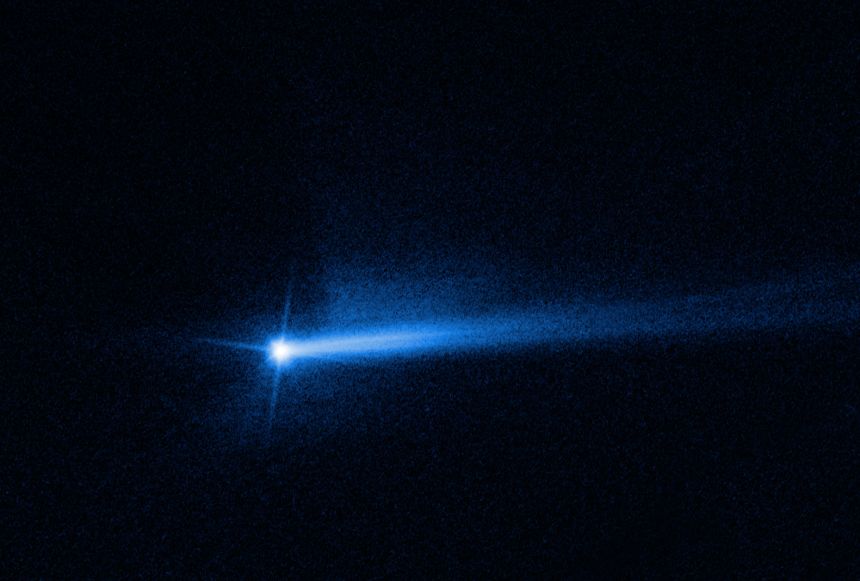
When DART slammed into Dimorphos, a massive cloud of debris was released into space, estimated to be 35.3 million pounds (16 million kilograms). While the 560-foot-wide (170-meter-wide) space rock only lost 0.5% of its mass, the debris released was 30,000 times greater than the spacecraft’s mass, according to previous research.
Scientists determined that the force of the rubble spewing from the asteroid actually packed more of a punch than the spacecraft did when it slammed into the space rock. The momentum boost helped shrink the time it takes for the pair of asteroids to orbit the sun.
Previous research has shown that Dimorphos’ 12-hour orbit around Didymos decreased by 33 minutes.
The new study highlights that the sheer amount of material blasted away from the asteroid system also increased the speed at which both space rocks orbit the sun, reducing the total orbit time by 0.15 seconds.
In order to measure this orbital change, astronomers relied on ground-based observations of Didymos as well as data from when the asteroid passed directly in front of stars. Known as stellar occultations, such movements enable scientists to measure an asteroid’s direct position, speed and shape.
But spotting when a star blinks for a fraction of a second as an asteroid passes in front of it from our perspective on Earth is incredibly challenging. The study’s findings were dependent on 22 stellar occultations taken between October 2022 and March 2025 by volunteer astronomers around the world.
“When combined with years of existing ground-based observations, these stellar occultation observations became key in helping us calculate how DART had changed Didymos’ orbit,” said study co-lead author Steve Chesley, a senior research scientist at NASA’s Jet Propulsion Laboratory in Pasadena, California, in a statement. “This work is highly weather dependent and often requires travel to remote regions with no guarantee of success. This result would not have been possible without the dedication of dozens of volunteer occultation observers around the world.”
Patrick Michel, principal investigator of the European Space Agency’s follow-up Hera mission, which was launched in 2024 and will fly by the aftermath of the DART collision, was amazed that such a small difference in the orbits of both asteroids could even be measured.
“We knew that such a tiny change could occur, which poses no risk to the Earth, but actually measuring it was another challenge that the team tackled extremely well,” Michel wrote in an email. “Doing so requires a well-organized international coordination because one needs to time precisely the blinks caused by the passage of an asteroid in front of a star, as seen by different observers across the planet. If this is done correctly, as in this study, then one can perform measurements at incredible accuracy.”
More observations and measurements of DART’s effect on the space rocks will be shared once Hera arrives in orbit around the asteroid system later this year. Hera will capture and share the first new images of Dimorphos this fall, Michel said.
Meanwhile, NASA’s Near-Earth Object Surveyor mission, currently in development, could spot dark, risky asteroids that have remained nearly invisible from Earth-based observatories.
Identifying potentially dangerous asteroids and understanding how a tiny change in orbit can lead to a significant deflection go hand in hand with how space agencies envision protecting Earth.
“The team’s amazingly precise measurement again validates kinetic impact as a technique for defending Earth against asteroid hazards and shows how a binary asteroid might be deflected by impacting just one member of the pair,” said Thomas Statler, lead scientist for solar system small bodies at NASA, in a statement. He was not involved in the study.
If an asteroid that poses risks to our world is found with enough time to deflect it, a kinetic impactor like DART could be sent to nudge the space rock, or its companion, into a more benign orbit that misses Earth.
Sign up for CNN’s Wonder Theory science newsletter. Explore the universe with news on fascinating discoveries, scientific advancements and more.
First Appeared on
Source link






