


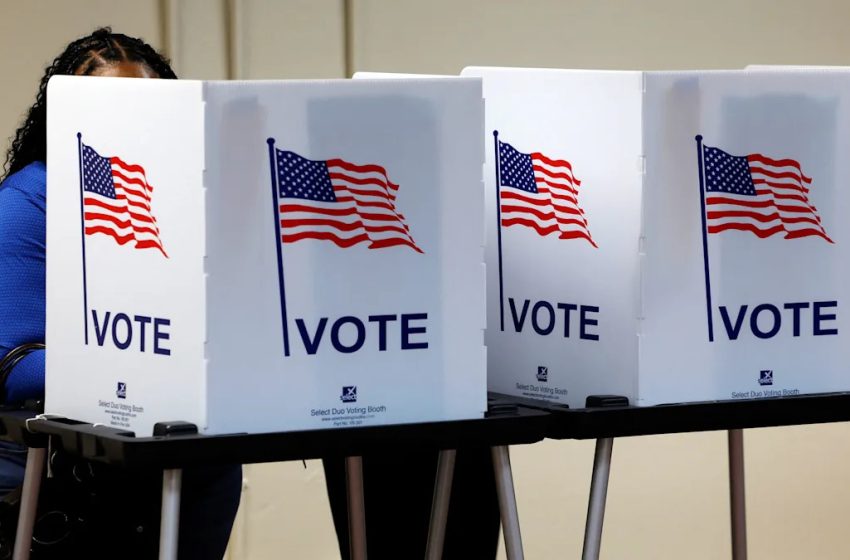
The Illinois primary is next in the midterm election cycle. Here’s what to expect, plus the biggest races to look out for as control of Congress hangs in the balance.
The midterm elections are officially underway. They kicked off with a bang earlier this month in Texas, with high-stakes Senate primary contests for both parties.
Now the primary calendar moves to Illinois, a solid blue state where many of the winners in Tuesday’s primaries will be the overwhelming favorites to win in November’s general election.
The biggest contest to watch in Illinois is the Democratic Senate primary. It’s a three-way race for the chance to fill the seat that retiring incumbent Dick Durbin has held for the past 30 years. Polls show Illinois Lt. Governor Juliana Stratton and U.S. Rep. Raja Krishnamoorthi in an extremely close contest, with U.S. Rep. Robin Kelly not far behind. Whoever comes out on top will be all but assured to become the state’s newest senator after the midterms.
Illinois is also home to one of the country’s most-watched congressional primaries as 15 Democrats compete to fill an open House seat in a safe blue district. The candidates include Evanston Mayor Daniel Biss, state lawmaker Laura Fine and progressive political commentator Kat Abughazaleh. The race began to garner national attention after Abughazaleh, a popular political influencer who has been indicted by the Trump administration, announced her candidacy. Polls have shown Biss slightly out ahead, but the contest could go any number of directions with so many candidates on the ballot.
We’re still very early in the midterm cycle. Here’s a rapid-fire rundown of what’s coming next and the most important races to watch for heading into Election Day in November.
May 5 — Indiana
House races
There are two primaries for House seats in the Hoosier State that pit sitting members of Congress against younger challengers. On the Democratic side, nine-term Rep. André Carson is up against attorney George Hornedo, a 34-year-old progressive who argues that Carson hasn’t been aggressive enough during his tenure in Washington. A similar dynamic is at play on the GOP side, where 80-year-old Rep. Jim Baird is facing conservative state representative Craig Haggard.
May 12 — Nebraska
Senate and House races
Strange things are afoot in the Cornhusker State. Republican Sen. Pete Ricketts is up for reelection. The Nebraska Democratic Party initially chose not to run a candidate so that independent Dan Osborn would have a clear path to challenge him. However, a purported Democrat named William Forbes has jumped into the race, sparking accusations that he is only running to try to split the opposition vote to help Ricketts. That prompted another Democrat, Cindy Burbank, to throw her hat into the ring. She has pledged to support Osborn’s independent candidacy if she wins the party nomination. Democrats also have a crowded primary field in the state’s only competitive House district, with six candidates in the running.
May 16 — Louisiana
Senate, House races
Republican Sen. Bill Cassidy, one of President Trump’s few critics within the GOP, appears to be at serious risk of losing his seat to a challenge from within his own party. Trump endorsed one of his opponents, U.S. Rep. Julia Letlow, before she even formally entered the race. Polls show Cassidy trailing Letlow and another MAGA-friendly candidate, Louisiana State Treasurer John Fleming. A runoff will be held in June if no candidate receives 50% of the vote.
Seven Republicans have joined the race to fill Letlow’s seat in the House.
May 19 — Alabama, Georgia, Kentucky, Pennsylvania
Senate, House and gubernatorial races
First-term Alabama Sen. Tommy Tuberville announced last year that he would run for governor rather than seek another term in the Senate, opening the door for a wide-open primary that will effectively decide the deep-red state’s next senator. As of early February, there was no clear frontrunner in the race, despite Trump giving his endorsement to U.S. Rep. Barry Moore.
In Georgia, Republicans will be choosing their candidate to take on incumbent Democrat Jon Ossoff in what forecasters expect to be a very tight Senate race. Two GOP congressmen, Mike Collins and Buddy Carter, have entered the primary along with former football coach Derek Dooley. There could be a handful of close contests in Georgia’s House primaries, with incumbents in four of the state’s 14 districts not running for reelection. Georgia will also be electing a new governor this year. Democrat Keisha Lance Bottoms appears to have a clear path through her party’s primary, but the most recent poll of the GOP primary shows Lt. Gov. Burt Jones and billionaire health care executive Rick Jackson essentially tied.
Republican Sen. Mitch McConnell is retiring after holding one of Kentucky’s two Senate seats for more than 40 years. Five candidates have jumped into the GOP primary for the chance to replace him, including the state’s former attorney general Daniel Cameron, U.S. Rep. Andy Barr and MAGA-friendly entrepreneur Nate Morris. In the House, GOP Rep. Thomas Massie, who has been at the heart of congressional efforts to force the Trump administration to release files related to Jeffrey Epstein, is being challenged by Trump-endorsed farmer Ed Gallrein.
Pennsylvania will be home to one of the highest-stakes gubernatorial races in November, but Democratic Gov. Josh Shapiro and his likely challenger, Republican state treasurer Stacy Garrity, appear to have a clear path through the primaries. Democrats have crowded primary fields in several House races, particularly in GOP-held districts that may be flippable in a blue wave election.
May 26 — Texas
Senate and House runoffs
One of the most contentious Senate primaries in recent memory will be decided in Texas as Republican Sen. John Coryn faces state Attorney General Ken Paxton in a head-to-head runoff for the GOP nomination. The winner will go on to face Democrat James Talarico, who is hoping to become the first member of his party to win a statewide race in the Lone Star State in more than three decades.
There will also be a runoff for a closely contested Democratic House seat. Democratic Reps. Al Green and Christian Menefee, who were redrawn into the same district by a GOP gerrymander last year, are facing off in another race that pits one of the party’s longtime stalwarts against a younger challenger
June 2 — California, Iowa, Montana, New Jersey, South Dakota
Senate, House and gubernatorial races
California is electing its next governor this year, and the June primary will play a huge role in deciding who ends up leading the country’s biggest state. At least nine Democrats are running in the state’s open primary, in which the top two vote-getters from any party move on to a head-to-head matchup in the general election. This unique system creates a slim possibility that two Republicans could emerge from the primary if the Democratic vote ends up splitting between too many candidates. If that does happen, the Golden State would be guaranteed to have its first GOP governor since Arnold Schwarzenegger.
In Iowa, U.S. Rep. Ashley Hinson is the frontrunner for the GOP nomination to replace retiring Republican Sen. Joni Ernst. Two state lawmakers, Josh Turek and Zach Wahls, are competing for the Democratic nomination.
Montana has only two congressional districts, but one of them features what could be closely contested primaries on both sides. Longtime Montana political operative Al Olszewski is facing conservative radio host Aaron Flint in the GOP primary. Four Democrats have entered their party’s primary. Despite the state’s reputation as a conservative stronghold, Republicans carried the district by only 2 percentage points in 2024.
In New Jersey, as many as nine Democrats may join a crowded primary field in the state’s Seventh Congressional District, where Republican Rep. Tom Kean Jr. is considered to be vulnerable. Crowded doesn’t even begin to describe the field in New Jersey’s 12th Congressional District, where 18 Democrats have entered the primary.
South Dakota’s Republican Gov. Larry Rhoden, who became governor after Trump named Kristi Noem as Homeland Security secretary last year, is running for reelection. He is being challenged by Republican U.S. Rep. Dusty Johnson, the state’s only member of the House of Representatives.
June 9 — Maine, Nevada, South Carolina
Senate, House and gubernatorial races
Maine Sen. Susan Collins of Maine is widely viewed as one of the most vulnerable Republican senators. The Democratic primary to choose her challenger has pitted the state’s current governor, 78-year-old Janet Mills, against political newcomer Graham Platner. Despite Mills’s record of success in the state and a bizarre scandal involving an apparent Nazi-inspired tattoo on Platner’s chest, recent polls have shown Platner out ahead. Maine will also be choosing a new governor this year. Primary races on both sides appear to be wide open.
All four of Nevada’s House districts were decided by five points or less in 2024. Multiple Republicans have jumped into the GOP primaries in the state’s three Democrat-held districts. The primaries are especially crowded in Nevada’s Second Congressional District, where candidates from both parties have flooded into the race to replace retiring GOP Rep. Mark Amodei.
Two high-profile Republican representatives, Nancy Mace and Ralph Norman, have opted to give up their seats in the House to run for governor in South Carolina. Despite their national profiles, neither Mace nor Norman has been able to establish themselves as the clear frontrunner in the race. Polls show them locked in a tight four-way contest with South Carolina’s Attorney General Alan Wilson and Lt. Gov. Pamela Evette.
June 16 — Oklahoma
Senate race
Oklahoma’s Senate suddenly got interesting in March when incumbent Republican Markwayne Mullin was tapped by Trump to become the next Homeland Security secretary. Oklahoma’s governor has the power to choose Mullin’s replacement in the Senate, but under a unique state law, that appointee would be barred from running for a full term in November. No Republicans have announced a bid for Mullin’s seat yet, but potential candidates have until early April to file their campaign paperwork.
June 23 — Maryland, New York, Utah
House races
Maryland Democrat Steny Hoyer set off a mad scramble in January when he announced he would be giving up the House seat that he’s held for the past 45 years. More than 20 candidates have entered the Democratic primary in his deep-blue district. Democrats are also locked in another interesting primary in Maryland’s Sixth Congressional District. Former Rep. David Trone is trying to get back the seat he gave up in 2024 to launch an unsuccessful Senate bid. To do that, he’ll have to oust incumbent Rep. April McClain Delaney in the primary. Trone, the co-owner of the Total Wine & More retail chain, has a massive funding advantage because of his personal wealth, but McClain Delaney has secured the endorsements of most of Maryland’s high-profile elected officials.
There’s plenty of intrigue across the primaries for New York’s 26 House districts, but the race with the most national interest is in the state’s 10th Congressional District. Incumbent Democrat Dan Goldman, a relative moderate in the party, is facing a challenge from his left by former New York City comptroller Brad Lander. Lander, who ran for New York mayor last year, gained a strong base of support among the city’s young voters for the way he embraced eventual winner Zohran Mamdani after suspending his own campaign.
Utah is using a completely new congressional map this cycle, thanks to court rulings that found that its old, Republican-drawn map violated state law. Now, instead of four safe GOP seats, Utah has one solidly blue district. Ten Democrats are competing in the primary for that newly created seat. The redraw also left four incumbent Republicans for just three red districts. Rep. Burgess Owens ended up being the odd man out and announced he isn’t seeking another term. His exit means that none of the other incumbents will have to face each other in the primary, but at least two of them have fielded challenges from other GOP candidates.
June 30 — Colorado
House race
Controversial Republican Rep. Lauren Boebert is running for reelection in Colorado’s Fourth Congressional District. Three Democrats are competing for the chance to potentially unseat her in November. The Democratic primary in the state’s Eighth Congressional District also has three significant candidates hoping to oust Republican incumbent Gabe Evans, who won his seat by an extremely narrow margin in 2024.
July 21 — Arizona
Gubernatorial race
Two Republican congressmen, Andy Biggs and David Schweikert, have entered the GOP gubernatorial primary for the chance to challenge Democratic Gov. Katie Hobbs in the general election. Their choice to give up their seats in the House has prompted a number of Republicans to join the race to become their replacements.
Aug. 4 — Kansas, Michigan, Missouri, Virginia
Senate, House and gubernatorial races
Kansas Gov. Laura Kelly is the rare Democrat who has enjoyed consistent electoral success in an otherwise strongly red state. After leading the state for eight years, Kelly is not eligible to run for reelection. Two state lawmakers, Ethan Corson and Cindy Holscher, are running to succeed her at the top of the Democratic ticket. Six Republicans are vying for the chance to turn the Kansas statehouse red, including the current president of the state Senate, the current secretary of state and former governor Jeff Colyer.
Michigan Democrats will be playing defense in two of the most pivotal elections in this year’s midterms. The race to replace popular Democratic Gov. Gretchen Whitmer, who is term-limited, seems to be all but settled. Michigan Secretary of State Jocelyn Benson appears to have a clear path through the Democratic primary, and U.S. Rep. John James looks primed to secure the GOP nomination. Things are much tighter in the Democratic Senate primary, where polls show state lawmaker Mallory McMorrow with a modest lead over U.S. Rep. Haley Stevens and physician Abdul El-Sayed. The winner of the Democratic primary is likely to face Republican Mike Rogers, who came 19,000 votes away from being elected to the Senate in 2024, in November.
Missouri’s First Congressional District will feature a rematch of one of the most-watched primaries from the 2024 election. Former Rep. Cori Bush, a progressive member of “the Squad,” is challenging U.S. Rep. Wesley Bell, a moderate who defeated her in the Democratic primary last cycle. Their matchup two years ago was the second-most expensive House primary race in history, thanks to $8 million spent by a pro-Israel group that targeted Bush.
Virginia’s 11 House seats will be on the ballot this year, but the primary fields are still taking shape amid an ongoing redistricting push by state Democrats.
Aug. 11 — Connecticut, Minnesota, Vermont, Wisconsin
Senate, House and gubernatorial races
Democratic Rep. John Larson is seeking a 14th term in the House but is facing his first serious primary challenge since he first won his seat back in 1998. Three Democrats have entered the primary, with each arguing that it’s time for Larson, 77, to allow a new generation to lead the district.
Minnesota is on track to have an enormous amount of turnover in its most important elected offices. With Gov. Tim Walz not seeking reelection, Sen. Amy Klobuchar has chosen to leave the Senate to pursue the chance to replace him. At least 10 Republicans, including My Pillow CEO Mike Lindell, have joined a wide-open GOP gubernatorial primary. Klobuchar would potentially be in a position to name her own successor if she becomes governor. Minnesota’s other Senate seat is open this year because Democrat Tina Smith is retiring. Lt. Gov. Peggy Flanagan and U.S. Rep. Angie Craig are the main candidates in the Democratic Senate primary. Former sports broadcaster Michele Tafoya is the frontrunner for the GOP nomination.
Vermont’s gubernatorial race hinges on whether current Republican Gov. Phil Scott, who was recently declared the most popular governor in America, decides to run for another term. If he does seek reelection, he would be a strong favorite to win. If he doesn’t, the GOP would have to scramble to find a suitable replacement who can compete in the otherwise solidly blue state.
In Wisconsin, Democratic Gov. Tony Evers has chosen not to seek another term. Seven high-profile Democrats have entered the race to replace him. That’s a stark contrast with the Republican primary, where U.S. Rep. Tom Tiffany looks like he’ll coast to his party’s nomination.
Aug. 18 — Alaska, Florida, Wyoming
Senate and gubernatorial races
Alaska’s unique nonpartisan “jungle” primary system means that the four highest-ranking candidates in its Senate and gubernatorial races will move on to the general election, which will be decided by a ranked-choice vote.
Florida will elect a new governor this year. Rep. Byron Donalds, a strong Trump ally, is the overwhelming favorite to win the GOP nomination. Democrats haven’t won a governor’s race in Florida since 1994, but recent polls have shown Donalds leading the two main Democratic nominees — Orange County Mayor Jerry Demings and former GOP Rep. David Jolly — by single digits. It’s a similar story in the Florida Senate race. Incumbent Republican Ashley Moody is outpacing potential opponents in the crowded Democratic field by roughly 8 points.
Sept. 1 — Massachusetts
Senate race
Progressive Democrat Ed Markey, 79, is running for another term in the Senate. He’s being challenged by U.S. Rep. Seth Moulton. Despite age being a major issue throughout the Democratic electorate, polls show Markey holding a solid, though not insurmountable, lead over his 47-year-old primary opponent.
Sept. 8 — New Hampshire, Rhode Island
Senate and gubernatorial races
Democratic Sen. Jeanne Shaheen is not running for reelection. U.S. Rep. Chris Pappas has a huge lead in polls of the Democratic Senate primary. Republicans have recruited two former senators in their effort to flip Shaheen’s seat. Polls show John E. Sununu, who Shaheen knocked out of the Senate in 2008, with a healthy edge over former Massachusetts Sen. Scott Brown.
Rhode Island’s Democratic Gov. Dan McKee seems to be at serious risk of being knocked out of office by a member of his own party. With an approval rating of just 25%, he trails former corporate executive Helena Foulkes by a significant margin in recent polls.
First Appeared on
Source link






