


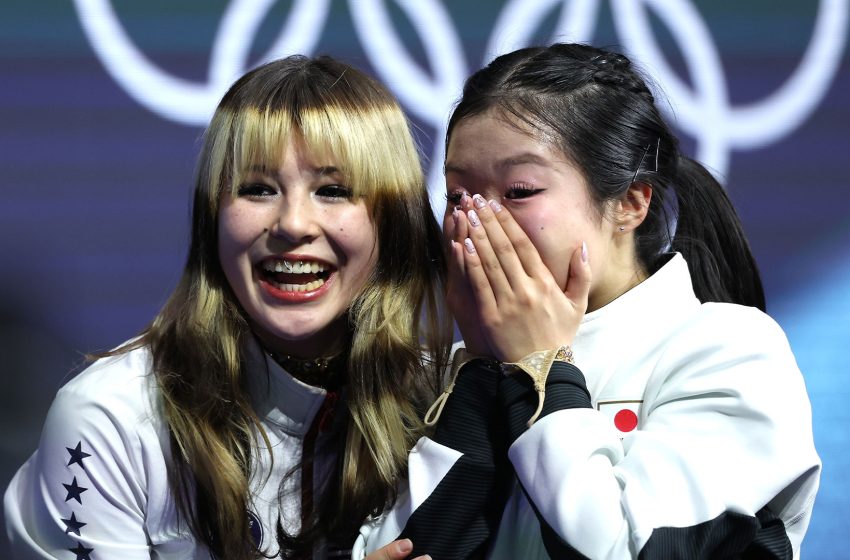
The Olympic figure skaters of the Milan Cortina Games leaving rivalry on ice
It’s hard to say exactly what instigated the change. Athletes like Glenn and her Japanese counterpart, Kaori Sakamoto, are preternaturally positive individuals. Both older athletes in their field, and both at the top of it, they set the tone for the younger skaters that look up to them. This was perhaps most notable when, in 2025, the three-time world champion Sakamoto found herself unseated by a totally stunned Liu. Sakamoto didn’t miss a beat, giving Liu a huge hug, jumping up and down with her, joyfully celebrating the success that meant her failure.
Another explanation of the camaraderie of the world’s elite figure skaters points to the team events that have given skaters not only more opportunity to compete, but more opportunity to view their success as collective.
The inaugural World Team Trophy event — a biannual competition in which the nations with the top athletes across all four skating disciplines compete for points as national teams — was in 2009. A version of the event then had its Olympic debut in 2014. It’s taken some time for athletes to take the event seriously, but heading into these Games many of the contenders indicated just how much the event mattered.
“The team event is extremely important to us,” Evan Bates said in the days before it kicked off in Milan. “Having the opportunity to compete as a team is so special, and this team in particular is so talented.”
Team USA won the gold medal in the figure skating team event in Milan Cortina.
Getty
That respect is born of shared experiences, whether at the team event, performing in shows together, or attending annual training camps. Although many of the figure skaters within the U.S. train far apart from one another, those opportunities give athletes time to bond with the tiny percentage of people who can best relate to them.
“Getting to skate with you guys is really rare for me,” Liu said to the other “Blade Angels” after the 2026 U.S. Figure Skating Championships. “Back at home, there’s not really many people at my level, and I’m always really grateful coming to these competitions because I get to see what crazy things y’all do.”
With the sport shifting away from an emphasis on quadruple jumps and toward an array of athletically complex movements on the ice, skaters have learned to be inspired by one another’s creativity, making it so much more enjoyable to pursue.
It also makes it more enjoyable to watch, and that’s a goal for many of the top athletes today. Malinin has shared in multiple interviews how much he wants to bring figure skating back to its ‘90s glory days.
“I really want figure skating to be big and popular like it was decades ago,” he said. “Huge stadiums sold out. Tons of shows. On every news platform — that’s what I want skating to be brought back to.”
When viewed as a whole like this, their teamwork starts to make a lot more sense: The athletes train hard to be competitive on the ice, but work together to elevate the sport’s image while off it.
“I just think that we are all trying to lift each other up,” Glenn said. “I think it’s just all about that, and doing it in a healthy way, and that’s the future of our sport.”
First Appeared on
Source link






