



‘The Pitt,’ as Told by Its Patients
John Lee Ames could only stare at the ceiling and scream. In his first scene as Gus, a severely injured and malnourished inmate, he entered Pittsburgh Trauma Medical Center handcuffed to a gurney and stabilized by a neck brace before multiple doctors started peppering him with questions. “It’s intense. My heart’s racing, I’m strapped down, completely restricted,” Ames says. “And they’re talking to you, and you have to look there and do this and do that—it’s a lot coming into my little brain.”
Across the emergency department set, Ernest Harden Jr. lay upright with his eyes closed and a tube in his mouth, blood spurting onto his hospital gown. As Louie, an alcohol-dependent repeat visitor, Harden had to act out a pulmonary embolism that quickly led to his character’s death. In between compressions to a prosthetic chest plate, Harden had to keep his body limp and his face frozen. “They would tell me to hold my breath,” he says. “I just tried to be still and real about it.”
A few doors down, Brittany Allen winced in pain as Roxie, a mother of two whose lung cancer has progressed to a debilitating level. She has recently had a seizure, been given a heavy dose of morphine, and now can’t find the strength to reach the bathroom. Every physical move Allen made had to be carefully considered—and then appropriately portrayed. “The hospital setting kind of allows her to come to terms with just how much pain she’s in,” Allen says. “I got to go to that very raw, human place.”
Welcome to being a patient on The Pitt.
Although the Emmy-winning HBO show centers the precise work, complex relationships, and limited capacities of its student, resident, and attending doctors and nurses, it’s the patients who are the secret MVPs. In the span of just a few scenes, these guest actors have to convincingly inhabit whatever catastrophe has landed them there—a severed hand, a heart attack, or even just a violently upset stomach. They have to calibrate the right decibel level of pain, endure invasive treatment (and prosthetics), and find an emotional truth within the show’s real-time, choreographed trauma. “They’re just troupers,” says series creator R. Scott Gemmill. “You tend to believe that these characters are really suffering from whatever malady we’ve given them.”
Understandably, these coveted roles are hard to get. As Gemmill notes, for each patient who’s rushed into the ER, there are typically thousands of actors sending in self-taped auditions, which can sometimes include creative props like prosthetics, fake blood, and other special effects to sell their character. “I don’t know if it helps,” Gemmill laughs. “It’s really about the performance.” And by that he means: Are they competent moaners? Can they vomit properly? Can they elicit a visceral reaction? Whittling down the list isn’t exactly a science. “You just have to go with your gut,” he says. “If I feel sorry for them, I’m guessing the audience will.”
For those who eventually earn a spot on the call sheet, the job only gets harder: clinical rehearsals, constricting makeup, and a commitment to “really make us believe that we’re saving their life,” says Gerran Howell, who plays Dr. Whitaker. It’s rigorous work, but playing a patient can also be unexpectedly rewarding. For five actors at the heart of Season 2, life in the Pitt quickly became one of the most unique, immersive, and meaningful experiences of their careers. “It’s magic,” Ames says. “I don’t know how else to say it.”
Louie Cloverfield (Ernest Harden Jr.)
Alcohol poisoning, ascites, tooth infection, pulmonary embolism
Harden is a Pitt OG. The character actor appeared in the show’s very first hour and quickly turned Louie, a congenial drinker, into a fan favorite. By the time the first season wrapped, Gemmill and Noah Wyle had taken notice and promised to bring Louie back. “In the emergency department, you get a lot of recurring characters—especially unhoused people who are struggling—and they become what is known as ‘frequent flyers’ because they’re there all the time,” Gemmill says. “They know all the doctors, the doctors know them. They become kind of like family.”
In Season 2, Louie’s arc begins in familiar fashion. He enters the ER with a horrible toothache spurred by his excessive drinking. Over several episodes, Whitaker and a student doctor ease his suffering and start draining liters of fluid from his abdomen into large bottles beside his bed. (To pull off the effect, Harden wore a 40-pound prosthetic attached to the top of his stomach.) Louie’s return also gives Dr. Langdon (Patrick Ball) a chance to make amends with his former patient after he’d used Louie’s benzos to feed his drug addiction. “[Patrick] was the first person to start talking to me,” Harden remembers. “We became very friendly throughout the show.”
That friendship bleeds onto the screen as the pair reconcile, but it becomes even more noticeable when Louie suffers an embolism and flatlines in this season’s sixth episode. Unlike some other patient traumas, his emergency hit close to home for many actors—especially those who didn’t know his fate before rehearsals. “It really adds to the reality of the scene,” Howell says. “You’ve met Ernest, and you built a rapport. He’s super talkative and lovely. He’s just full of anecdotes, and it became a fixture for me to go hear one of Ernest’s stories. … And now that won’t happen again.”
In the midst of the embolism, Harden had to stay frozen. But on the inside, he was struggling. Throughout his stretch of filming, he’d stopped taking his heart medication, leading to a few days of feeling out of breath. “I was lying on that table, and they were doing these things to me, and I felt like I wanted to scream,” Harden says. His manager compelled him to restart his medication routine as soon as possible. “She said, ‘You can’t die. This is the role of your lifetime!’” Harden says.
When filming began for Louie’s memorial, Harden focused on doing his best corpse acting while the rest of the room filled in the life story he hadn’t fully known. Wyle’s Dr. Robby shared how the former groundskeeper had begun drinking after his pregnant wife died in a car accident. Harden says that even with his eyes closed, he could feel the emotion in the room, especially when Nurse Emma (Laëtitia Hollard) reached over to hold his hand. The solemnity of the moment “showed that, even though he was an unhoused drunk, he deserved the same sort of sanctity as everyone else,” Gemmill says.
The role meant a lot to Harden. He got his first speaking role in Three Days of the Condor and The Jeffersons, the start of a 50-year career as a TV and movie character actor. But Louie has touched the show’s fans—and cast and crew—in ways he never expected. “To finally be recognized for the work that you put in,” he says, “there’s nothing better than that.”
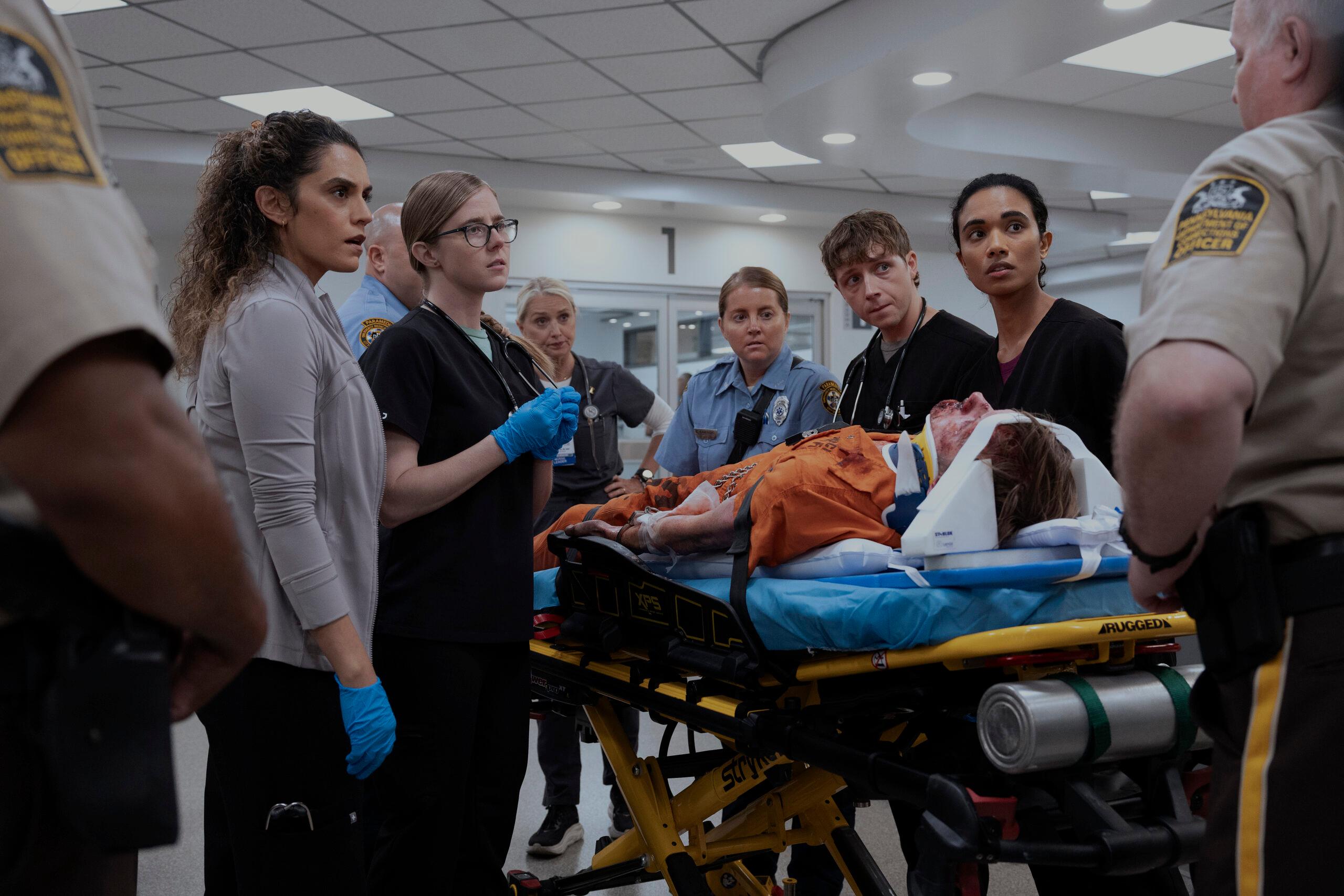
Gus Varney (John Lee Ames)
Fractured left mandible, multiple rib fractures, complex forearm laceration, megaloblastic anemia, malnutrition
Over the span of an episode of The Pitt, there’s usually a moment when a patient stops being a case and starts feeling like a person. For Gus Varney, that shift comes after the worst of his wounds have been stitched up and his appetite returns. At the detention center where he was attacked, Gus has been malnourished. His lacerations and orange jumpsuit suggest menace. But his face softens when Dr. King (Taylor Dearden) asks him which flavor of dietary milkshake he’d like to try. “Chocolate!” he replies in an excited, breathy voice, as if conjuring the taste in real time. It’s just a small acting beat, but it immediately reveals that he’s not a threat.
“That line in particular struck me. It kind of brought me to a childhood state,” Ames says. “People don’t realize that something so simple can mean so much to somebody.”
Ames has an acting résumé filled with unsavory characters, but playing Gus was a special kind of challenge—starting with his audition, which he performed sitting in a chair, holding up his injured arm. His slim physique already fit the script’s description. The bigger test was harnessing the restricted movement and pain of someone with a broken jaw and fractured ribs. He did some basic research, watching YouTube videos of patients with the same injuries and trying to sound like a native Yinzer. “He was written very skinhead-esque,” Ames says. “That’s where your imagination comes into play—how deep and colorful you want to make the character.”
The last step to get Ames into patient mode came from the makeup department. To sell Gus’s swollen face, the team stashed prunes into the side of his mouth, administered a glue-like substance to his eyelids, and stuck a hidden tube up his nose. “It helped me kind of physicalize his speech and his voice and gain a bit of an obstacle for myself,” Ames says. “It does become uncomfortable and annoying. You want to rip stuff off all the time.” As for his sutured arm? The special effects crew took a mold of his limb, developed a latex skin to rest above it, and then painted his exact color code and freckles around the bleeding gash. “Everything is incredibly accurate and defined,” Ames says. “The work is just genius.”
Before filming began, the entire cast rehearsed the precise beats of his ER entrance, walking through every movement and line (first at half speed, then full) until the camera crew eventually joined what Ames describes as a choreographed dance. Although he didn’t have to sync up his steps, Ames still had to be precise about the timing of his screams—scripted exclamations to cue the doctor-actors. If at any time Ames was unsure of his modulations, he could tap the expertise of a real on-set doctor, who advised on how he might be breathing or reacting to administered drugs. “There’s a lot of surprise in the actors’ faces when they realize how chaotic the scenes can get,” Howell says. “They’re prepped as much as they can, but when we’re rolling, it is all systems go.”
Ames admits that his first day was nerve-racking—he had to remember multiple names and cues without slowing down the daily operation. But everyone on set understood the challenge of parachuting into the chaos, starting with Wyle. “Noah sent this little email to me beforehand saying they were excited to have me and make this amazing project. I thought that was just really cool,” Ames says. “They’re a family. And it really helps you—not only as an actor, but as a person.”
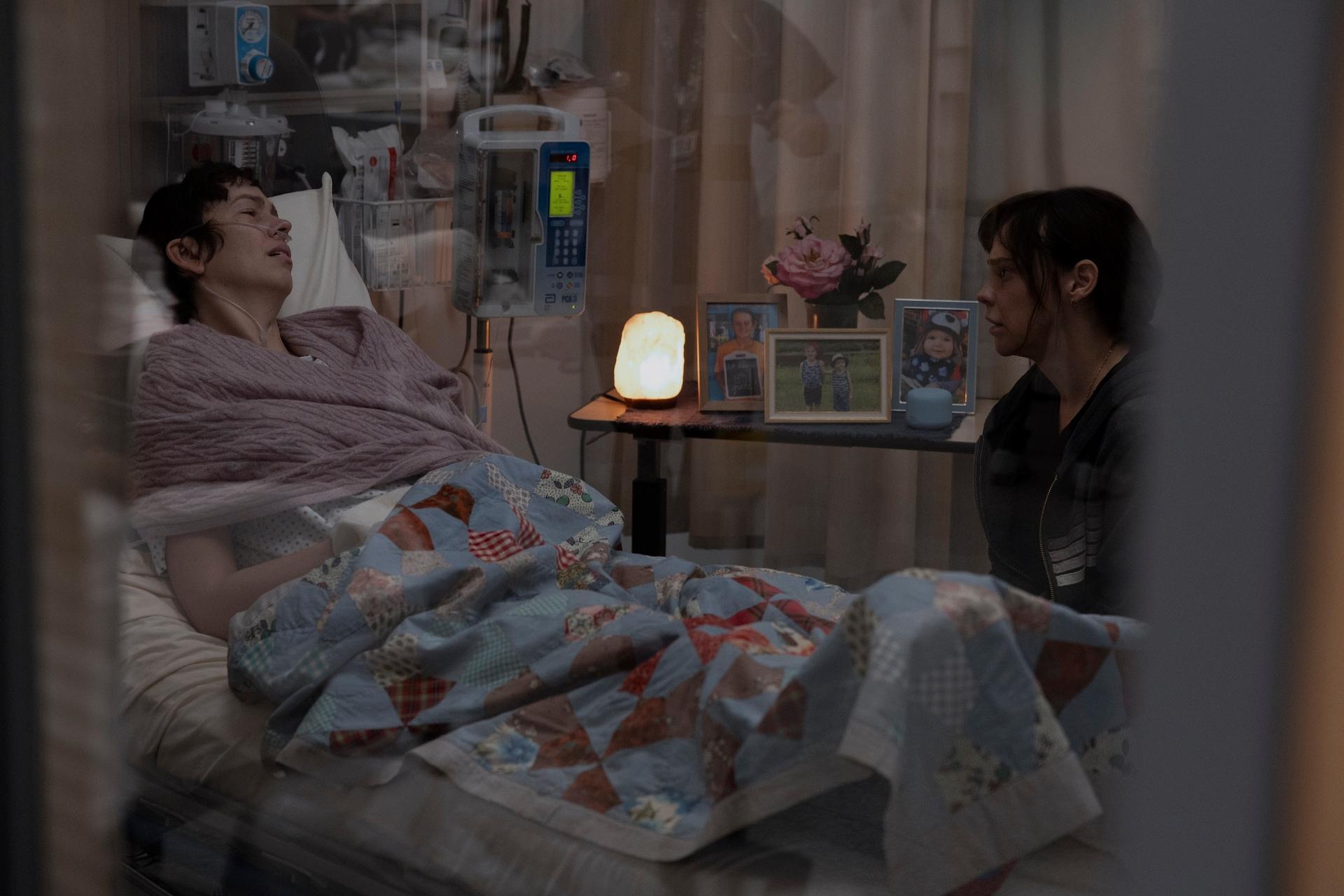
Roxie Hamler (Brittany Allen)
Advanced lung cancer, tonic-clonic seizure, pathological leg fracture
When Gemmill starts mapping out a new season of The Pitt, he considers the ripple effect that each new case might have on his ensemble of doctors. “The medicine is always there to serve a higher purpose,” he says. “Who is going to be affected by this story?” One of his initial case ideas centered on Dr. Javadi (Shabana Azeez), a 20-year-old medical student struggling to pull away from her parents’ expectations. Her designated foil: Roxie, a mother with terminal cancer who enters the ER after a seizure in hospice care. The question guiding Javadi’s story line was simple: What happens when a student doctor who dislikes her parents is suddenly faced with a mother whose only wish is to spend whatever time she has left with her children?
Allen began poking at that question with an affecting audition that channeled Roxie’s physical vulnerability and extreme pain, characteristics she’d already conquered in the horror genre. “I’ve definitely had to go to some very physical places where the body is in a lot of distress,” she says. Mostly, though, she tapped into her own instincts as a mother. “You kind of have to have a conversation with your heart before you begin: Is it safe to let yourself go there?” Allen says. “It’s really rewarding when you do because you feel like you’re doing justice to the story line.”
Unlike most TV shows, The Pitt films chronologically. And since Roxie’s arc spans several episodes, Allen had multiple days off in between each of her scenes. Instead of cramming her entire arc into one afternoon of shooting, which can be “exhausting and crazy in its own way,” she says, the spread-out schedule was a “welcome challenge.” Each shooting day, Allen had to consider her character’s emotional through lines and progression. “It was beautiful to go, ‘OK, today is about this moment,’” she says. “Once you get into the scene, it’s extremely fluid and playful.”
With the extra time between shooting days, Allen read several memoirs by cancer patients to gain further insight into her condition. That included Paul Kalanithi’s When Breath Becomes Air, which chronicles the neurosurgeon’s physical and spiritual journey through a terminal illness. (“I was weeping as I read it,” she says.) She also navigated Reddit forums and YouTube to find cancer stories and observe post-seizure behavior. And because Roxie brings a “death doula” with her into the hospital room, Allen also looked into Buddhist texts. Like Ames, she leaned on the show’s medical consultants to maintain authenticity. “If anything wasn’t feeling accurate, they were there to gently give a really clear sense of how the drugs would be making me feel,” she says.
At certain points between filming setups, Allen found herself overwhelmed by the sheer number of people hustling around the hospital floor. That’s by design. For the sake of continuity and realism, Gemmill makes sure that every background actor has a specific path and plan as they move through the set. The experience, in some ways, mirrored Roxie’s reality and forced Allen to consider her character’s mental state with life whirling around her. “She’s in so much pain, so she’s not as hypersensitive to the noise,” Allen says. “She’s just within her body knowing that she’s close to losing the people that mean the most to her.
“When you’re in that stage, all the bullshit just drops,” she says. “It really just made me hyperaware of the fragility of life.”
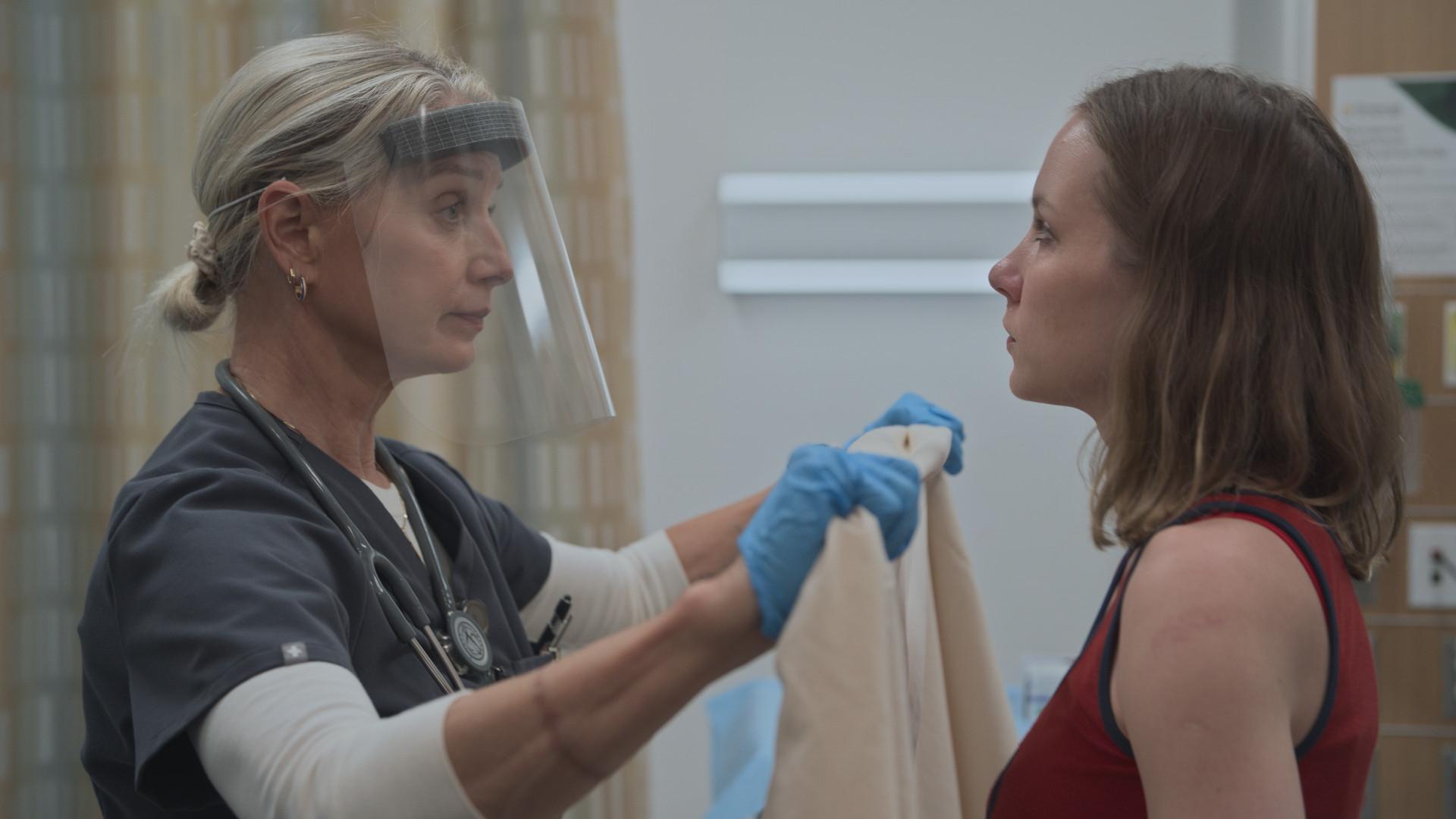
Ilana Miller (Tina Ivlev)
Sexual assault examination
Most patient-actors on The Pitt need time adjusting to a set that moves like a living, breathing organism, but Ivlev didn’t have many distractions during her scenes as Ilana, a young woman who enters PTMC after being raped by her male friend at a Fourth of July barbecue. Ivlev’s three-episode arc involves a forensic exam that takes place entirely behind a curtain. And instead of multiple doctors hovering around her, only charge nurse Dana (Katherine LaNasa) can conduct the rape kit exam. It’s the kind of quiet, slow, intimate sequence that The Pitt rarely gets to highlight.
“You have to handle it much more solemnly and discreetly than the typical ER visit,” Gemmill says. “The pace was certainly deliberate, but also appropriate for the condition and what was being done. We wanted to show the reality of how that process works.”
What separated Ivlev from the other actors who auditioned for Ilana was perspective. As she began thinking about the character’s limited background (and the intentional lack of a trauma plot), Ivlev considered tapping into a different feeling than inner turmoil: anger. Not just about what has happened to her, but about the indignity of being called a “victim” and spending an afternoon at the hospital because of it. “That’s really the emotion that’s under the surface,” Ivlev says. “I just think about what this person must have experienced.”
The exam is invasive and uncomfortable. It requires Dana to bag her clothing, take photos of her bruises, use a blacklight to detect bodily fluids, and use wet and dry swabs to take DNA samples. In between, an advocate from Pittsburgh Action Against Rape arrives with fresh clothes and guidance on what the next steps will be for Ilana. On set, the whole process “felt real” to Ivlev, who notes that both LaNasa and Hollard, who plays a trainee nurse, had previously visited trauma centers and spoken with sexual assault nurse examiners. Ivlev also had access to an intimacy coordinator for her brief moment of nudity. “She was always checking on me and making sure I was feeling safe,” she says.
Channeling Ilana’s confusion and internal struggle was important to Ivlev. Throughout the hour-plus process of the exam, Ilana keeps asking when she can leave—and at one point she steps out, reconsidering whether she should continue the exam and press charges against someone in her social circle. As she thought about Ilana’s backstory, Ivlev felt that the exact circumstances were less important than identifying the complicated feelings she had about her rapist. “There’s all this confusion circling through your head, and then there’s self-blame as well, like, ‘Maybe it’s me?’” she says. “She’s all alone. I think a lot of people who are in that situation have those exact thoughts.”
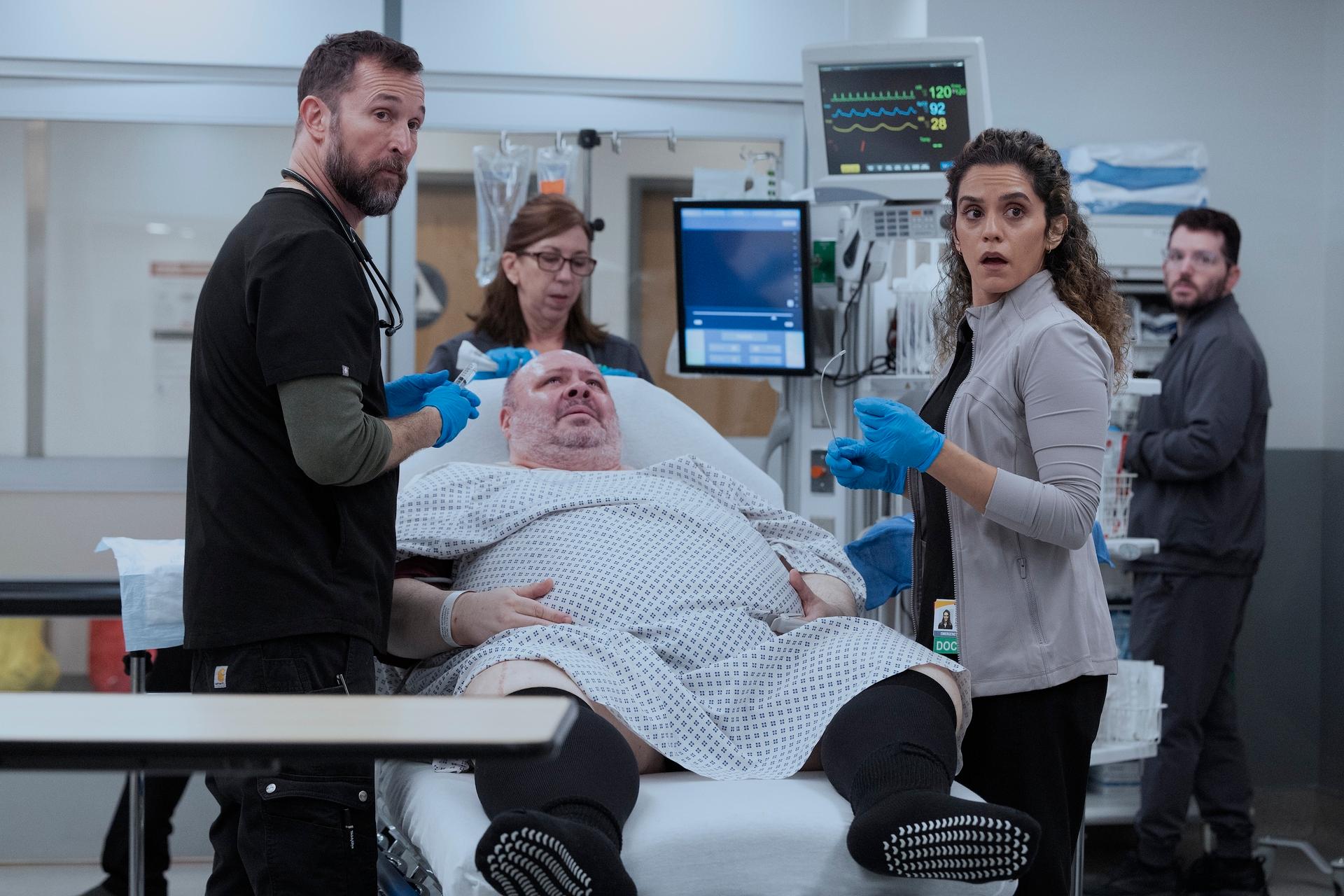
Howard Knox (Craig Ricci Shaynak)
Abdominal pain, fever
Shaynak doesn’t think he left his house more than four times in 2024. The longtime character actor had stepped away from Hollywood around the pandemic, when a leg injury made walking difficult. During that stretch, he mostly subsisted on a steady diet of DoorDash and Uber Eats while picking up income through various computer jobs. But when he auditioned for The Pitt and landed the role of a patient with obesity, Shaynak was thrilled—and a little terrified. Taking the job meant commuting to Burbank on a regular basis. It meant having to go outside again. “I was very afraid of going to The Pitt,” he says.
Shaynak declined to read with another person for his audition, instead reciting his lines as a monologue because, as he puts it, “People will watch a two-minute video more than they’ll watch a four-minute video.” After he got the job as Howard, he received a call from the episode’s writer, Joe Sachs. The two already had some history: About 25 years earlier, Shaynak had worked with Sachs when he played a patient on ER. Now, Sachs wanted to reconnect and fold some of the actor’s real-life experiences (including a doctor’s glib remarks about his weight) into the story. Shaynak had mostly retired from playing the “fat, stupid guy,” but Sachs’s interest in his life encouraged him to recommit and share a rare side of himself. “I thought, ‘You know what? This is different,’” he says.
Upon arriving on set, Shaynak got a parking spot close to the stage, and crew members wheeled him to locations—much like real hospital workers would. The verisimilitude extended inside, where he began adapting to the production’s heightened demands. “You can’t bring your script on set because it slows down the flow,” he says. “It feels like real emergencies are going on around you.” Shaynak also had to get used to his vocal restrictions. Not long after Howard enters the ER with abdominal pain, doctors send a scope down his throat and insert a tube through his nose—accomplished with some sleight of hand, precise editing, and an earplug device inside his nostril.
Because Howard isn’t able to speak, he’s given an electronic touch pad to answer questions and share feedback. The audio device was functional for his scenes, but Shaynak occasionally got carried away. “We all had a good time with that little pad because there’s some phrases on there that are terrible,” he says. “Am I going to die? I need a sponge bath. We were all trying to make crazy sentences together. The intimacy coordinator came up to me and said, ‘We don’t want to have any HR violations here …’”
The role did much more than get him back on camera. It motivated him to change his life. Over his two weeks on set, he lost 25 pounds, and since then, Shaynak has upgraded his health insurance and begun visiting more doctors to take care of the issues he’d previously neglected. “I’ve been going and meeting up with people I haven’t seen in four or five years,” he says. “This show has inspired me to take care of myself.”
Before Dr. Robby starts operating on his throat, an apologetic Howard looks around the room, meets each doctor’s eyes, and offers a heartfelt thank you. The line barely required acting. Shaynak says he was genuinely grateful for the opportunity to work with the cast and crew and for the help he received getting to set each day. “I really broke up on that line,” Shaynak says. “It was legitimately, ‘Thank you, guys, for taking care of me.’”

Jake Kring-Schreifels
Jake Kring-Schreifels is a sports and entertainment writer based in New York. His work has also appeared in Esquire.com, GQ.com, and The New York Times.First Appeared on
Source link






