


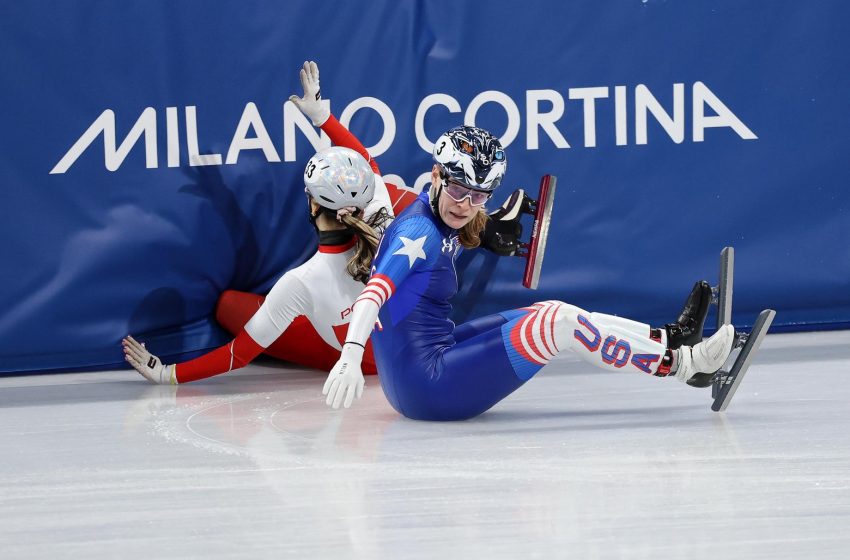
The saddest Winter Olympian couldn’t stop falling.
Since the start of her international short-track speedskating career just over seven years ago, 24-year-old American Corinne Stoddard has established herself as one of the best competitors in her field. The Seattle native currently sits third in the world rankings for both the 500-meter and 1,000-meter events, and fourth in the rankings for the 1,500 meters. When Stoddard first began competing internationally, the reputation of American short-track speedskating was arguably at its nadir. Her prowess on the ice has helped change that.
At the Olympics, however, Stoddard has developed a very different (and very frustrating) reputation: She is known for crashing.
On Olympic ice, she crashes more than Crash Davis, who I suppose was known less for crashing than for disdaining the novels of Susan Sontag. (Stoddard has not publicly shared her thoughts on Sontag’s work.) At the Beijing Games in 2022, Stoddard crashed and broke her nose during the 500-meter heats. Then, in the first heat of the 500 meters at these Winter Olympics, Stoddard crashed going into the final lap, taking out two other skaters and leaving China’s Wang Xinran to cruise across the line as the only competitor left standing.
“That is absolutely not what she wanted to have happening here at the first race of this Olympics,” NBC’s Katherine Reutter-Adamek said, in a bit of an understatement. On the other hand, Stoddard didn’t break her nose this time.
I’m ashamed to admit that I found Stoddard’s “callback” crash in Milan just a little funny, given that it was almost an exact repeat of what happened in Beijing. But it didn’t take long for her Olympic experience to become almost too heartbreaking to bear.
During the quarterfinals of the mixed team relay event, Stoddard fell just as she was about to tag teammate Kristen Santos-Griswold. “The same thing happens,” said Reutter-Adamek. “Her shoulders go in, her hips go out, she spins like a top.” This time, luckily, the other U.S. skaters were able to make up enough time to move onto the semifinals.
In those semifinals, Stoddard—who had just pulled into the lead—fell yet again while coming around a turn, crashing into the wall and taking out Korea’s Kim Gil-li. “I’m flabbergasted,” said Reutter-Adamek, speaking for us all. “Something’s in the water, and it’s frozen in the ice.”
This crash kept both nations out of the mixed team relay finals, and made a lot of Koreans rather frustrated with Stoddard. “One might question whether this can be considered skill at this point,” the Chosun Daily snarked.
Stoddard’s nightmare Olympics weren’t over. In a 1,000-meter heat, in the final stretch of the final lap, Stoddard fell again. No, seriously—again! For a fourth time in a single Olympics! This time, she took out Poland’s Gabriela Topolska, who managed to scramble up in time to cross the finish line and proceed into the quarterfinals, eliminating Stoddard and forcing her to sit and contemplate what in the world was going on.
At first, Stoddard pinned the blame on the rink conditions in Milan, claiming that the ice was too soft, and that it was better suited for figure skating than for speedskating. (The figure-skating and short-track events used the same rink at these Olympics.) While Stoddard isn’t the only speedskater in Milan to criticize the ice conditions, the “soft ice” excuse didn’t explain why she, in particular, had been falling so much.
The Chosun Daily quoted former American short-track star Apolo Ohno speculating that Stoddard’s skating style might have something to do with her repeated falls. “Stoddard generates explosive speed by swinging her right arm widely,” he said, “but excessive swinging can destabilize her upper body and collapse her balance axis.” But again, Stoddard uses that same explosive swinging style at World Cup events, and she doesn’t fall all the time there. She only falls all the time at the Olympics.
A few days ago, Stoddard posted an anguished message to her Instagram account. “I’m not sure what’s been going on,” she wrote in a caption alongside a photo of her prone body on the ice. “Part of me thinks I haven’t been able to handle the pressure and expectations I put on myself. The other part of me feels so physically drained every time I try to race.”
Stoddard went on to write that she was “embarrassed by how much I’ve choked on the Olympic stage over and over again,” and she apologized to her friends, family, and fans for letting them down. “I have one last chance on the 20th (1500m), and then my 2026 Olympics will be over,” she wrote. “Thank you to everyone who has continued to be there for me. I’m sorry I haven’t been myself.”
While all that self-flagellation is hard to read, opening up about her struggles may have been the best thing that Stoddard could have done. In advance of the 1,500 meters, she got a lot of encouraging messages, including from NBC Olympics gadfly Snoop Dogg. “Corie don’t apologize for dreamin big. That pressure just means you care,” said Snoop on Instagram. “You’re not defined by a fall or a tough week. You’re defined by your heart n how you keep showing up!!!”
Stoddard said later that all the responses she got to that post made her feel like she “wasn’t a failure.” She also said that went into her last event with a different mindset: “Fuck it, I deserve to be here.”
In the 1,500 meters, Stoddard remained upright in the quarterfinals to advance to the next round. But shortly after her race, the event paused as medics tended to Poland’s Kamila Sellier, who got gashed in the face with a skate blade during a crash in her quarterfinal. Workers had to clean Sellier’s blood off the track—a reminder that short-track spills aren’t just comedy pratfalls. (Thankfully, Sellier reports that she’s “doing quite okay.”)
That scary accident must’ve been in Stoddard’s head going into the semifinals, but she didn’t let the pressure show. Stoddard again stayed on her feet and earned a spot in the final alongside six other skaters, including two top-tier South Koreans: 2022 gold medalist Choi Min-jeong, and Kim Gil-li, whom Stoddard had wiped out in the mixed team relay.
In that final, Stoddard went to the front of the pack, pumping her right arm every time she accelerated. Every time she waved her limb, I cringed and waited for the worst to happen. And then, with two laps to go, the South Koreans pulled ahead, and everyone picked up the pace.
If Stoddard had wiped out on the final stretch, I don’t think that she or I could’ve handled it. But this time, she finished on her feet, in third place. After all of that anguish, she had won an Olympic bronze—America’s first women’s individual short-track medal in 16 years.
“I’m crying. I mean, come on, that was amazing,” said NBC’s Reutter-Adamek, who actually started clapping when Stoddard crossed the finish line.
After the race, Stoddard told reporters that she’d just been through “the worst week and a half of my life.” She said, “I came into this Games with the goal of being Olympic champion, but this whole Games has just been a shitshow, so at that point I was just like, Let’s just try to get on the podium.”
At her medal ceremony, Stoddard didn’t just step onto that podium. She leaped, then raised her arms in triumph. The saddest Winter Olympian was finally, mercifully, happy.

Matthew Stockman/Getty Images
First Appeared on
Source link






