


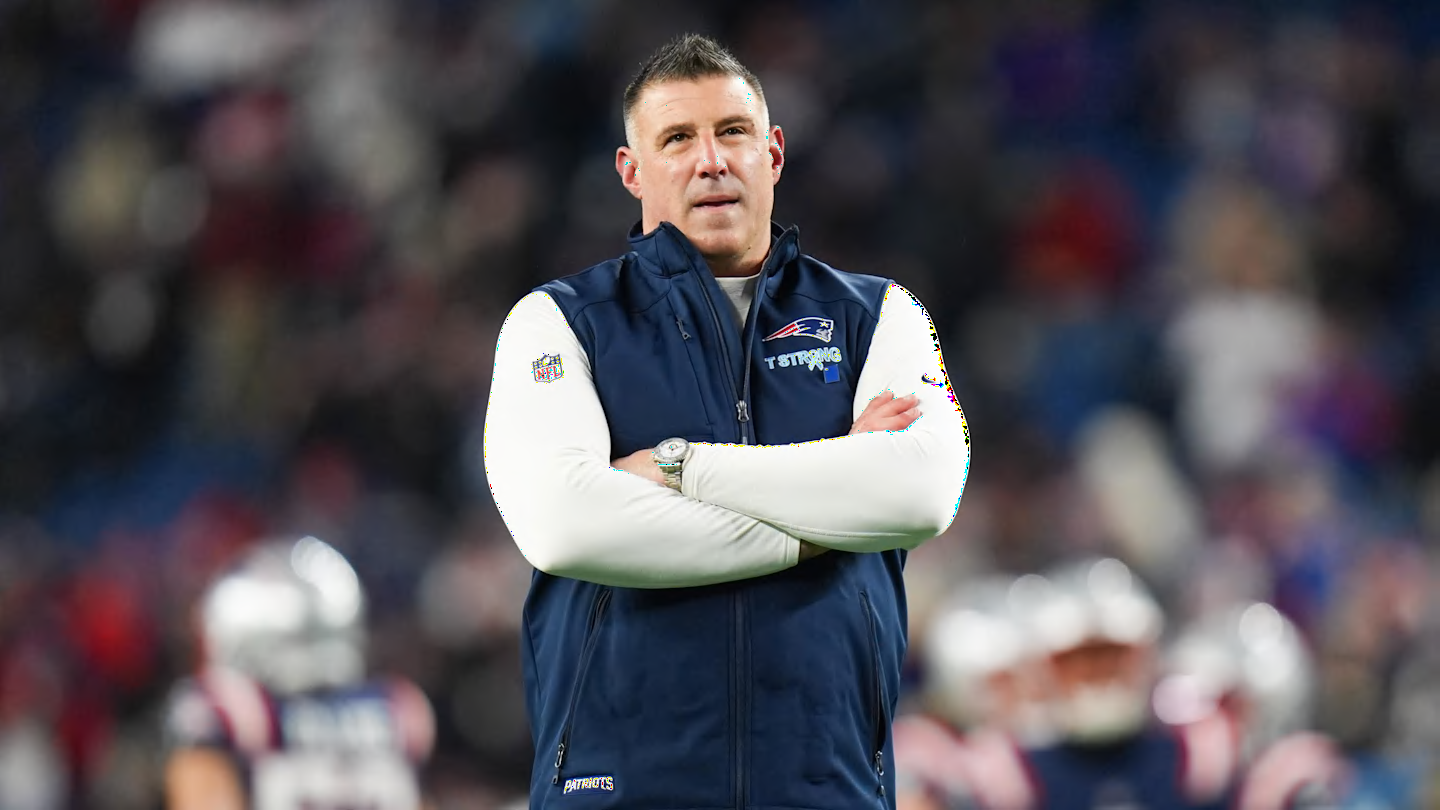
The Secret to Mike Vrabel’s Success
We use cookies to improve your experience on our website.
The saying that encapsulates all of this for Patriots coach Mike Vrabel is scribbled in blue marker at the bottom of a giant greaseboard, otherwise covered in football jargon, to the right of the desk in his windowless office.
“We Treat You The Way You Treat The Team!”
It was his Northstar in September as his program was getting off the ground, and his bellcow running back, Rhamondre Stevenson, fought through a ball-security problem. The 27-year-old had a history of putting the ball on the ground, and did so twice in a loss to the Steelers. His first lost fumble was on the game’s fourth snap, the other at the Pittsburgh 2-yard line.
The day after that 21–14 defeat, plenty of coaches, including the one Vrabel once sat before in that same meeting room, might’ve played a lowlight reel of Stevenson’s miscues. Instead, the first-year New England boss showed everything else that went wrong on the plays. He showed offensive linemen failing to finish their blocks, and receivers laying off their blocks, leaving defenders clean shots that jarred the ball loose.
“You guys, everyone on TV, radio, Twitter, thinks it’s all on this one guy,” he said, pointing at Stevenson. “Ball security is on all 11 of us. Not just one guy.”
Vrabel was, to be sure, driving home a message to his players—that everyone on the field has a hand in the outcome of every play, good or bad—that reinforced his guiding principle on play style. That one is to “finish longer than the guy with the ball.”
But beyond that, it showed Stevenson who had his back.
By Vrabel’s estimation, Stevenson had treated the team incredibly well over the new staff’s first eight months, proving to be a top-shelf worker, teammate, student and player. Vrabel was returning the favor. He publicly defended Stevenson, too, steadfastly refusing to criticize him as the media prodded, just as he took up for him privately in front of his teammates.
So four months later, with a trip to the Super Bowl on the line, it was the coach leaning on Stevenson as he might have leaned on Derrick Henry years earlier. Stevenson carried the ball nine times in the fourth quarter in the Denver snow, accounting for every offensive gain the Patriots had in the game’s final 15 minutes, leading up to Drake Maye’s game-clinching naked bootleg. The Patriots won 10–7. And it was on the back of these kinds of bonds.
“He’s going to treat players like they treat the team,” Stevenson said. “And I’ve said it before; I think I treat the team pretty well. That’s why he had my back the way he did. And I was intentional about fixing the problem. I come in, work hard every time and try not to make that mistake again. I think he realizes that about me.”
In the bigger picture, Vrabel knew how Stevenson felt. He knew his mistakes were obvious, and that his tailback didn’t need the reminder, and that it would get fixed.
He knew because he’d been a player, having made the mistakes that didn’t need to be called out, and those that did—the less obvious ones, like a receiver whiffing on a block that leads to a turnover. It’s Vrabel’s feel, for Stevenson and all his teammates, that made it easy to buy into what he was trying to build. And paved the way for all that’s come since.
There are plenty of football elements that explain why and how the Patriots have pulled off pro football’s most stunning turnaround in years. But simple relationships like these, ones intentionally and carefully built by the head coach, are at the heart of it.
An aggregation of his own experiences
Vrabel, now 50, vividly remembers how he first landed in New England half his life ago—after his coach, Bill Cowher, served him a cold dose of reality. A free agent considering his options, Vrabel was weighing a measured overture from Bill Belichick’s Patriots.
Cowher told him the truth.
“Free agency started, and the Patriots offered a $225,000 signing bonus, which was less than my third-round signing bonus four years earlier,” Vrabel said, leaning back in his office chair, a generation later. “And Bill [Cowher] said, ‘We could pay you that, but I can’t give you the opportunity that they have.’ That was his way of saying you should probably take the opportunity.”
Cowher, a former player himself, had Pro Bowler Jason Gildon and Pro Bowler-to-be Joey Porter at Vrabel’s position. Gildon was 28, and Porter was 23. Vrabel moved on. He wound up making more than $20 million as a player, winning three Super Bowls over a 14-year career, before going into coaching. All of that may have gone differently had Cowher not been looking out for him the way he was in March of 2001.
Interestingly enough, in 2018, before the Titans hired him, Vrabel interviewed for the Colts job, and Indianapolis GM Chris Ballard left the meeting telling people he believed he’d sat down with the “next Bill Cowher.”
But reducing what Vrabel’s become to some knockoff of anyone he played for or coached with would minimize what’s gone into how he’s built his program.
Instead of trying to be Cowher or Belichick, what he’s built in New England is in so many ways an aggregation of his own experiences, which start with his upbringing as an only child raised by a dad, Chuck Vrabel, who coached high school basketball.
I think my dad, as a basketball coach, taught me to value the importance of being part of a team. And so with that comes all the other stuff—the good stuff, the bad stuff, the arguing, the disagreeing on things. But, yeah, growing up, I could probably get with any group that I needed to.”
Mike Vrabel
“You’re always looking for somebody to hang out with,” he said. “You’re always looking for some group to be attached to. I think my dad, as a basketball coach, taught me to value the importance of being part of a team. And so with that comes all the other stuff—the good stuff, the bad stuff, the arguing, the disagreeing on things. But, yeah, growing up, I could probably get with any group that I needed to.”
There were other influences, of course. He credits Fred Pagac, the linebackers coach when he got to Ohio State and defensive coordinator there as he became a star, for showing him the value of connectivity between players and coaches at an early age—“He did a great job of being noticeable with the entire team, on both sides of the ball”—helping elevate a program. Belichick was different than Cowher, Todd Haley was different than either of them.
And so through high school and college, four years as a Steeler, eight as a Patriot, and two as a Chief, Vrabel went into coaching plenty comfortable in his own skin. Authentically himself, he also had a pretty good idea of how he’d wanted to be coached as an NFL player.
Which is how he’d coach others.
We use cookies to improve your experience on our website.
Signs of becoming a head coach
Vrabel returned to Ohio State in 2011, with Luke Fickell, one of his best friends, asking him if he’d retire from the NFL and come aboard in a fire-drill situation—Vrabel had been serving on the NFLPA’s executive committee through that spring and summer’s lockout, and legendary coach Jim Tressel had just been fired at their alma mater.
The signs of what Vrabel would become as a head coach surfaced early.
One came on the Fourth of July during Vrabel’s three years as a Buckeye assistant. He’d started to recognize the work (and potential) of John Streicher, a young student assistant who would be around for the holiday without much to do after working through Ohio State’s summer camps. Vrabel invited him to his pool party in the Columbus suburbs, and Streicher wound up sitting shotgun on Vrabel’s ATV, criss-crossing the property with the ex-NFL linebacker, drinking beers and setting up, then lighting off fireworks for the crowd.
That was a little thing, sure, but it made a younger guy feel like he was in, and it was a pattern that’d spread like the sparks off a roman candle when Vrabel got the Titans job.
The stories of how Vrabel would look out for others are now everywhere.
Shane Bowen, like Streicher, was part of Vrabel’s crew at Ohio State, and Vrabel got him on at the Texans under Bill O’Brien, then took him to Tennessee in 2018. In their first year in Nashville, Bowen’s mother-in-law was diagnosed with breast cancer. She lived in Chattanooga. Bowen, in the middle of the season, was buried in his work. Vrabel kicked him out of the building and told him not to come back until he spent time with her.
The following year was Arthur Smith’s first as offensive coordinator of the Titans, and he’d get the same treatment when Vrabel found out that Smith’s wife, Allison, was going into labor with their third child. Smith was working through red zone tape. “Get the hell out of here,” the head coach said to his OC, assuring him that, even on a Wednesday, he needed to go.
There’s also Todd Downing’s story. In 2022, his second year as Smith’s replacement as OC, Downing was arrested for driving under the influence after a November win. He was driving home after the team flew back from Green Bay. The story turned into a public-relations mess for the team.
Yet, as was the case with Stevenson, Vrabel knew the guy working for him well enough to know that he didn’t need any more reprimanding to understand he’d done wrong.
“Because it’s him and because it’s important to me, I’ll share it with you,” Downing says now. “It’s no secret. I went through a tough time my last year in Tennessee. And after my off-the-field mishap, I think some people would be pissed at that coach or make life harder on that coach. Mike walked with me pre-practice every day and made sure that I was good mentally and focused. He found ways to help me through that, as opposed to making me feel shame or guilt for it. And I’ll never forget that.”
Vrabel fired Downing at the end of that year, as the team tried to dig itself out after the season ended with seven consecutive losses. But, Downing says, Vrabel was intentional in staying in touch with him. And, the now-Patriot assistant continues, “When he called me to join him again, I thought, ‘Why wouldn’t I? That guy had my back when not many would.’”
There are dozens more examples of that.
Some are on the football side—part of Smith’s loyalty to Vrabel comes from Vrabel’s steadiness in sticking with him in 2019, as Smith replaced Matt LaFleur, and the offense scuffled through a 2–4 start. In three of those four losses, the Titans scored seven or fewer points. Yet, Smith never felt like he was on an island. The Titans turned to Ryan Tannehill in Week 7 and ended up in the AFC title game three months later.
On the personal side, the Patriots players got a very early look at who Vrabel is through his handling of defensive coordinator Terrell Williams, his support for Williams after Williams’s prostate cancer diagnosis, and his handling of linebacker Jahlani Tavai’s family tragedy. In November, Tavai’s partner, Kalei, sustained a rare blood infection that put her into a six-day coma and led to the loss of their daughter, Ka ua.
Vrabel gave Tavai all the time he needed, and, with Tavai’s blessing, would regularly sent mass text updates on Kalei’s progress so the team could celebrate the steps she was taking.
The message was received
A few months ago, Patriots equipment manager Preston “Stick” Rogers came to Vrabel with a problem. Players had been coming out of the showers and throwing their washcloths on the floor, rather than in the laundry bin. By then, Vrabel had already told the guys that support staff wasn’t there to be, in his words, “your personal chef, maid or butler.”
“I said, ‘I can get that fixed quick,’” Vrabel said. “I told the team, ‘Every washcloth that’s on the floor, I’ve told Stick to just throw in the dryer and put back on the shelf, and then you guys can use them, and you can decide whether they’ve been used and not cleaned and just been dried.’ We haven’t had an issue with the washcloths ever since.”
The story, which has become legend in the Patriots’ facility, does have a little more colorful piece of Vrabel’s demeanor to it—a couple of guys said that he told the team, “If you guys want to take a chance with getting somebody’s balls on your face the next time you’re cleaning yourself, go ahead.”
Regardless of delivery, the message was received—Treat people and this place with respect—and illustrates how the above acts of kindness are earned by those who get them. And where that message on the towels was Vrabel looking out for Rogers, there are folks way further down the totem pole that get the same treatment.
When Vrabel was playing, Belichick was known for asking players random football questions in the halls to test their knowledge of the opponent. As a coach, Vrabel has adapted it to ensure his players are acting appropriately.
In Tennessee, he’d come into a team meeting, pick a young player out, and ask, Who is cleaning the tables at lunch? “His name is Chris.” Vrabel would then say, “Get to know Chris and say hello to Chris.” Then, he’d ask who takes care of the coffee station. “Her name is Miss Marilyn.” And he’s carried that over to New England, coming into the room with $100 bills in his pocket, ready to find a rookie who can tell him, say, who served them breakfast that day.
“I want to make sure they, one, respect everybody here, and make sure they understand their job is just as important as the players,” Vrabel says. “Those are the little things. And the more that you focus on the little things, the less they turn into big things. You just let something slide because somebody you know didn’t make your eggs right, and you treat them poorly; that doesn’t sit well with me. I’m not going to sit there and watch that.”
Vrabel puts his money where his mouth is, too.
Instead of a traditional fine system, the Patriots have adopted a cash-based system—money that goes to what they call the “treatment bank.” Players know that if they walk into a meeting late, rather than incurring hefty monetary penalties withdrawn from their paychecks, they’ll incur more minor fines that come in cash. That cash is then handed over to lunch ladies, equipment guys or intern trainers as bonuses.
And Vrabel’s own money is part of the rewards for supporting people, too.
As Streicher was working his way up in Tennessee, every offseason, Vrabel would hand him his credit card and tell him to book a spring break trip for him and his wife. Streicher tried to refuse at first. Vrabel wouldn’t let him. Just the same, Vrabel noticed in January that I.T. manager Brianna Avedisian’s sister had come to a game without Patriots gear on. Last week, Vrabel handed Avedisian his card and insisted she go to the pro shop to outfit her sibling for the Super Bowl.
‘Coach Vrabel is who he is’
The payoff for the players, as Vrabel sees it, is in the resources that are created for them if all those supporting them are working at the highest level they can.
As such, he’s pushed to get as many of those kinds of resources in as he can.
He brought Titans team chaplain James “Mitch” Mitchell with him to the Patriots, knowing the 63-year-old former football coach could give the players a lot of wisdom, and someone to confide in who wouldn’t run to Vrabel with their problems. He inherited Richie Armand in player development, and has empowered him. He’s put Halle Ross in position to help with families, giving wives and girlfriends a resource for gamedays and road trips.
The idea is to take as many issues and worries off the players’ plates as he can, so they can perform at their highest level. So if, for example, a player needs to be late, because there’s something off the field he needs to take care of, so long as it’s communicated, it’s allowable. Because Vrabel would rather the player be locked in mentally for eight hours than with his mind elsewhere for 10. And because he does actually care.
“Coach Vrabel is who he is,” says Patriot captain Robert Spillane, who was with Vrabel in Tennessee in 2018. “If anything, he’s really taken relationships to the next level. He’s really focused on connecting with each and every player as an individual. He makes himself available to the team. He really wants the players to know that he has our back and he’s willing to be there for whatever we have going on.”
And that doesn’t mean coddling them. It means treating them the way Cowher once treated him—giving them opportunities as they’re earned, and being real with them when needed.
Spillane himself is an example of it, having made the Titans roster in Vrabel’s first year as an undrafted free agent. Receiver Nick Westbrook-Ikhine was another from Tennessee. As was center Aaron Brewer, who came in undersized, worked to put on weight, did all the classroom and field work, earned a spot on the practice squad, then 53-man roster as a fourth interior lineman, became a starter, then landed a deal with Miami. This year, Brewer was a second-team All-Pro. And one more, a favorite of Vrabel’s, would be tight end MyCole Pruitt.
“I knew Pru in Houston, and we were short a couple guys, got him off the practice squad [in Tennessee],” Vrabel remembers. “He’d been frustrated in Houston because he was on our show team. I would say, ’Hey, we need you to do this, block like this, run the route.’ And guys get frustrated, everybody wants to play. And I just tried to talk to him [about that], and he came and helped us out.
“And again, it’s a two-way street. Guys are helping us out, but I’m happy for them when they turn that into something else and get another contract, as Brew did, or like Nick Westbrook did. And Pruitt went on to Atlanta [with Smith] and played a few more years.”
Stories like that are materializing now in New England, with guys such as Elijah Ponder, Efton Chism III, Cory Durden and Leonard Taylor III, who was on the practice squad in the fall, and blocked a field goal against Denver in the fourth quarter that would’ve tied the game.
It’s hard to say, of course, how far those guys will go with the Patriots over the next few years. But they know, like Vrabel once did with Cowher, their coach will look out for them.
Vrabel’s program evolution
Even those closest to Vrabel will tell you they’re surprised all of this has come together as quickly as it has, with the Patriots 17–3 and in the Super Bowl.
In Tennessee, it didn’t. It really clicked there toward the end of Year 1. When I asked Vrabel why it has happened faster in Foxborough, he answered, matter-of-factly, that “We have good quarterback play. We got better every week. There was a lot of turnover, but guys, I think, really believed in each other. And we played good defense in the playoffs when we needed to.”
All of that, of course, is true. So, too, is that in Tennessee, Vrabel inherited a team that had been in the playoffs the year before, and had a strong leadership core, and vets such as Jurrell Casey, Brian Orakpo, Ben Jones and Delanie Walker that might’ve taken a little longer to sell. In New England, conversely, he, Streicher, EVP of player personnel Eliot Wolf and VP of player personnel Ryan Cowden have imported a raft of guys connected to the coaching staff, like Spillane and Harold Landry III, that could be instant torchbearers for the program.
But there’s also been an evolution of the program.
Some came through Vrabel’s firing in Tennessee and the work he did for Kevin Stefanski in Cleveland. More was refinement; he and Streicher have worked through it, with stuff borrowed from Streicher, spending 2024 with Sean McVay in Los Angeles. One example of that is McVay’s saying, “A player can never meet the enemy on the sideline,” a simple way to crystallize how Vrabel handled Stevenson. Another is heeding “decision fatigue,” where a head coach shouldn’t treat every decision like it’s fourth-and-1 in the Super Bowl—that’s where the idea of changing the fine system originated.
There was also an added intentionality that grew from Vrabel’s experiences.
It started after his introductory press conference last January, when Vrabel, still in his suit, burst into a free-agent film session during a break in his media obligations. The personnel guys in the meeting room were a little taken aback. Vrabel disarmed them quickly, and went through what he would look for in offensive players, then asked if he could come back the next day to repeat the exercise with the scouts on the defensive side.
Within weeks, that extra effort was reciprocated with Wolf going to Streicher to ask for Titans games that best exemplified the play style Vrabel was looking for. Which was the precursor to a home-run offseason of player acquisition, during which the Patriots hit on just about every free agent they signed and drafted four guys who’d start as rookies.
Which, in the end, is the concept behind all of this. Everyone, from the equipment guy to the cafeteria worker to the starting quarterback, is doing their best to bring out the best in the next guy. Everyone judged the same way.
“It’s just a good reminder that you treat them how they treat the team. And if they treat the team well, then I’m doing everything I can to help them.”
Vrabel
“If you’re someone who shows up, does your job, works hard, knows what to do, is accountable, and communicates, I’ll listen to you and do whatever we can to help you,” Vrabel says. “If you’re somebody that doesn’t do those things, one, we don’t want you, and if we have to keep you, then we’re certainly not going to take into account what your opinion is. And that’s never been a problem.
“It’s just a good reminder that you treat them how they treat the team. And if they treat the team well, then I’m doing everything I can to help them.”
That approach has taken Vrabel to a lot of places in the past few years. It’s meant going to Williams’s son’s hockey games, and inviting Bowen to a Patriots walkthrough after he was fired by the Giants in December, and then surprising him by appearing at Bowen’s daughter’s dance competition later that day. It’s led him to run up his own credit card bill and to push owner Robert Kraft to create new departments at his old place of work.
And five months after a moment with Stevenson that resonated with everyone else in the room, it’s gotten him here, to the precipice of the sport’s biggest stage and grandest prize.
Yes, it’s all happened faster than anyone thought it would.
But how Vrabel’s gotten the Patriots here has been no accident.
More NFL on Sports Illustrated
First Appeared on
Source link






