


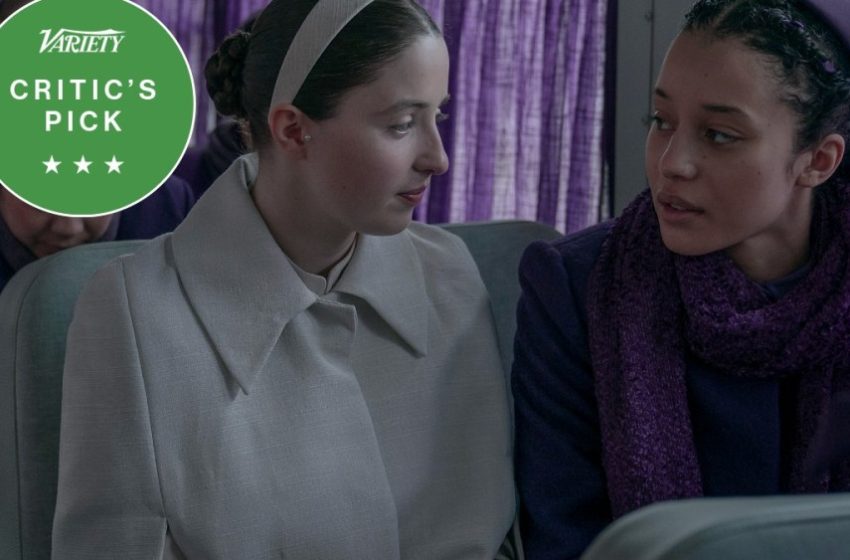
‘The Testaments’ Review: Chase Infiniti Is Impeccable
Set four years after the finale of “The Handmaid’s Tale,” Hulu’s “The Testaments” returns viewers to Gilead. In “The Handmaid’s Tale,” June Osborne (Elisabeth Moss) was forced into Gilead as a Handmaid, a fertile woman subjected to ritualized rape at the hands of the elite so that she could bear their children. The new series, created by Bruce Miller and adapted from Margaret Atwood’s novel of the same name, depicts Gilead from a different vantage. It centers on the young women who have grown up among the privileged class and are being groomed to become the pious wives of the totalitarian regime’s most powerful men. A series about girlhood, survival, rage and friendship, “The Testaments” is an exemplary follow-up to the original series. It is also a magnificent coming-of-age story that draws terrifying parallels to the modern-day experiences of women living in a misogynistic society emboldened by religious psychosis.
Told from the perspectives of three women, “The Testaments” begins with Agnes MacKenzie (Chase Infiniti). Agnes, who is about 16, appears to have an idyllic life. Her father, a top commander, seems kind enough, and her Marthas, Rosa (Kira Guloien) and Zilla (Blessing Adedijo), provide the warmth and stability in her home. However, her icy stepmother, Paula (Amy Seimetz), is an adversary rather than a nurturer. Agnes looks forward the most to her time with her friends Hulda (Isolde Ardies), Shunammite (Rowan Blanchard) and Becka (Mattea Conforti) at the preparatory school run by Aunt Lydia (Ann Dowd, reprising her “Handmaid’s Tale” role).
At school, Agnes and her friends have transitioned from prepubescent Pinks to Plums. Marked by their deep purple uniforms, the teenagers have not yet gotten their periods, but are preparing for the marriage market. Agnes and her friends aren’t permitted to read or write, yet they have been rigorously tutored by Aunt Lydia and the other aunts. Tender Aunt Estee (Eva Foote), even-keeled Aunt Gabbana (Zarrin Darnell-Martin) and vicious Aunt Vidala (Mabel Li) have worked to mold them into perfect wife material. With the arrival of their periods, the girls are officially eligible for the marriage market, where they move from Plums to Greens and eventually into the teal blue of the Gilead wives.
While Agnes and most of the others are eager for the first drops of menstrual blood to appear, her best friend Becka, who has already begun menstruating, is increasingly agitated by mentions of her impending marriage. Another wrench is thrown into the mix when Aunt Lydia asks Agnes to welcome Daisy (Lucy Halliday), a Pearl Girl, into the fold. Pearl Girls are young women from outside Gilead who are broken in and trained in the Gilead way. Always obedient, Agnes happily welcomes Daisy despite Shu’s warnings. Pearl Girls aren’t favored by the Plums, who see them as untrustworthy. As Shu tells Agnes, “Get her before she gets you.” Though Daisy appears eager to fulfill her duties and become a true woman of this world, viewers quickly learn that she has reasons for leaving her life in Toronto and donning the pearl-white uniform.
The 10-episode first season shifts among the points of view of Agnes, Aunt Lydia and Daisy. More is learned about Agnes and Daisy’s upbringings, as well as Aunt Lydia’s origin story and early involvement with Gilead. As the pillars of this tale, these three cling to their humanity in a deeply unjust world. They push down their true feelings to keep up appearances. Agnes has a special affinity for her guardian, Garth (Brad Alexander), a young man whom she desperately desires. Daisy struggles to conceal her emotions, having been able to express them freely in Canada. Finally, Aunt Lydia clearly cares for the girls but also revels in her power. It’s a gut-wrenching example of inner emotional turmoil and the instinct for survival.
Like its predecessor, “The Testaments” is a disturbing watch. Though the series offers glimpses of the palatial houses and parties of the elite, something horrific is always just within frame. Daisy nearly falls apart the first time she happens upon a row of hanged bodies. Yet it’s an everyday occurrence for Agnes and the other young women. The older women are less restrained and lash out; Paula cruelly threatens Agnes and the Aunts, and beats the Plums for any perceived indiscretion. Though the Plums have endured this for as long as they can remember, as they move toward marriage, they chafe against Gilead’s rules. They also begin to realize something isn’t quite right. Episode 5, “Ball,” where the young ladies first interact with their prospective suitors, is especially unnerving.
The start of a brand-new reckoning, “The Testaments” is a show about sovereignty and rebellion. It’s about having the courage to pull the rug out from under oneself, even when a soft landing place isn’t guaranteed. It’s a reminder that while the youth may be naive, once their eyes are opened, they can never unsee what they’ve discovered. Finally, it’s a stellar examination of the uniqueness of girlhood and how the patriarchy underestimates the power of female connection, often to its peril.
The first three episodes of “The Testaments” debut April 8 on Hulu, with the remaining episodes airing weekly on Fridays.
First Appeared on
Source link






