


The top 12 storylines for the 2026 MLB season: Skubal’s three-peat try, a looming lockout threat and more
The Athletic has live coverage of the New York Yankees vs. the San Francisco Giants Opening Day game.
This is my 40th season covering Major League Baseball, and I still can’t figure this wacky sport out.
No one can, even though more information is available to players, teams, reporters and fans than ever before.
That’s the beauty of the game. That’s what draws all of us in, game after game, season after season.
The mystery is the game’s lure, the unpredictability a big part of its appeal. Why was Game 7 of last year’s World Series so spellbinding? Because one crazy thing happened after another, in a winner-take-all contest between the two best teams in the sport.
The projection models front offices devise keep growing more sophisticated. But as the season begins, the models cannot foretell which players will get hurt, which will get traded, which pitchers will alter their mixes, which hitters will develop new approaches or swings. And those are just some of the variables in play.
It’s the time of year when supposed experts like myself make predictions on awards races, division races, World Series winners and heaven knows what else. I’ll spare you my thoughts on what I think might happen. For 40 years, to my family’s great amusement, I’ve been consistently and often comically wrong.
Instead, here are my top dozen storylines for 2026. Happy Opening Day, everyone!
The Dodgers’ quest for a three-peat
Baseball’s latest Death Star is again poised to leave its rivals in ruins. Baseball Prospectus’ PECOTA projections envision the back-to-back World Series champions winning 103 games and the Seattle Mariners next at 94. Fangraphs also projects a wide gap, with the Dodgers winning 99 games and the New York Mets next at 90.
I’m not sure the Dodgers will lap the field by either of those margins, even with their free-agent additions of right fielder Kyle Tucker and closer Edwin Díaz. They’ve won the NL West in 12 of the past 13 years, but shown an increased inclination to slow play the regular season, particularly with their pitching. Their theme song might as well be Green Day’s “Wake Me Up When September Ends.”
Still, Fangraphs projects their odds of winning the NL West at nearly 94 percent and their odds of winning a third straight World Series at 27 percent. The biggest question in the West is which team will finish second. And the biggest question come the postseason will be whether the Dodgers might finally get upset after nearly losing to San Diego in the 2024 Division Series and Toronto in the 2025 World Series.
Tucker, who turned 29 in January, freshened up the position-player group, which includes Miguel Rojas, 37; Freddie Freeman, 36; Max Muncy, 35; and Teoscar Hernández and Mookie Betts, 33. The Dodgers also have a number of outfield prospects coming. Their starting-pitching depth is among the game’s best. And if Tanner Scott regains his mojo in front of Díaz, their bullpen also could prove elite.
At times during the regular season, the Dodgers might look like they’re sleepwalking. It was that way last season, when they won 93 games, their lowest total in a 162-game schedule since 2018. But barring a wave of pitching injuries and several of the 30-something position players getting old at once, there is only so much that can go wrong with this team.
The Automated Ball-Strike System finally debuts
“ABS now!” was the prevailing sentiment after plate umpire Cory Blaser mistakenly called third strikes on Juan Soto leading off the eighth inning and Geraldo Perdomo ending the ninth in the Dominican Republic’s 2-1 loss to Team USA in the World Baseball Classic semifinal.
Fair enough. But the potential for unintended consequences worries me.
When the league introduced replay review in 2014 to cover most plays, the idea was to eliminate egregious mistakes. That mostly has happened. But teams also went beyond the spirit of the rule, challenging plays when a baserunner’s foot is inches off the bag, for example. And umpires in the replay review center occasionally seem reluctant to overturn calls on the field.
ABS is more cut and dry. A pitch is either a strike, or it isn’t. But say a hitter challenges a 3-2 pitch with the bases loaded, and the pitch is found to be a tenth of an inch under the zone. One executive, granted anonymity for his candor, said, “That’s not a good eye. That’s guessing right.”
The same executive fears the flow of games will be disrupted in the ninth inning, when players might ask for reviews on pitch after pitch and retain their challenges as long as the system proves them right. Then there are the questions The Athletic’s Jayson Stark raises about the imperfection of the system, even though it marks a sign of progress.
Tracking the players who are most successful at challenging will be fun – someone like Philadelphia Phillies catcher J.T. Realmuto, who went 6-for-7 in spring training, will bring additional value to his team. Players who lose challenges, meanwhile, will face scrutiny, particularly if they burn them too early.
I’m in favor of the system. Let’s just hope it operates as intended.
Tarik Skubal’s final season before free agency
The back-to-back American League Cy Young winner already has dominated headlines in 2026, first by beating the Detroit Tigers and earning a record $32 million for a pitcher in arbitration, then by starting once instead of twice for Team USA in the World Baseball Classic.
Skubal’s biggest news, a free-agent contract that could surpass Yoshinobu Yamamoto’s record $325 million for a pitcher, is still to come, perhaps even before the expected lockout on Dec. 1.
First, though, Skubal will complete what is expected to be his final season in Detroit – a season in which the Tigers could end up World Series contenders thanks to the signings of free-agent starters Framber Valdez and Justin Verlander and expected arrivals of top position-player prospects Kevin McGonigle and Max Clark.
It should be virtually impossible for the Tigers to fall out of contention in the AL Central, so the chances of Skubal getting traded at the deadline are minimal. The more intriguing question concerns his individual performance, and whether he can win a third straight Cy Young.
No American League pitcher has accomplished that feat. Only two have done it in the National League, where both Greg Maddux (1992 to ‘95) and Randy Johnson (1999 to 2002) won four straight Cys, long before the NL adopted the DH.
The looming lockout threat
Let me tell you a story. In 2006, my first year at Fox, I got a call in the hours before Game 3 of the World Series from one of the network’s higher-ups – if memory serves, it was Ed Goren, the executive producer.
An announcement was imminent. Major League Baseball and the Players Association had reached a new collective bargaining agreement. The network wanted me to interview commissioner Bud Selig and union head Donald Fehr live on the pregame show.
The expiration of the previous CBA was nearly two months away – two months! The relationship between the players and owners then could not be called amicable. But the parties reached a deal without going down to the wire or triggering a work stoppage.
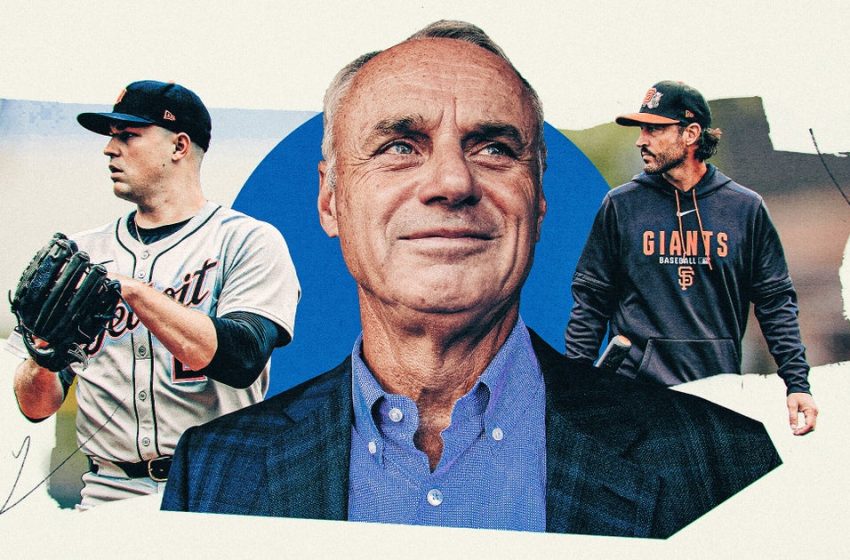
Contrast that with the current environment, in which commissioner Rob Manfred, nearly two years before the expiration of the current agreement, told The Athletic, “In a bizarre way, (a lockout is) actually a positive.”
Manfred continued, “there is leverage associated with an offseason lockout and the process of collective bargaining under the NLRA works based on leverage. The great thing about offseason lockouts is the leverage that exists gets applied between the bargaining parties.”
Needless to say, I won’t be worrying about interviewing Manfred and new Players Association head Bruce Meyer at the 2026 World Series.
The CBA talks are expected to begin next month, but the entire sport knows where this is headed. The threat of a lockout will loom over the season, perhaps shaping how teams approach player moves at the deadline and the early part of the offseason.
MLB’s most fascinating new manager
Of the eight new managers – 10 if you count Pittsburgh’s Don Kelly and Colorado’s Warren Schaeffer, both of whom had interim tags removed – San Francisco’s Tony Vitello is easily the most fascinating.
Vitello is the first college coach to become a major-league manager without professional experience since the Boston Red Sox hired George Huff of Illinois in 1907. His adjustment, with a team that has been the definition of mediocre, winning between 79 and 81 games in each of the past four seasons, will be one of the season’s most interesting subplots.
How will Vitello treat major leaguers as opposed to collegians? How will he pace himself in a season that generally is nearly 100 games longer than a collegiate campaign? And perhaps most important, how will he handle a bullpen that isn’t exactly stocked with star relievers?
Vitello, 47, is energetic and charismatic. Those who know him well are convinced he will succeed. And the difference between college baseball and the majors gets smaller every year. Still, this is Buster Posey’s biggest gamble yet as president of baseball operations. It truly could go either way.
The wide-open AL East
Good luck predicting this division, which once again looks like the game’s most competitive.
Consider: All five clubs from the East made the playoffs in the past five seasons. Three teams qualified in four of those years, including 2021, before the playoffs in each league expanded from five to six clubs. And not once was the combination of the three teams the same.
| Year | AL East playoff teams |
|---|---|
|
2025 |
TOR, NYY, BOS |
|
2024 |
NYY, BAL |
|
2023 |
BAL, TB, TOR |
|
2022 |
NYY, TOR, TB |
|
2021 |
TB, BOS, NYY |
This season? Fangraphs projects the Yankees as the favorites. PECOTA prefers the Blue Jays. But both systems rank all five teams in the East within seven games of each other, so really, not even the computers know what the heck is going on.
When the margins are this small, injuries and trades often prove critical. Returning players, too. The Yankees expect right-hander Gerrit Cole and lefty Carlos Rodón to join them sometime in the first half, righty Clarke Schmidt sometime in the second. The Blue Jays are waiting on righties Shane Bieber, José Berríos and Trey Yesavage; the Orioles on second baseman Jackson Holliday and third baseman Jordan Westburg; the Red Sox on first baseman Triston Casas.
The Mariners try to run it back in the AL West
Coming off their first division title since 2001, Seattle is positioned to become not only the class of the AL West, but perhaps the entire American League.
On paper, this year’s team looks better than last year’s. First baseman Josh Naylor, a deadline acquisition re-signed to a five-year, $92.5 million free-agent contract, will be with the club the entire season. So will two pivotal trade additions, super-utility man Brendan Donovan and left-handed reliever Jose A. Ferrer.
The Mariners’ dynamic rotation remains intact, though righty Bryce Miller is expected to open the season on the IL with left oblique inflammation. Second baseman Cole Young looks poised for a breakout, while a number of prospects, including infielder Colt Emerson, lefty Kade Anderson and righty Ryan Sloan, are close to contributing.
The Houston Astros, bolstered by the additions of starting pitchers Mike Burrows and Tatsuya Imai, still look formidable. The Texas Rangers figure to improve under new manager Skip Schumaker. The Athletics will hit even though their pitching remains questionable. The Los Angeles Angels . . . eh, never mind.
According to both PECOTA and Fangraphs, only the Dodgers are a bigger favorite than the Mariners to win their division.
The makeover Mets take the field
Now we get to see what the Frankenstein that president of baseball operations David Stearns assembled looks like.
The Mets have a new ace, two new back-end relievers, a new first baseman, second baseman, third baseman, right fielder and center fielder. Oh, and an almost entirely new coaching staff, too.
I’ve written about the Mets’ defensive concerns, injury concerns and perhaps even chemistry concerns – with so many new players and coaches getting thrown together, it might take time for the team to jell.
Still, the Mets’ roster is impressive, which is why Fangraphs projects them to win the division. PECOTA, curiously, has them a close second to the Atlanta Braves. The rotation could be a strength, particularly if Kodai Senga stays healthy. And if veteran starters get injured or underperform, youngsters such as Christian Scott and Jonah Tong are positioned to emerge.
The Braves already are depleted, with starting pitchers Spencer Schwellenbach, Hurston Waldrep and Spencer Strider injured and left fielder Jurickson Profar suspended for the entire season. The Philadelphia Phillies again should be quite good, particularly if ace right-hander Zack Wheeler makes a strong return from thoracic outlet decompression surgery. And the Miami Marlins, after improving from 62 wins in 2024 to 79 games, might emerge as a wild-card contender.
The Mets, though, will command the most attention. Their payroll is second only to the Dodgers’. And their makeover was the most extreme in the sport.
Managers/executives on hot seat
The Mets’ Carlos Mendoza tops the list. When teams fire virtually an entire coaching staff, it’s a warning sign to the manager – you’re next.
Stearns, who hired Mendoza, also will be blamed if the Mets miss the playoffs for the second time in three years under their respective watches. But the manager is almost always the first to go, and things could get tense in Queens if the Mets are hovering around .500 in say, early June.
Across town, Yankees general manager Brian Cashman and manager Aaron Boone seem to operate with permanent job security, much to the exasperation of a certain segment of the team’s fan base.
The Yankees last won a World Series in 2009, Barack Obama’s first year as president. Cashman is entering his 29th season, Boone his ninth. Aaron Judge turns 34 next month. But if owner Hal Steinbrenner is impatient, he never seems to show it.
Astros owner Jim Crane is sort of the anti-Hal, demanding excellence even when his roster is not capable of providing it.
The Astros’ run of eight straight playoff appearances ended last season. Both GM Dana Brown and manager Joe Espada are in the final years of contracts, and Espada oversaw the overhaul of the team’s major-league hitting department last offseason. Crane, who ran off GM James Click after the Astros won the 2022 World Series, might grow restless with anything short of another title.
The Phillies’ Rob Thomson and Red Sox’s Alex Cora, like Mendoza and Boone, are managing teams with high payrolls and high expectations. Neither appears particularly vulnerable at the moment, but the heat will rise if either of their clubs starts slowly.
Four playoff berths in four seasons, two straight NL East titles and an appearance in the 2022 World Series speak to Thomson’s success. The Red Sox, on the other hand, reached the postseason only once in the last four years under Cora, and that was last season when the Yankees eliminated them in the wild-card round.
Cubs vs. Brewers
Here we go again. The Cubs loaded up by signing third baseman Alex Bregman, trading for righty Edward Cabrera and remaking their bullpen. The Brewers pared down by trading their ace, righty Freddy Peralta, and the third- and fourth-place finishers for NL Rookie of the Year, third baseman Caleb Durbin and outfielder Isaac Collins.
Will it matter? Does it ever matter?
Prior to the 2024 season, the Cubs lured Craig Counsell from the Brewers by awarding him a five-year, $40 million contract, a record total for a manager. Since then, the Brewers have won two more division titles, making it four in five seasons. And Counsell’s replacement, Pat Murphy, twice has won NL Manager of the Year.
Every year, people like me predict the Brewers’ demise. Every year, the Crew defies expectations. Their rotation without Peralta looks vulnerable, but the same was true at the start of last season, and Milwaukee won 97 games, most in the majors.
The Cincinnati Reds could be dangerous with second baseman Matt McLain finally looking recovered from shoulder surgery, an improved, versatile position-player group and a potentially deep rotation even with ace righty Hunter Greene likely out until July.
The Pittsburgh Pirates, led by NL Cy Young winner Paul Skenes and featuring veteran offensive additions Ryan O’Hearn, Brandon Lowe and Marcell Ozuna, also might be more competitive.
The Brewers, though, remain the division’s standard. Just ask the Cubs.
Rookie of the Year races
As The Athletic’s Will Sammon and I wrote, the Pittsburgh Pirates will cost themselves the chance of getting a draft pick if they do not promote shortstop Konnor Griffin by April 9 and he wins NL Rookie of the Year.
Then again, maybe the Pirates are looking at the NL field and thinking, “As good as Griffin is, he’s no lock for the award. Let’s give him the development time we think he needs.”
The NL class features at least 10 ROY candidates, including Mets righty Nolan McLean and outfielder Carson Benge; Phillies righty Andrew Painter and center fielder Justin Crawford; Braves righty Didier Fuentes; Cubs catcher/first baseman Moíses Ballesteros; St. Louis Cardinals shortstop JJ Wetherholt; Marlins outfielder Owen Caissie and Reds infielder Sal Stewart.
The AL field isn’t quite as deep, and features three veterans from Japan, Chicago White Sox first baseman Munetaka Murakami, Blue Jays infielder Kazuma Okamoto and Astros righty-hander Tatsuya Imai. Among the others worthy of mention: The Tigers’ McGonigle and Clark; Orioles catcher/first baseman Samuel Basallo; Guardians outfielder Chase DeLauter; Mariners infielder Colt Emerson; and Kansas City Royals catcher Carter Jensen.
Potential surprise teams
I’ve got four.
Marlins: I like their rotation, their Brewers-like athleticism and overall attention to detail. The question: Will their young starting pitchers advance to the point where GM Peter Bendix is comfortable trading Sandy Alcantára if the team is in contention at the deadline?
Royals: Closer Carlos Estévez’s velocity drop this spring aside, the pitching again should be a strength. The offense is the greater concern, and much depends on how much Jensen and right fielder Jac Caglianone contribute. A bounceback season from second baseman Jonathan India and positive impact from newcomers Isaac Collins and Lane Thomas also would help.
Reds: It’s always a what-if game with teams on the fringes, but the arrivals of third baseman Eugenio Suárez and even first baseman Nathaniel Lowe at least give the Reds the potential for a better offense. If the starting pitching stays healthy – and Greene’s surgery and Nick Lodolo’s and Brady Singer’s blister problems are early red flags – the Reds will be intriguing.
Athletics: It’s difficult to imagine the pitching being good enough, even with Denzel Clarke catching everything in center field. But the offense should be electric, particularly if third baseman Max Muncy hits as well he did in the spring. A full season of AL Rookie of the Year Nick Kurtz in West Sacramento could get silly, and trade acquisition Jeff McNeil figures to bring veteran stability to a still-emerging group.
Then again, what do I know? It’s my 40th season, and I still get blindsided by this crazy sport every year.
First Appeared on
Source link






